By ShriprasannaPublished July 30, 2026Updated September 26, 2026
Best AI Humanizer in the UK (2026)
The thing that makes the UK different is not the detector. It is what happens after the detector.
In most countries, a high AI score on a submission starts an awkward email thread. In the UK it starts a process with a name, a form, a committee, and an appeals route that ends at an independent ombudsman. A Turnitin flag goes to an academic conduct officer. You may be invited to a viva, sometimes called an authenticity interview, where two academics ask you to explain your own essay. If that does not satisfy them, an academic offences panel convenes. If the panel goes against you, you exhaust the internal appeal, and then you go to an ombudsman — which one depends on where you study. In England and Wales that is the Office of the Independent Adjudicator. In Scotland it is the Scottish Public Services Ombudsman, and in Northern Ireland the Northern Ireland Public Services Ombudsman. The OIA has no jurisdiction over a Glasgow or Belfast institution, and this is worth knowing before you spend a week filling in the wrong form.
That machinery is why the stakes feel so high for UK students. So this is not a generic list with a Union Jack on it. It is a look at what actually decides whether one of these tools is worth your money in Britain: how UK institutions enforce, why American-flavoured AI output gets noticed by British markers, what the sticker prices feel like in pounds, and which tools hold up under that scrutiny.
How a Flag Becomes a Case Here
The enforcement layer is remarkably uniform. Turnitin is widely used across UK higher education, and for many universities its AI writing indicator arrived as a feature of software they already licensed, installed, and trained staff on, rather than as a separate purchase.
The volume tells you how much that mattered. A Guardian investigation used Freedom of Information requests to 155 universities, of which 131 provided some data. It found almost 7,000 proven cases of AI cheating in 2023-24, or 5.1 per 1,000 students, up from 1.6 the year before. Figures for 2024-25 pointed to about 7.5 per 1,000. Meanwhile, confirmed cases of traditional plagiarism fell from 19 per 1,000 students to 15.2 in 2023-24. Students did not become more honest. The category simply moved.
Now the part that surprises people. There is no national AI threshold in the UK. The QAA, which maintains the UK Quality Code, has been explicit that outright bans are unlikely to be effective or helpful, that detection remains unreliable and that the false-positive risk is significant, pointing providers toward a whole-community approach rather than a percentage. The Russell Group's joint principles on generative AI commit member universities to AI literacy, adapted assessment and upholding academic rigour. They do not hand you a number either.
So the figure that decides your case is set by your own department, and often it is not written down anywhere you can read it. Some departments ask for an explanation above a set percentage. Others publish nothing and you learn the rule when a supervisor forwards you a report. Turnitin itself shows scores from 1% to 19% only as an asterisk, so the lowest number above zero an instructor ever sees is 20% (Turnitin FAQ). Our guide on what Turnitin actually detects covers the mechanics of the score.
Sector guidance says the AI score is a supporting indicator, not evidence. Departmental practice does not always agree, and you are the one who finds out which you are dealing with.
The British English Tell
Here is a detection nuance that genuinely only applies on this side of the Atlantic.
Large language models learn spelling probabilistically from corpora that skew heavily American. Ask for British English and most models comply for a paragraph or two, then drift back. You get "organize" three pages in, a stray "color", "analyze" in a methods section, a "fall term" where you meant autumn, and full stops parked inside the closing quote mark in the American fashion.
None of this is AI detection in the statistical sense. It is worse than that, in a way. It is a human marker noticing that a British student has suddenly started writing like an American undergraduate, and that noticing is what prompts them to run the detector at all. Plenty of UK cases begin with a hunch and reach for Turnitin afterwards as confirmation.
The consequence for tool choice: a humanizer that rewrites your text into fluent American prose has solved one problem and created another. After any pass, sweep for -ize and -yze endings, -or where you want -our, and check your dates and quotation marks have not quietly emigrated. Proof the output as a British document rather than assuming it came back as one.
Who Gets Flagged Hardest
The UK hosted 685,565 international students in 2024/25, down 6.1 percent year on year, according to HESA data summarised by the British Council. That group carries a disproportionate share of the risk here, and not because they cheat more.
Stanford researchers testing seven detectors on writing by non-native English speakers found the tools misclassified 61 percent of it as AI-generated on average, while essays by US eighth-graders were classified almost perfectly (Liang et al., 2023). Careful second-language academic writing scores badly on the two things detectors measure, predictability of word choice and variation in sentence length, for entirely respectable reasons: safe vocabulary, uniform sentences, formal register learned from textbooks.
The UK evidence has caught up. In July 2025 the Office of the Independent Adjudicator published a casework note and six case summaries on AI and academic misconduct. Those cases come from England and Wales, since that is the OIA's remit, but the mechanism they describe is not regional. Two of the six concern international students called to a viva after a Turnitin flag, and three complaints were found justified or partly justified. The casework note tells decision-makers to "understand the strengths and limitations of detection software" and to consider whether assumptions about AI use could be biased against a student's writing style, for example if the student is disabled or if English is not their first language. In one summary, a student who said the viva came a significant time after submission had not been given a fair opportunity to respond to the allegations. In another, a panel recorded an admission of using AI to paraphrase, whilst the transcript showed the student had said they used Google to find synonyms because English was not their first language.
Our piece on the false positive crisis has the wider numbers. The short version for UK readers: a flag is not a finding, and some flags land on writing nobody generated.
The UCAS Layer
Applicants have a separate exposure that current students do not.
UCAS scans every personal statement with a similarity detection system that compares it with previous statements. Anything more than 30% similar is flagged, and UCAS informs the universities and colleges you applied to, each of which decides what to do with it (UCAS). That check looks for copied text rather than AI, but admissions tutors read statements too, and smoothed-out, genericised phrasing is exactly what models produce by default.
UCAS's own personal statement builder lists "Don't use artificial intelligence software or writing service providers" among its don'ts. With the format now split into three structured questions, the temptation to let a model fill each box is obvious, and the risk is asymmetric: an offer is worth far more than the twenty minutes you saved.
What These Prices Look Like in Pounds
Almost every tool here bills in US dollars, so your card may add a foreign transaction fee on top of whatever rate it uses. On 25 September 2026, the ECB's euro reference rates implied about 1.33 dollars to the pound. Conversions below are approximate at that rate and will move. Prices are monthly-billing list prices from each vendor's pricing page, checked September 2026.
| Tool | Monthly (USD) | Approx. GBP | What you get | British English setting |
|---|---|---|---|---|
| SupWriter | 9.99 (Basic) | around 7.50 | 5,000 words | No dedicated UK dialect toggle |
| Undetectable AI | 9.99 (Starter) | around 7.50 | 10,000 words | Not on its pricing page |
| Humbot | 7.99 listed (billing period not labeled) | around 6.00 | 3,000 Basic + 1,000 Advanced words | Not on its pricing page |
| Phrasly | 24.99 (Unlimited) | around 18.90 | Unlimited humanizations, up to 5,000 words per process | Not on its pricing page |
| WriteHuman | 20.00 (Basic) | around 15.10 | 80 requests of up to 600 words | Not on its pricing page |
| QuillBot | 19.95 (Premium) | around 15.05 | Full paraphraser and humanizer access | Yes, English (UK) option |
| HumanTone | 8.00 listed (down from 10) | around 6.05 | About 15,000 words | Not mentioned on its homepage |
Annual billing cuts most of these by 40 to 60 percent: SupWriter Basic is 4.99 USD a month billed annually, Undetectable AI 5.00, Phrasly 10.99, WriteHuman 12.00 and QuillBot 8.33. Our full pricing breakdown explains why cost per word you actually keep beats the monthly sticker as a comparison.
The Ranking
1. SupWriter
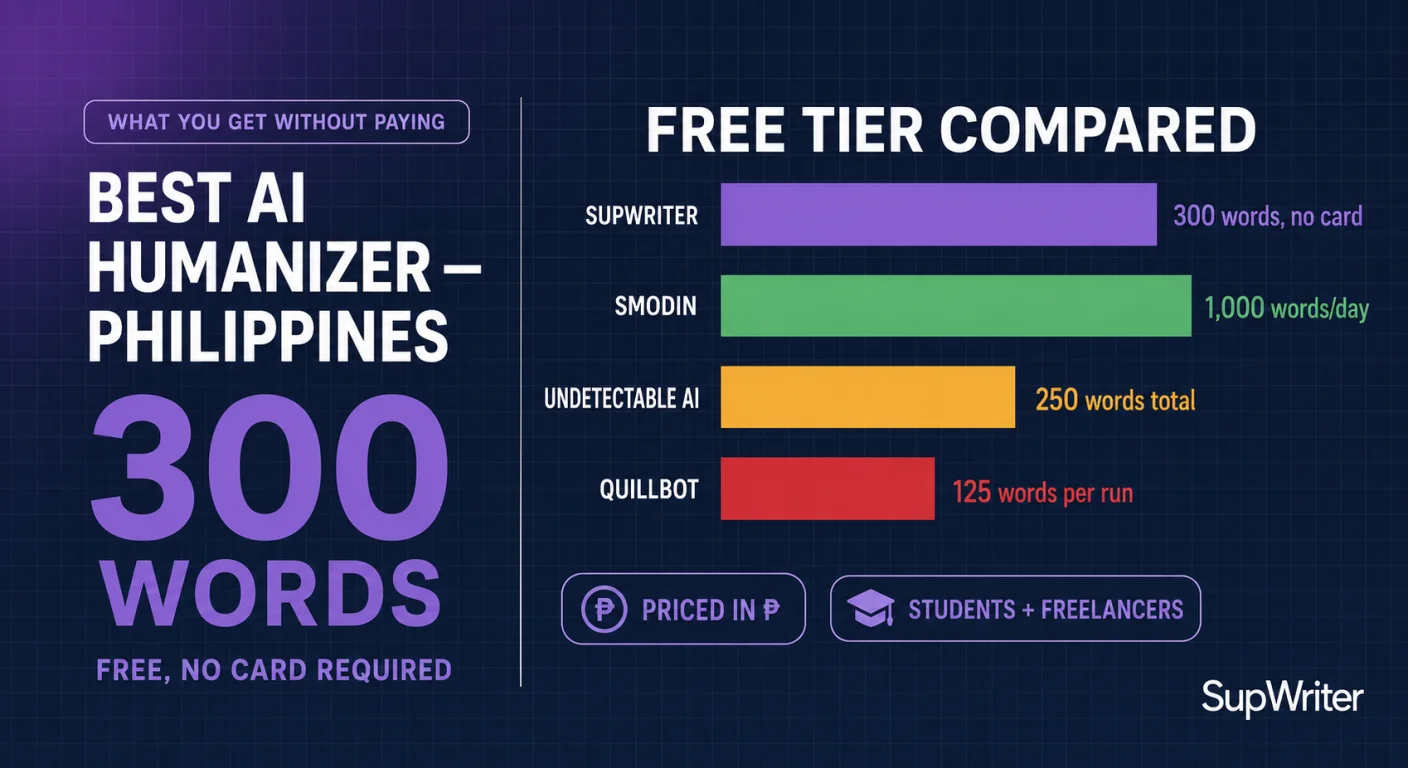
Why it tops our list for the UK: it pairs a humanizer with a built-in AI detector, so you can pre-check a draft before it goes near Turnitin. That detector is one scoring model, not Turnitin, and its 12 named labels are a guide mapped from that single score. Results vary by detector, text length and topic, and no tool can guarantee a result (how we test). Basic is 9.99 USD a month (roughly 7.50 GBP) for 5,000 words, or 4.99 USD a month billed annually; Pro is 19.99 USD for 15,000 words. The 300 free words need no card, just a free account. For a dissertation, run a sample chapter first and check your references come through intact.
Pros: built-in AI detector for pre-checks, a genuine no-card free tier, 50+ languages, annual billing at half the monthly price.
Cons: no British English dialect switch, so sweep the output for Americanisms yourself. Billing is in dollars, which may mean a small forex cost on a UK card. Basic's 5,000 words is half of Undetectable AI's entry allowance at the same price.
Best for: UK students and researchers who want to rewrite and pre-check in one place, where a flagged submission means an academic offences process, not an inconvenience.
2. Undetectable AI
The most visible alternative, and a legitimately capable one.
Pros: a broad suite around the humanizer, and more words for the money: 10,000 on the 9.99 USD Starter plan, twice SupWriter's Basic allowance.
Cons: the free trial is only 250 words in total, so you are largely committing before you have seen it handle your own work. Its Terms also split cancellation between two inboxes; see our cancellation guide. Test citation handling on a sample chapter before trusting it with a long reference list. Our full review has more.
Best for: higher-volume work where words per pound matter most.
3. Humbot
Pros: fast, simple, no learning curve, and a low listed entry price.
Cons: the allowance is split into Basic and Advanced words, the entry plan caps each request at 500 words, and the pricing page we saw didn't say whether its prices were monthly or annual. Side by side in our Humbot comparison.
Best for: blog drafts and marketing copy, not long coursework.
4. Phrasly
The budget student pick if you pay annually: 10.99 USD a month billed annually (roughly 8.30 GBP), or 24.99 USD on monthly billing, for unlimited humanizations of up to 5,000 words per process.
Pros: unlimited humanizations on its main plan, and a 2 USD three-day trial.
Cons: the trial converts to a paid plan automatically, and monthly billing costs more than twice the annual rate.
Best for: high-volume writing on a tight budget, if you commit annually.
5. WriteHuman
Pros: clean interface, straightforward requests-based pricing (20 USD a month, or 12 USD billed annually, for 80 requests of up to 600 words), and a small free plan to test with.
Cons: requests-based limits get awkward for long documents like dissertations, where 600 words per request means a lot of pasting. Details in our WriteHuman review.
Best for: shorter pieces where per-request caps don't bite.
6. QuillBot
Widely used by students, and one of the few mainstream options with a proper British English setting: its Paraphraser lets you choose English (US), English (UK), English (Canada) or English (Australia) (QuillBot help). That is a genuine advantage for the spelling problem above.
Pros: the dialect control is real and useful, the paraphrasing is good, and most people already know it.
Cons: its humanizer is an add-on to a paraphraser; the free humanizer takes only 125 words at a time; and full access sits behind Premium at 19.95 USD a month (around 15 GBP), or 8.33 USD billed annually. Turnitin also says it looks for AI text that has been run through paraphrasers, in English submissions. See our QuillBot review.
Best for: rewording and dialect correction. Not for clearing a detector.
7. HumanTone
HumanTone is a smaller humanizer with a built-in detector and credit-based pricing: its homepage lists plans from 8 USD a month (down from 10) for about 15,000 words, at 100 words per credit.
Pros: a low entry price, simple credit maths, and a detector for checking before you publish.
Cons: its homepage did not mention British spelling when we checked in September 2026, so don't assume it handles -ise and -our consistently; test that yourself. We have seen no independent performance data, so treat the marketing as marketing.
Best for: someone who wants a low-cost option and will proof the output for British spelling themselves.
Choosing One, Practically
If a flag means an academic offences panel, no tool's marketing figure should reassure you. You can't see Turnitin's AI score for your own work, and no humanizer can guarantee what it will say. What protects you is a draft that is genuinely yours and a paper trail that shows it: outlines, version history, notes. Check your university's AI policy first; many allow AI for brainstorming but not for final text.
If you are writing a dissertation, test citation handling before anything else. A humanizer that mangles your references creates a second, entirely separate marking problem.
If you are being falsely flagged on your own writing, which is where a great many UK cases originate, understand what the ombudsman will actually examine, because it decides what you should be collecting now. Neither the OIA nor the SPSO re-marks your essay or re-runs the detector. They ask whether the provider followed its own published procedure and whether the outcome was reasonable on the evidence it had. That makes procedural detail the valuable currency: secure the university's final decision letter — in England and Wales that is the Completion of Procedures letter the OIA requires before it will look at anything — record whether you were shown the actual detector output rather than a summary of it, check that the panel's minute of your viva matches what you said, and note whether anyone treated a score as proof when the institution's own policy calls it a supporting indicator. Those are the grounds that succeed.
If money is the constraint, organise a proper test before paying anyone. Run the same passage of at least 300 words (Turnitin's minimum) through each free tier, check each result with an AI detector, try the free humanizer, and only then commit. Remember you are buying dollars on a sterling card, so the real monthly cost is the sticker plus any foreign transaction fee your bank charges — worth knowing before you agonise over two tools three pounds apart.
The Bottom Line
The UK combines widespread Turnitin use with a formal disciplinary apparatus and no published national threshold. That is an unforgiving mix, and it falls hardest on the international students the detectors misread most often.
SupWriter takes our top spot because it pairs rewriting with a built-in pre-check and a no-card free tier. Undetectable AI gives you more words per pound. QuillBot is worth keeping for its dialect control. None of them, and no other tool, can promise what Turnitin will say.
Whichever you pick, test it on your own writing before the deadline, and check the output reads as British before you submit. For a look at the same analysis in a very different regulatory environment, our India guide covers a market with the opposite problem: enormous demand and almost no formal process at all.
Try SupWriter's AI humanizer on your next assignment: 300 words free, no credit card required.
Make an AI-assisted draft sound like you
Rewrite stiff, AI-sounding passages in a natural voice.
Free account, no card · 300 free words