By ShriprasannaPublished July 30, 2026Updated September 26, 2026
Best AI Humanizer in Nigeria (2026)
Ask a Nigerian final-year student what keeps them up at night and you will not hear "AI detection." You will hear "defence." The project. The bound copy. The supervisor who wants the Turnitin report attached before your name goes anywhere near a defence timetable.
That is where this category actually touches Nigerian life. Not in an abstract argument about ChatGPT ethics, but in the four weeks before submission, when a student who wrote their own chapter three watches a report come back with numbers nobody explains and a supervisor who will not schedule them until those numbers move. And then the second problem: most tools claiming to fix this want 10 or 20 US dollars a month from a naira card that may or may not work at checkout.
What follows is a look at which humanizers are actually usable from Lagos, Nsukka, Zaria or Ile-Ife, judged on the two things you can check before you commit: whether you can test the tool without paying, and what it costs in naira once you do. No tool can promise how its output will score on your department's checker, so this guide doesn't pretend to rank them on that.
Start With the Money, Because Here It Decides Everything
Almost every humanizer on earth prices in US dollars. In Nigeria that is not a minor detail, it is the filter.
On 25 September 2026 the Central Bank of Nigeria's official NFEM rate was about 1,330 naira to the dollar (CBN exchange rates). Every conversion in this post uses that figure. What your bank actually charges on a dollar card payment is usually higher once fees and markups are added, and the rate moves constantly, so check it again before you budget anything.
At that rate, a 9.99 dollar plan is about 13,300 naira a month, and a 19.99 dollar plan is about 26,600. For a student on an allowance, that is a real decision, not a rounding error. Annual plans look cheaper per month, but you pay the whole year at once, which is often the harder number to find.
Then comes the part nobody outside Nigeria thinks about. International spending on naira cards has been restricted for long stretches in recent years, and the limits that apply today vary widely by bank and account tier, with some cards restricted far more tightly than others. Recurring dollar billing also fails at checkout more often than it should, for reasons that are rarely explained to you at the time.
The practical consequence is simple:
In Nigeria, "can I try this without a card" is not a nice-to-have. It is the first question, and it eliminates half the market before you have read a single feature list.
We do not know whether any of the tools below accept naira or local payment rails, so we are not going to claim it. SupWriter, for one, bills in US dollars. What we can tell you is which ones let you evaluate the output before your card is involved at all.
What Nigerian Institutions Actually Run
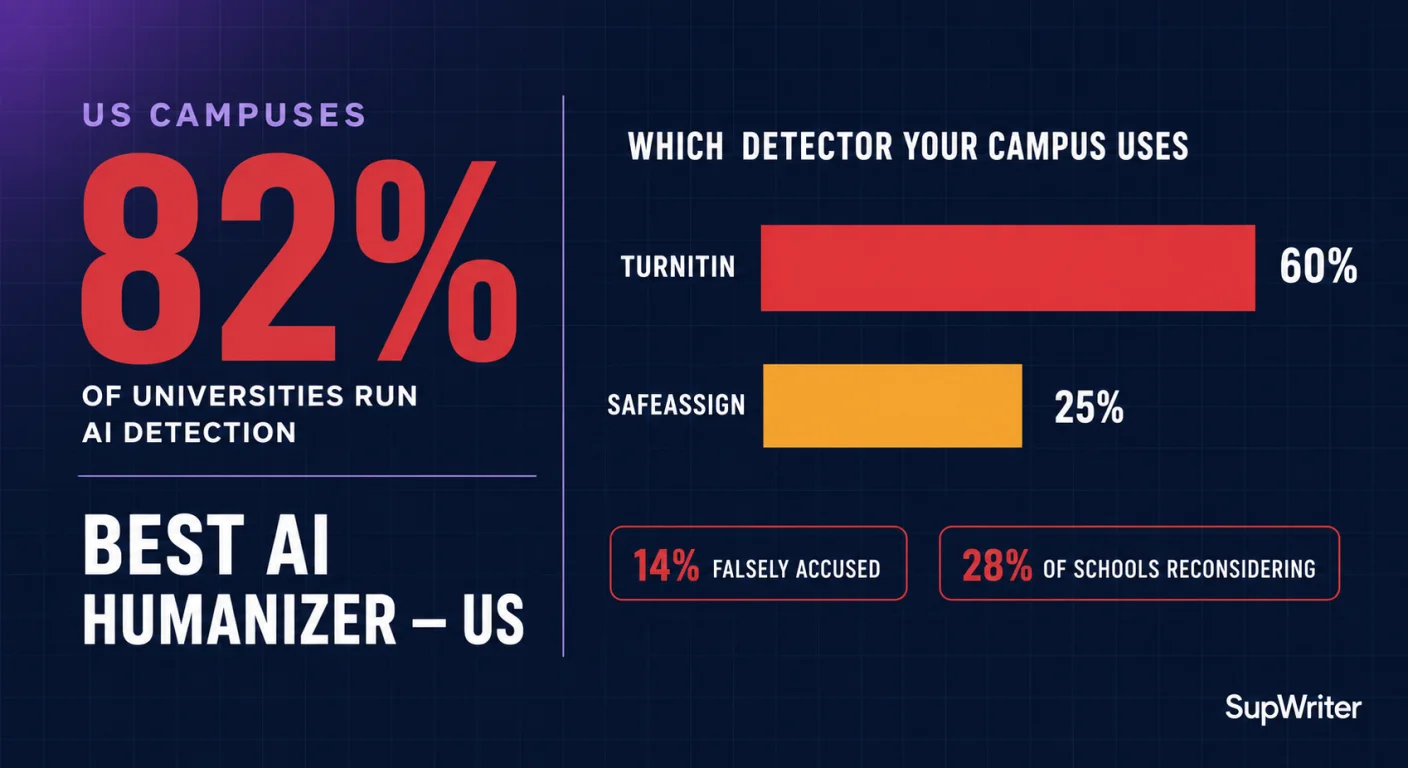
Turnitin is the checker most Nigerian students run into, and it usually got there the same way it got there in a lot of places: it was procured for plagiarism compliance long before AI writing was a concern, and the AI indicator arrived later on infrastructure the university had already paid for.
Students tend to experience it as a compliance gate rather than a teaching tool. The software decides, nobody explains it. It doesn't help that the AI indicator isn't visible to students at all: Turnitin shows it to instructors, who can choose to download and share the report (Turnitin AI detection FAQ).
On thresholds, the honest answer is that there is no single national number. We could not find a published National Universities Commission directive setting a specific AI-detection percentage for theses or projects. Treat anyone who quotes you a national figure with suspicion.
What does exist is institutional practice around similarity: many departments set a maximum similarity index for projects and theses, and the figure varies by institution and department, so ask for yours in writing. Similarity and AI probability are two different measurements, and conflating them is the single most common mistake we see in Nigerian student forums. Our guide on whether Turnitin detects AI writing separates the two properly.
The 2026 policy direction worth knowing, globally and increasingly here, is that undisclosed AI use is the violation, not AI use as such. Turnitin's own guidance says the AI percentage "should not be used as the sole basis for action or a definitive grading measure by instructors" (same FAQ). Whether your particular supervisor has read that guidance is a different question.
The False-Positive Tax on Nigerian English
Here is the part that makes this genuinely unfair.
Nigerian students write their degrees in English. Most speak two or three languages, and academic English is a learned register layered over Yoruba, Igbo, Hausa, Pidgin or something else entirely. Detectors were not built with that writer in mind.
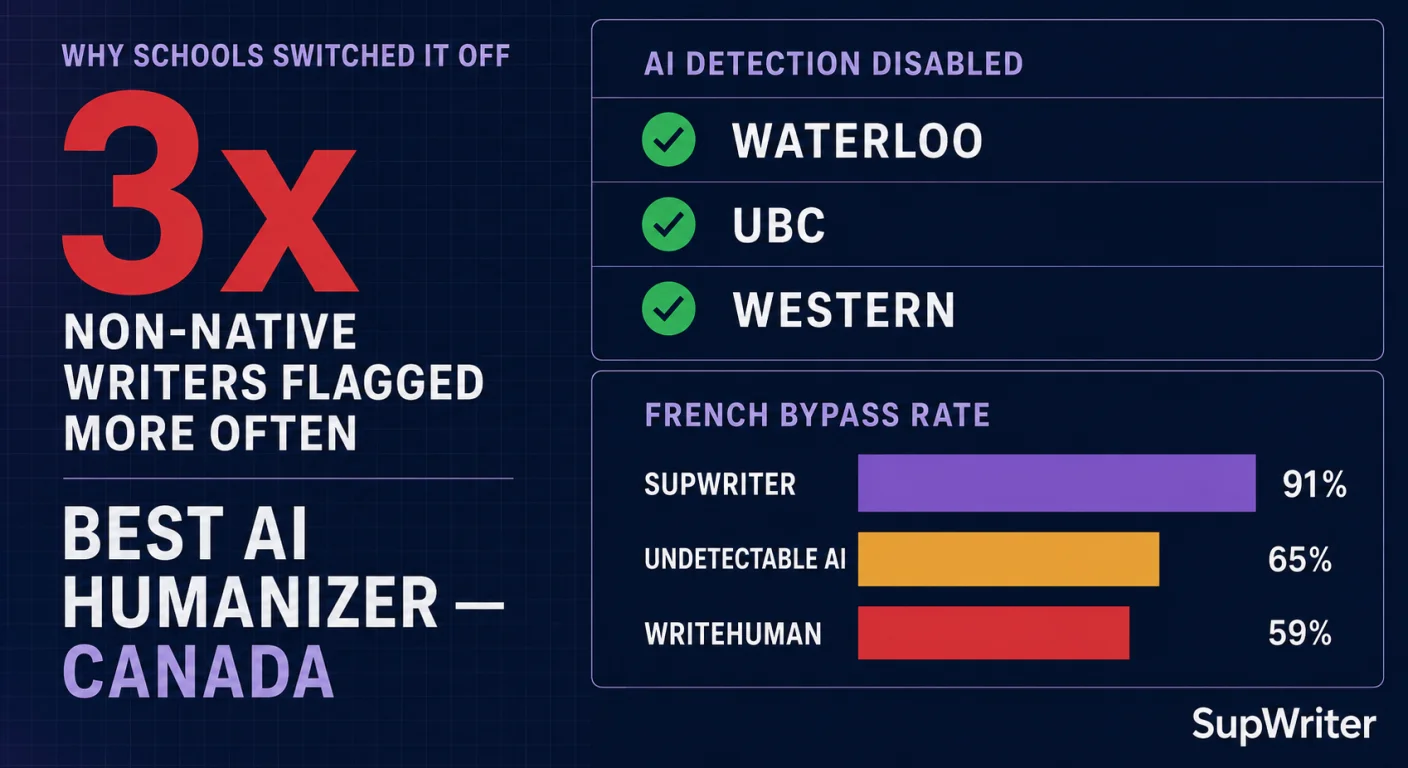
In a 2023 Stanford study, seven AI detectors flagged human-written essays by non-native English speakers as AI-generated at an average rate of 61 percent, while essays by native speakers were accurately identified (Liang et al.).
The mechanism is not mysterious. Detectors measure perplexity, meaning how predictable your word choices are, and burstiness, meaning how much your sentence lengths vary. What is worth spelling out is why Nigerian academic prose scores badly on both, because it is not a story about weak English.
Start with what academic English actually is for a Nigerian writer. For a very large share of students the everyday register is Pidgin, or Pidgin alternating with Yoruba, Igbo or Hausa depending on who is in the room. Academic English is not the language you relax into. It is a deliberate code-switch into a register you were taught, and taught precisely. Language you perform carefully is language you control tightly, and tight control is the exact signature these detectors were built to read as generation. The better you were drilled, the worse you score.
Then there is the drilling itself. The WAEC and NECO essay is a format with rules: a stated position in the opening paragraph, a set number of supporting paragraphs, connectives assigned to specific jobs, a conclusion that restates. Millions of Nigerian students learn to write English through that template, are marked on how faithfully they follow it, and carry it into university intact. A detector reading an essay built on a national marking scheme sees uniform paragraph architecture and predictable transitions, which is also what it sees in model output. It cannot distinguish a template a machine learned from a template an examiner enforced.
The last layer is the Nigerian project itself. The five-chapter format is close to universal here, and it arrives with a house style: "This chapter presents", "The researcher observed that", "It is pertinent to note that", the third person maintained throughout, a literature review written to a shape your department will hand back to you if you deviate from it. Those are not clichés you chose. They are the conditions of acceptance. And each of them is a phrase a language model would also produce, for precisely the same reason: it is the most probable thing to say in that slot.
Our post on why ESL students get falsely flagged covers the underlying research. The Nigerian version of the problem is sharper than the general one, because here the features being penalised by the software are the features your supervisor requires.
The Other Nigerian Use Case: Client Work
Nigeria has an enormous freelance writing economy serving overseas clients, and many of those clients run submissions through an AI detector, often Originality.ai, before paying. Detectors regularly disagree about the same passage, so a draft that looks fine on one checker can still fail the one your client uses (why AI detectors give different results).
For a Nigerian freelancer, a false positive is not an academic conversation. It is a withheld payment, a damaged rating, sometimes a closed contract, with no appeal process worth the name. Our Originality.ai guide explains how that detector works and what you can realistically do about a flag.
The Comparison, in Naira
Prices are from each vendor's pricing page, checked in September 2026, converted at about 1,330 naira to the dollar. Your bank's rate and markup will move these.
| Tool | Listed price | Approx. NGN | What you get | Free access |
|---|---|---|---|---|
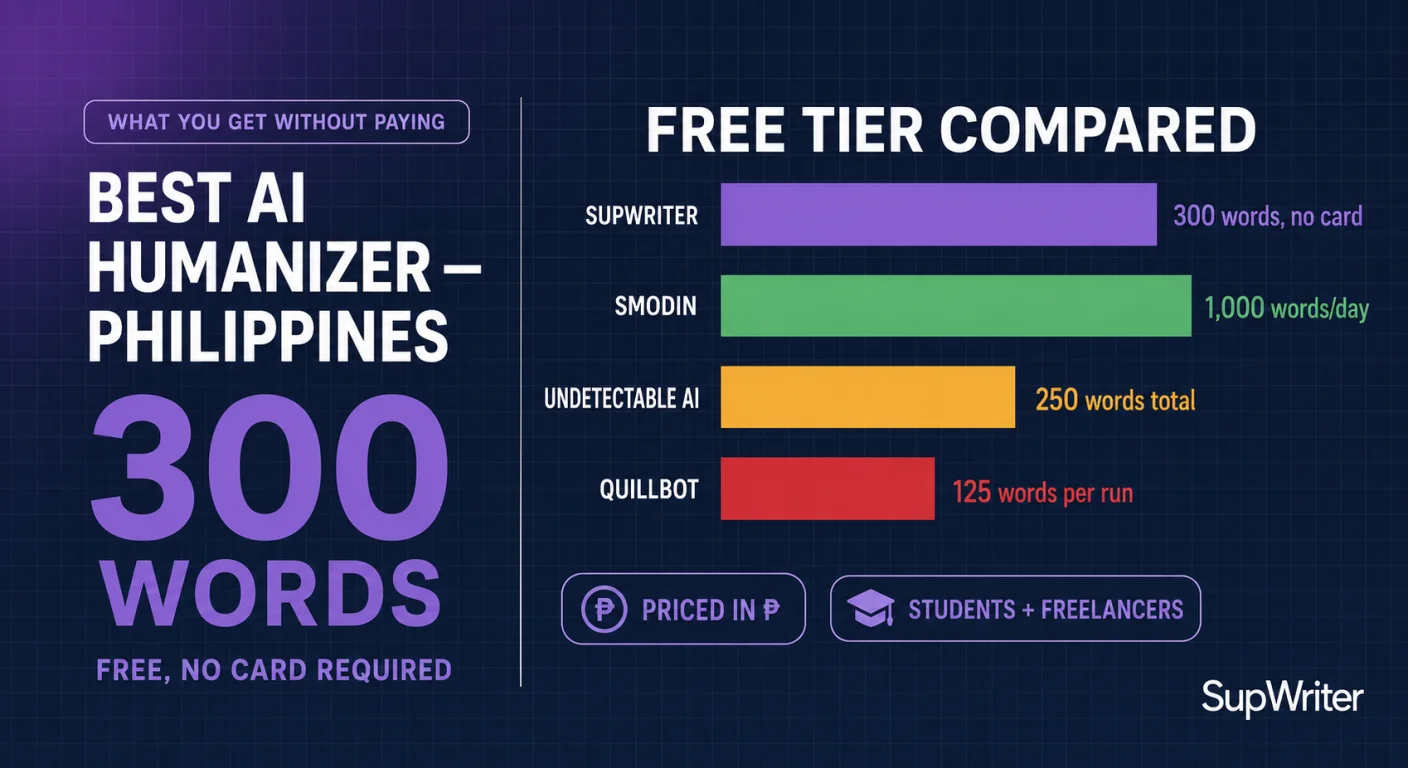
| SupWriter | 9.99 USD a month (4.99 on annual billing) | about 13,300 a month (6,600 on annual) | 5,000 words a month, up to 500 per request | 300 words once; account needed, no card |
| Humbot | from 7.99 USD a month | about 10,600 a month | 3,000 Basic plus 1,000 Advanced words, up to 500 per request | Not described; 30-day money-back guarantee |
| QuillBot Premium | 8.33 USD a month, billed annually | about 11,100 a month (about 133,000 upfront) | Full paraphrasing and humanizing | 125 words per paraphrase or humanize |
| Undetectable AI | 9.99 USD a month (5.00 on annual billing) | about 13,300 a month (6,650 on annual) | 10,000 words a month | 250-word free trial |
| NaturalWrite | 9.99 USD a month (4.99 on annual billing) | about 13,300 a month (6,600 on annual) | 5,000 words a month | "Try for free" link; allowance not stated |
| Smodin Starter | 10 USD a month, billed annually | about 13,300 a month | "Limited" writing output | Not stated on pricing page |
| Phrasly Unlimited | 10.99 USD a month, billed annually | about 14,600 a month | Unlimited humanizing, up to 5,000 words per process | 3-day trial for 2 USD |
| WriteHuman | 12 USD a month, billed yearly (144 USD) | about 16,000 a month (about 191,500 upfront) | 80 requests a month, up to 600 words each | 3 requests a month, up to 250 words |
Our full pricing breakdown compares more tools and plans.
The Tools, One by One
SupWriter comes first because it's ours, so you can weigh what we say about it accordingly. The rest follow in order of the headline price each vendor lists, whether that's a monthly or an annual rate.
1. SupWriter
What it offers from Nigeria: the 300 free words need an account but no card, so you can evaluate real output on your own chapter before any payment question exists. The editor also covers Hausa, Yoruba and Igbo among its 50+ languages, although most Nigerian project work will be in English.
What it costs: 9.99 dollars, about 13,300 naira, buys 5,000 words a month on Basic. That is 2.00 dollars per 1,000 words, and it is not cheap next to this table: Undetectable AI lists twice the words for the same monthly price. Annual billing halves the rate to 4.99 dollars a month, about 6,600 naira, but you pay 59.88 dollars, around 79,600 naira, upfront. Pro and Ultra come to 1.33 dollars per 1,000 words on monthly billing and 0.67 on annual.
Pros: no-card evaluation, a built-in AI detector that is free on paid plans (one scoring model, so a pre-check rather than a preview of Turnitin), 50+ languages, larger requests on Pro (2,000 words) and Ultra (5,000).
Cons: it is still a US dollar subscription, and one of the pricier options per word at the entry level. Basic's 500-word request cap means feeding a chapter in pieces. If your card is capped or blocked, the paid plan is only reachable through whatever international payment method you already have working. We are not going to pretend otherwise.
Best for: students who want to test on a real chapter before paying, and who value having a pre-check alongside the rewrite.
2. Humbot
Humbot's pricing page lists plans from 7.99 dollars a month, about 10,600 naira. The entry plan includes 3,000 "Basic" words and 1,000 "Advanced" words a month, with a 500-word input limit per request, and an AI checker is part of the product.
Pros: a low entry price, a 30-day money-back guarantee, a built-in checker.
Cons: a small allowance at the entry tier, split across two word types you have to track, and the pricing page doesn't describe a free tier. You commit money on an international card before you have seen much output.
Best for: short pieces where you can check the result yourself.
3. QuillBot
Probably the most familiar writing tool among Nigerian students, and the one most often mistaken for a humanizer.
Pros: enormous familiarity, genuinely good paraphrasing, a free tier that includes a 125-word humanizer as well as the paraphraser, and Premium at 8.33 dollars a month on annual billing, about 11,100 naira, for full access.
Cons: that Premium price is billed annually, so it is about 100 dollars, roughly 133,000 naira, in one payment. And the free tier's 125-word cap is the real problem for a project chapter: you feed it in blocks, the blocks come back with no memory of each other, and a chapter three that was consistent going in reads as stitched-together going out. Your supervisor notices that before any detector does. Turnitin also says it looks for AI text that has been run through paraphrasers, in English (see the FAQ above).
Best for: vocabulary help and rewording a sentence you are stuck on.
4. Undetectable AI
Pros: 10,000 words for 9.99 dollars a month, about 13,300 naira, which is twice SupWriter's Basic allowance at the same price. Annual billing brings it to 5.00 dollars a month (60 dollars a year). Detection checking is built into the product, and the pricing page advertises a money-back guarantee if output is flagged as not human. Read those terms before you rely on them.
Cons: the free trial is limited to 250 words, which is barely one paragraph of a project chapter.
Best for: users who already have reliable international payment sorted and want more words per dollar.
5. NaturalWrite
Pros: its plans mirror SupWriter's almost exactly: 9.99 dollars a month for 5,000 words, 4.99 on annual billing, and the same 15,000 and 30,000-word tiers above. It says it humanizes in 50+ languages.
Cons: the pricing page shows a "Try for free" link but doesn't state the free allowance, so you can't plan around it. Price per word is the same as SupWriter's.
Best for: users comparing like-for-like plans who want to try both before choosing.
6. Smodin
Pros: a broad toolkit for the money. The pricing page lists an AI detector and humanizer, a rewriter and a translator, with Starter at 10 dollars a month and Premium at 16, both billed annually.
Cons: Starter's writing output is only described as "Limited", so you can't work out a price per word, and the free allowance isn't stated on the pricing page. Verify both on the site before you plan around it.
Best for: undergraduates who want several writing tools in one place.
7. Phrasly
Pros: unlimited humanizing on the annual plan at 10.99 dollars a month, about 14,600 naira, with up to 5,000 words per process. A 3-day trial costs 2 dollars, about 2,700 naira.
Cons: the headline price needs a full year upfront: 131.88 dollars, about 175,400 naira. The trial is paid, so your card is involved from the first step, and the free sign-up allowance isn't stated.
Best for: heavy users who can pay for a year at once.
8. WriteHuman
Pros: request-based pricing that can be very cheap per word. The 12-dollar plan (billed yearly at 144 dollars) allows 80 requests a month of up to 600 words each. If you use them fully, that is about 0.25 dollars per 1,000 words. It lists 40+ languages, and the free tier gives you 3 requests a month of up to 250 words.
Cons: the 12-dollar price is billed yearly, so you pay about 191,500 naira at once. Short requests waste the allowance, and 600 words per request still means splitting a chapter.
Best for: regular users who can pay annually and work in chunks.
A Testing Routine That Costs You Nothing
You can evaluate much of this list without spending a naira, and you should.
- Take one real 300-word paragraph from your own project, not a sample.
- Run it through the free allowances that need no payment: SupWriter's 300 words (account, no card), WriteHuman's free requests (up to 250 words each), and QuillBot's free 125-word humanizer.
- Compare the outputs with a detector or two. Copyleaks lets you scan up to 25,000 characters without logging in (Copyleaks). SupWriter's AI detector is free on paid plans, but on the free tier each checked word uses a credit, so check one short sample there. Expect the checkers to disagree. Read the outputs yourself too, for meaning and for your department's house style, then decide whether anything here is worth an international transaction.
Our roundup of free AI humanizer tools goes deeper on what each free tier delivers, and the free humanizer page is the fastest place to start.
One more thing for students being falsely flagged on their own writing. In Nigeria there is usually no panel to appeal to and no ombudsman sitting above your department. There is a supervisor, an office, and a conversation, so prepare for that conversation specifically. Bring your drafts with their timestamps and the sources you actually read. Then ask, calmly, three things: which report produced the number, whether it is a similarity score or an AI score, and what figure the department treats as a problem. That third question resolves many of these, because some supervisors are enforcing a similarity ceiling against an AI percentage without having registered that they are two different measurements. Being the person in the room who knows the difference is worth more here than anything on this list.
The Bottom Line
Nigerian students and writers face a harder version of this problem than almost anyone. Detectors misread the English they were taught. Institutions enforce numbers that were never nationally published. And the tools that claim to help are priced in a currency that is expensive to reach, behind card limits that can shut the door before you see the product.
No humanizer here can promise a result against Turnitin or Originality.ai, so choose on what you can check. If you have no working card, start with the free allowances: SupWriter's 300 words, WriteHuman's three free requests and QuillBot's 125-word tools. If you can pay and want the most words per dollar, look at Undetectable AI's 10,000 words for 9.99 dollars, or at WriteHuman and Phrasly if you can pay for a year upfront. SupWriter costs more per word at the entry level, but it pairs the rewrite with a built-in pre-check and covers Hausa, Yoruba and Igbo alongside English. For the same analysis in another market with a similar detector problem, see our India country guide.
And check every naira figure in this post against today's rate before you commit to anything. All of them use the CBN rate of 25 September 2026, and in this market that is a shorter shelf life than it sounds.
Test SupWriter's AI humanizer on your own project chapter: 300 words free, no credit card required.
Make an AI-assisted draft sound like you
Rewrite stiff, AI-sounding passages in a natural voice.
Free account, no card · 300 free words