By ShriprasannaPublished July 30, 2026Updated September 26, 2026
Best AI Humanizer in India (2026)
India has one of the largest student populations on earth: about 45 million people were enrolled in higher education in 2023-24, according to the Ministry of Education's AISHE survey. A large share of them write academic work in English as a second or third language. Similarity checking is routine at Indian universities. And the people building humanizer tools are, overwhelmingly, building for an American student writing a five-paragraph essay in Ohio.
That mismatch is the whole story of this post. A tool that works beautifully for a native English speaker in Boston can fail an M.Tech student in Pune for reasons that have nothing to do with whether either of them used ChatGPT.
So this is not a generic "top tools" list with the word India stapled to the front. We looked at what actually decides whether a humanizer is usable here: how Indian universities enforce AI policy, why Indian English gets falsely flagged, whether a tool handles Devanagari or just claims to, and what the price feels like in rupees rather than dollars.
Why Indian Students Need This More Than Most
Start with the enforcement layer. The AI checks you are most likely to meet are the ones bundled with similarity checking: Turnitin, its research-side sibling iThenticate, and Copyleaks. UGC plagiarism regulations pushed institutions toward similarity checking years before AI writing existed, so whichever tool was already installed often became the AI checker too.
Here is the complication. As of September 2026, we have not found a national UGC threshold for AI-detected content in a thesis or dissertation. That decision sits with each university, and sometimes with each department or supervisor. Turnitin itself shows AI scores between 1 and 19 percent only as an asterisk, and says the percentage "should not be used as the sole basis for action" (Turnitin's AI detection FAQ).
The result is an uneven map. Some institutions publish their own rules. Plenty publish no threshold at all, and students there learn the rules only when a supervisor returns a flagged report. Treat any number you hear secondhand as a rumour until you have seen the document it comes from.
If you want the mechanics of what Turnitin is actually measuring, our guide on whether Turnitin detects AI writing covers it.
The Indian English Problem Nobody Designed For
The second reason demand is so high here has nothing to do with cheating.
Stanford researchers tested seven AI detectors on essays by non-native English speakers and found the tools misclassified about 61 percent of that writing as AI-generated on average (Liang et al. 2023). Native-speaker essays were classified almost perfectly. The gap is not subtle, and it lands hard on Indian writers. We cover the wider evidence in are AI detectors accurate.
Why? Detectors measure perplexity, which is how predictable your word choices are, and burstiness, which is how much your sentence lengths vary. Indian academic English tends to score badly on both, for entirely respectable reasons:
- Formal register by default. Indian academic writing inherits a formal British-derived convention. Phrases like "it may be noted that" and "the aforementioned study" are taught as correct. They are also extremely predictable to a language model.
- Consistent sentence length. Writers working in a second language keep sentences at a safe, uniform length because that is where fewer grammatical errors hide. Detectors read uniformity as machine output.
- Curated vocabulary. You use the word you are sure about rather than the messy synonym a native speaker would reach for without thinking. Low variance, low perplexity, high suspicion.
Our post on why ESL students get falsely flagged goes deep on this, and every mechanism in it applies to Indian writers with extra force, because Indian English is a distinct variety with its own conventions, which is exactly the kind of writing detectors tend to misread.
Then there is code-mixing. Hinglish is the everyday register for a huge number of Indian students, and it leaks into drafts. Detectors trained on monolingual English corpora have no coherent model for a sentence that switches script or language halfway through, and mixed-language text behaves erratically under detection in ways that are hard to predict in advance.
The uncomfortable summary: an Indian student may need a humanizer not to disguise AI text, but to stop their own writing from being misread as AI text.
Hindi, Devanagari, and Regional Languages
Most humanizers list Hindi on a features page. Far fewer process it natively.
The distinction that matters is whether the tool runs a language-specific model or a translate-humanize-translate pipeline. The pipeline approach produces Hindi that a native reader immediately clocks as translated: correct-ish grammar, wrong rhythm, English sentence structure wearing Devanagari. We walk through this pattern in our non-English humanization guide.
For Indian users, three questions separate real support from marketing:
- Does it handle Devanagari natively, or romanize first? Romanization destroys the structural information that makes Hindi read naturally.
- Does it cover regional languages? Bengali, Tamil, Telugu, Marathi, Gujarati, Kannada, and Malayalam matter enormously and are supported far less often than Hindi.
- What happens to Hinglish? Honest answer: no tool we know of handles code-mixed text reliably. If you are writing something that will be checked, commit to one language per paragraph.
SupWriter's editor covers Hindi, Bengali, Tamil, Telugu, Marathi, Gujarati, Kannada, Malayalam and Urdu among its 50+ languages, and there is a dedicated Hindi humanizer page.
Two things we will say plainly, because they change how you should judge any tool here:
- Turnitin does not score Hindi or other Indian languages. Its AI writing detection covers long-form English, Spanish, Japanese and Modern Arabic. Papers in other languages are not processed, and the AI indicator shows an empty state (Turnitin's AI detection FAQ).
- Our own detector is not a reliable judge of Indic text either. In a September 2026 spot check (one draft per language), it scored fully AI-written Tamil, Malayalam and Marathi drafts at only 71 to 74 percent AI, and after rewriting the scores went up rather than down, to 85 to 100 percent. For Urdu and Nepali it returned 0 both before and after, which means it cannot evaluate those languages at all.
So do not use our score, or anyone's, as proof that an Indic-language rewrite reads as human. Read the output, or ask a fluent reader to.
What These Prices Actually Feel Like in Rupees
Almost every tool in this category prices in US dollars. Your bank converts at its own rate and adds a forex markup, and recurring international card mandates in India add their own friction, which is why "free trial without a card" is a much bigger deal here than it is in the US or UK.
The rupee averaged about 95 to the dollar in September 2026 (X-Rates monthly average). At that rate, here is roughly what the US-dollar list prices convert to before your bank's markup. SupWriter may apply a regional discount at checkout, so treat its row as the most you would pay.
| Tool | Starting list price (USD) | Approx. in INR | Free option | Hindi / Indic support |
|---|---|---|---|---|
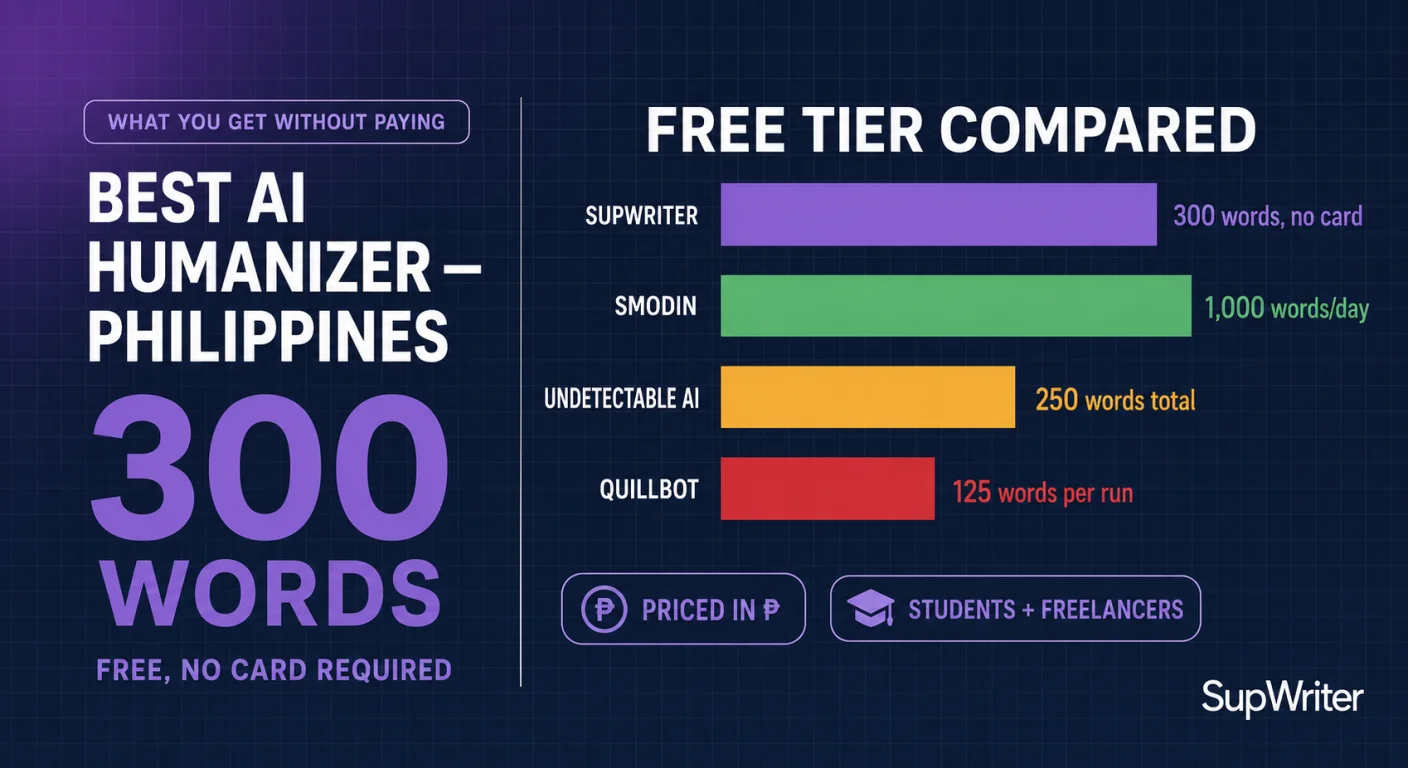
| SupWriter | 9.99/month (Basic, 5,000 words) | around 950 | 300 words, no card (sign-in required) | Hindi and eight more Indian languages in the editor |
| Smodin | 10/month, billed annually (Starter) | around 950 a month, paid yearly | Free humanizer; limits not published | "100+ languages" claimed |
| thehumanizer.ai | Not shown on its homepage | Not available | 350 words when you create an account | Lists Hindi among its languages |
| Humanizer PRO (texthumanizer.pro) | Not shown on its homepage | Not available | 300 words after sign-up, no card | No Hindi page found |
| QuillBot | 19.95/month (8.33 billed annually) | around 1,900 (around 790 on annual) | Humanizer and paraphraser up to 125 words | Paraphrasing in 23 languages |
| Phrasly | 19.99/month (10.99 billed annually) | around 1,900 (around 1,040 on annual) | $2 three-day trial | Not stated on its pricing page |
| StealthGPT | Pricing page did not load for us | Not available | Not verified | Not verified |
| Humbot | See the vendor's current pricing | Not available | Not verified | Not verified |
Prices from each vendor's own site, checked September 2026: Smodin, thehumanizer.ai, Humanizer PRO, QuillBot, Phrasly, Humbot. SupWriter figures are list prices.
Our full pricing breakdown compares more tools and plans.
The Ranking
We order this list by what we could verify in September 2026: Indian-language support, a way to test free without a card, and published prices. Not by a detector pass rate, because none of these tools, us included, has an independent one.
1. SupWriter
Why it tops the list for India: the Indic language coverage is the deciding factor. Hindi, Bengali, Tamil, Telugu, Marathi, Gujarati, Kannada, Malayalam and Urdu all sit in the same editor as English. List prices start at 9.99 USD a month for 5,000 words (4.99 USD a month on annual billing), and regional discounts may apply at checkout.
The 300 free words need a sign-in but no card, which for Indian users removes the single biggest evaluation barrier.
Pros: real Indic language coverage in one editor, published prices, a built-in AI detector for a pre-check on English drafts, and a no-card trial.
Cons: our detector cannot judge Indic-language text reliably (see above), so you evaluate Hindi or Tamil output by reading it. Three hundred free words let you judge the rewrite, not finish a thesis chapter. And we have no independent pass rate to show you.
Best for: Indian students and researchers writing in English, Hindi, or a regional language who want one tool for all of it and will still read and check the result.
2. Smodin
Smodin offers a free humanizer and claims support for 100+ languages, with paid plans listed on its pricing page.
Pros: a free tier to try, broad multilingual coverage, and published paid prices: Starter 10 USD and Premium 16 USD a month, both billed annually.
Cons: the free allowance is not stated on its pricing page, and the displayed prices assume annual billing. Its "95%+ detection bypass rate" is a vendor claim we have not seen independently verified. We found no Indic-specific tuning.
Best for: budget-constrained students with light, predictable volume.
3. thehumanizer.ai
It gives 350 free words when you create an account and lists Hindi among its supported languages (thehumanizer.ai).
Pros: 350 words in one go is a larger single-run allowance than QuillBot's 125-word cap, and Hindi is on the language list.
Cons: we could not find published pricing on its homepage. Its claim that it "consistently passes every major AI detection system" is marketing, not independent testing.
Best for: a quick one-off job where 350 words covers it.
4. Humanizer PRO (TextHumanizer.pro)
It offers 300 free words after sign-up with no card, and a 30-day money-back guarantee on paid plans (texthumanizer.pro).
Pros: a no-card trial and a guarantee in writing. Its site is also refreshingly blunt that no benchmark can predict every detector.
Cons: we found no Hindi or Devanagari page on its site in September 2026, and no prices on its homepage. Test Hindi output yourself before you pay.
Best for: English-first users who want a refund guarantee.
5. QuillBot
A familiar tool for many Indian students. It is a paraphraser first, and that is the limitation here.
Pros: familiar, solid paraphrasing in 23 languages (per QuillBot), and a free tier that is fine for rewording.
Cons: the humanizer's full version is part of Premium, at 19.95 USD a month (around 1,900 INR) or 8.33 USD a month billed annually (QuillBot Premium). The free humanizer and paraphraser cap each input at 125 words. Turnitin also says it looks for AI text that has been through a paraphraser, in English submissions; see can Turnitin detect QuillBot paraphrasing.
Best for: paraphrasing and vocabulary help. Not for clearing a detector.
6. Phrasly
Now a flat-rate plan: 19.99 USD a month (around 1,900 INR) or 10.99 USD a month billed annually (around 1,040 INR), for unlimited humanizations subject to fair use and 5,000 words per run (Phrasly pricing).
Pros: no word counting if you write a lot, and annual billing is 45% below the monthly rate.
Cons: the entry point is a $2 three-day trial that renews automatically unless you cancel, and refunds are available only if you have not used the account at all (Phrasly terms). No Indian-language work that we could find. The details are in our Phrasly pricing breakdown.
Best for: English-only, high-volume content work.
7. StealthGPT (Stealth AI)
It bundles AI writing and humanization in one product.
Pros: generation and humanization in one place, if that suits your workflow.
Cons: its pricing page would not load for us in September 2026 (it returned a security checkpoint), so we cannot confirm current prices or language support. Check the price, renewal terms and Hindi support on its site before committing.
Best for: users who want both tools bundled and will check current pricing carefully before committing.
8. Humbot
Pros: a straightforward humanizer for short English pieces.
Cons: its pricing page splits allowances into "Basic" and "Advanced" words across several tiers, and the figures were hard to pin down when we checked. We have not verified its Indian-language output. For Indian users specifically, there is little reason to pick it over the options above.
Best for: short English snippets where accuracy is not critical.
How to Choose, Practically
If your university runs Turnitin and the stakes are your degree, no humanizer can promise a score, ours included. What protects you is process evidence: notes, drafts, version history, and a clear record of any AI use your department allows. If you check the finished English draft with an AI detector, treat it as a single-model pre-check, not a preview of Turnitin; results vary by detector, text length and topic (how we test).
If you are writing in Hindi or a regional language, narrow the list immediately to tools with actual Indic processing, then read the output yourself. Turnitin will not produce an AI score for Hindi, and other detectors, ours included, are unreliable judges of Indic text.
If money is the binding constraint, start with the free tiers that do not need a card. Test the same 300-word paragraph everywhere, read the results side by side, and only then pay for anything.
If you are being falsely flagged on your own writing, a known risk for non-native English writers, the fix is not to write worse. Keep your drafts and version history, learn what triggers the score, and use humanization to restore natural variation to writing that was already yours.
The Bottom Line
India has an enormous number of people who need these tools and a poor fit with how they were built. Detectors misread Indian English. Universities enforce thresholds that are rarely published. Prices are quoted in a currency that costs you more every year.
SupWriter takes the top spot because it answers the India-specific questions rather than the generic ones: nine Indian languages alongside English in one editor, published prices, a no-card trial, and a straight answer about what detectors cannot judge. Smodin is the broadest free-first option, and thehumanizer.ai is a quick one-off with Hindi on its language list.
Whatever you pick, test it on your own writing before you need it. And if a tool will not let you try it without a card, that is information about the tool.
Try SupWriter's AI humanizer on your next assignment: 300 words free, no credit card required.
Make an AI-assisted draft sound like you
Rewrite stiff, AI-sounding passages in a natural voice.
Free account, no card · 300 free words