By ShriprasannaPublished September 14, 2026Updated September 27, 2026
Turnitin Similarity Score vs AI Score: Two Different Reports Everyone Confuses
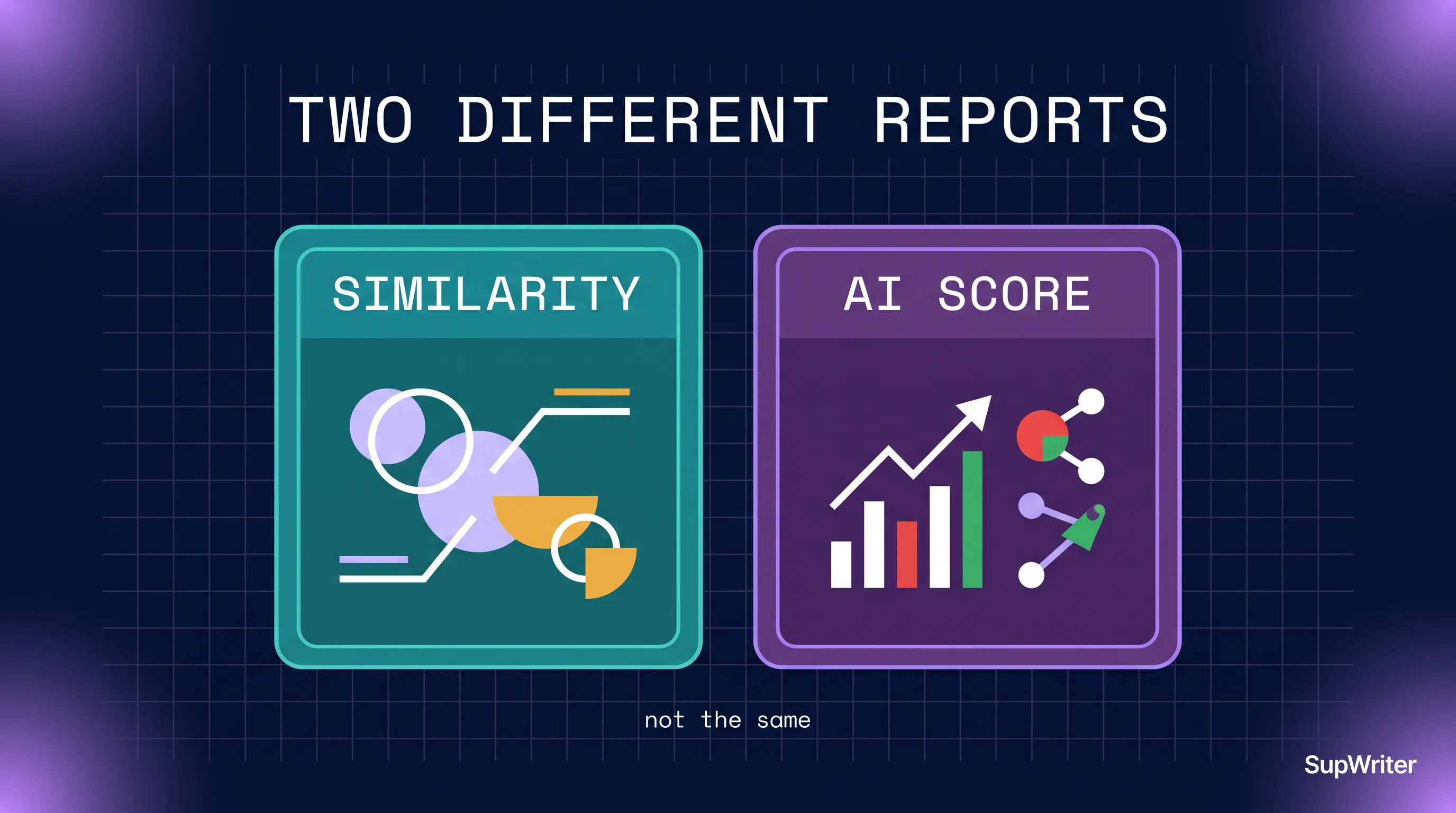
Turnitin's similarity score and Turnitin's AI writing score are two reports. They measure different things, use different databases, follow different display rules, and are shown to different people. Similarity is text matching: how much of your file overlaps with web pages, journals, and other student papers. The AI score is a statistical classification of qualifying prose — and as of 4 August 2026, one percentage that mixes AI-generated, AI-paraphrased, and bypasser-modified text. You can have 40% similarity and no AI indicator, or 2% similarity and a high AI indicator. Treating them as one "Turnitin percentage" is the most common way students and some staff misread the product.
If a classmate says they "got 18% on Turnitin," the useful follow-up is: which report? The rest of this piece is how to tell them apart, what each number can and cannot prove, and which 2026 updates touched only one of them.
Side by side
| Similarity (originality) | AI writing | |
|---|---|---|
| Job | Find overlapping text | Classify prose as machine-like |
| Method | Matching against Turnitin's corpora | Language-model detector (separate models per language) |
| Typical student visibility | Often yes, if the instructor enables it | Never. Instructor-only; staff can export PDF |
| Display quirks | Color bands and source list | *% for 1–19%; number from 20% up |
| What a high score can mean | Missing quotation marks, shared template, copied sources — or plagiarism | Model thinks qualifying sentences look generated, paraphrased, and/or (English) humanizer-processed |
| What a 0% proves | No substantial matches in the index | Almost nothing. Short files, lists, and tables may not be scored |
| Changed 4 Aug 2026? | No | Yes. Single blue highlight; purple paraphrase color retired |
| Minimum length | Works on short files, with less to match | 300-word English minimum for an AI score |
| Exclusions | Quoted material can still match unless filtered | Bullets, tables, code excluded; prose only |
The similarity engine is the older product, the one Turnitin was built on. The AI indicator shipped in 2023 and has been revised through 2026. They share a viewer chrome. That is why people merge them.
Deep dives on the AI side: Can Turnitin detect ChatGPT in 2026?, August 2026 AI update. Permissions: Can students see their Turnitin AI score?.
What the similarity score actually is
Similarity is overlap. Turnitin compares your submission to:
- Public web pages
- Licensed academic publications
- Its repository of previously submitted student papers (the setting that makes Southampton's 2026–27 exit over training-on-student-work a different controversy)
A 22% similarity report is a map of matching strings, not a judgment that 22% of the paper is "stolen." A methods section that repeats a standard protocol, a bibliography, a block quote, and a shared assignment prompt all raise similarity. Instructors can exclude quotes, bibliography, and small matches. The number you see depends on those filters.
Similarity is also the report students are most likely to see. Many LMS integrations have a "show report to students" checkbox. That checkbox does not unlock the AI layer.
High similarity and academic integrity can still coincide — uncited copying is a sourcing problem whether or not a detector thinks the prose was written by GPT-5. India's UGC PhD norms treat unacknowledged AI as plagiarism and recycle plagiarism-style bands (10–40% revise in six months; 40–60% barred a year; above 60% registration cancelled). Those bands are not documented as Turnitin AI-indicator cutoffs; they are similarity-style thresholds being applied to undisclosed AI. Cite: Times of India. Mixing "UGC 12% plagiarism" with "Turnitin 12% AI" is exactly the confusion this article exists to stop.
What the AI score actually is
The AI writing indicator does not search a database of ChatGPT outputs and highlight a match. It scores qualifying sentences for statistical patterns associated with machine text. Turnitin's English model was updated on 12 February 2026 to improve recall while maintaining low FPR. Spanish updated 5 May 2026 (trained on the GPT-5 family and Gemini 2.5). Arabic launched 18 August 2026 as its own model (academic leaders post; our explainer: Turnitin's Arabic AI Detection). Japanese is a separate language model as well.
In July 2026 (Turnitin gives the month, not the day), Turnitin says it "updated our model architecture to consolidate a multi-model ensemble into a single model," "maintaining a less than 1% false positive rate" (Turnitin AI detection FAQ).
4 August 2026 is the interpretation change. Turnitin simplified the report: one blue highlight instead of blue (generated) versus purple (paraphrased). One percentage now includes:
- AI-generated text
- AI-paraphrased text
- Bypasser-modified text
Bypasser / humanizer detection launched 27 August 2025 (Turnitin announcement), English-only — not in 2026. SEO pages that date it to August 2026 are off by a year. Feature write-up: Turnitin's bypasser detection. After 4 August that English-only layer no longer has its own color. It is inside the same number as raw generation.
Constraints that apply to the AI report and not to similarity:
- 300-word English minimum. A 180-word response can have a similarity score and no AI score.
- Prose only. Tables, bullets, and code are out of AI scoring and can still match for similarity.
*%for 1–19%. Similarity will happily show 7%. AI will not.- Instructor-only. Similarity can be student-visible.
- No retroactive rescore. A March similarity report can be re-opened with the same matches. A March AI report is frozen even if the February model or the August UI would have displayed it differently on a new upload.
Turnitin still publishes no official acceptable AI percentage. Institutions set policy. What percentage of AI is acceptable on Turnitin? is the policy piece; this one is the product distinction.
Four combinations people actually see
High similarity, low or no AI. Common in lab reports, law problem questions, and literature reviews that quote. The integrity question is citation, not ChatGPT. Fix quotes and references. Running the paper through a humanizer will not clear a match against a published article.
Low similarity, high AI. Common in "clean" LLM essays that do not copy a source. Nothing in the index matches, so similarity looks virtuous. The AI indicator is the report that moves. This is the pattern that makes "I only got 4% on Turnitin" a non sequitur when 4% was similarity.
High similarity, high AI. Possible when a student pastes a generated essay that itself contains stock phrases from the web, or when an LLM quotes badly. Two problems, two reports.
Low similarity, *% or low AI, instructor still unhappy. Detectors miss mixed drafts. Human readers notice voice shifts. ESL false positives also run the other way: human writing that looks machine-regular. Stanford's 61% average false-positive rate on human-written TOEFL essays is the citation we use (Liang et al., 2023); AI detection and ESL students and the false-positive crisis.
Consumer tools will not reconcile the two Turnitin numbers. GPTZero vs Turnitin, how to bypass GPTZero, and how to bypass Copyleaks are about other products. Why detectors disagree is the mechanism.
Which 2026 updates touched which report
| Date | Similarity? | AI writing? |
|---|---|---|
| 12 Feb 2026 English model | No | Yes |
| 5 May 2026 Spanish model | No | Yes |
| 12 May 2026 Google Classroom add-on | Workflow | Workflow |
| July 2026 ensemble → single model (day unpublished) | No | Yes |
| 16 Jul 2026 admin download of AI Writing Reports | No | Staff export |
| 4 Aug 2026 single blue AI highlight | No | Yes — display |
| 12 Aug 2026 Clarity timestamps | Clarity product | Clarity product |
| 18 Aug 2026 Arabic AI detection | No | New language model |
| 26 Aug 2026 Clarity mobile | Clarity product | Clarity product |
| 27 Aug 2025 bypasser detection | No | English AI layer |
Southampton dropping Turnitin entirely for 2026–27 is a vendor decision about both products, driven by training on student work — a similarity-corpus issue with integrity implications for the whole suite. Curtin (1 January 2026), WSU (February 2026), SUSS (11 August), and NTU (31 December 2026) are specifically about disabling AI detection, which can leave similarity running. Universities dropping AI detection.
UAE Cabinet Resolution 143 of 2026, effective 12 September 2026, is about AI-resilient assessment design, not a similarity cutoff. Malaysia: UM says detector output should not be conclusive; MOHE requires AI-use declaration (reaffirmed 22 July 2026, Bernama). Those rules attach to the AI integrity question, not to a 15% match against a textbook.
How to use both reports without mixing them
For students:
- If you can open a report and see a list of sources, you are in similarity. Edit citations. Do not "humanize" matched quotations.
- If you cannot see an AI percentage, that is expected. Check independently if you need a stylistic preview: SupWriter's detector gives one score from a single scoring model, and its twelve named labels are a guide derived from that score, not twelve separate checks. Still not Turnitin.
- Keep drafts. Hearings use process. Prove writing is human, including what to do after a professor's accusation. Newby v. Adelphi (28 January 2026) is the 100% AI flag that did not end the case.
For instructors:
- Do not paste one number into an email without naming the report.
- After 4 August, do not describe the AI view as cyan/purple. It is one blue layer covering three claims.
- A similarity hit with a URL is evidence of overlap. An AI percentage is a model score. UM's "not conclusive" language is the conservative version of that distinction.
- Filters on similarity (quotes, bibliography) do not exist as equivalent toggles on the AI blend.
Full disclosure: we build SupWriter. A humanizer is aimed at the AI-indicator problem, not at similarity. If a paragraph matches a published paper, rewriting the synonyms will not make the match honest, and it may not remove it. SupWriter has not published live bypass tests against Turnitin or any other detector (how we test), and nothing a humanizer does says anything about a 28% similarity report. Undetectable AI review, SupWriter vs Undetectable AI, best AI humanizers 2026.
Free humanizer: 300 words in total, one-time, with a free account and no card. List prices: Basic $9.99/month (5,000 words), Pro $19.99 (15,000), Ultra $39.99 (30,000); annual billing halves the monthly price.
If the assignment was drafted in Claude, GPT-5.6, or Gemini, the AI report is the one that might move. The similarity report moves if the model regurgitated a source.
Frequently Asked Questions
Can I have 0% similarity and still be flagged for AI?
Yes. Similarity finds matches. The AI indicator classifies style. A fully original LLM essay can be clean on similarity and high on AI.
Can I have 40% similarity and 0% AI?
Yes. Quoted statutes, shared lab templates, and bibliographies inflate similarity. They may not enter AI scoring at all (non-prose), or they may look like ordinary academic English.
Which score do students see?
Similarity, when the instructor allows it. Never the AI score. Details: Can students see their Turnitin AI score?.
Did the August 2026 update change similarity?
No. 4 August 2026 redesigned the AI report (single blue highlight, combined percentage). Similarity matching did not become an AI detector.
Is *% a similarity thing?
No. *% is the AI indicator's 1–19% display. Similarity shows integers in that range.
Does a humanizer lower similarity?
Not in any way you should rely on. A humanizer rewrites style. Similarity is string overlap with sources. If you copied, cite. If you are worried about the AI report, that is a different tool and a different policy.
If you need a stylistic check before an instructor opens the AI report, use our AI detector, a single-model pre-check rather than Turnitin — and remember a clean similarity bar is not the same product.
Related Articles

What SupWriter's AI Detector Actually Checks (vs Turnitin and Originality.ai)
How SupWriter's AI Detector Score Is Produced
How We Test AI Detectors: Method and Results So Far