By ShriprasannaPublished September 14, 2026Updated September 26, 2026
What Percentage of AI Is Acceptable on Turnitin? There's No Official Number — Here's What Universities Actually Do
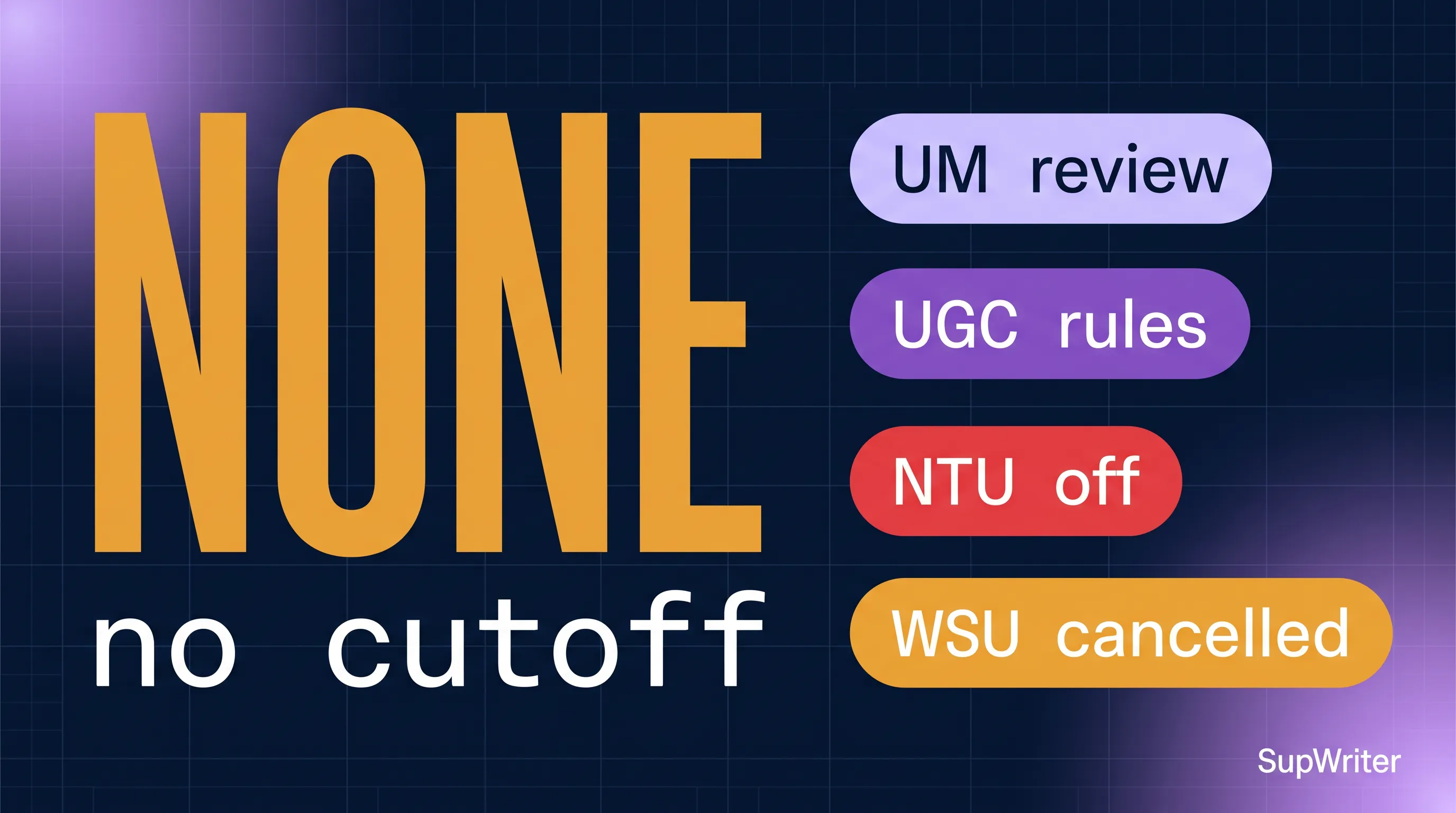
Turnitin does not publish an official acceptable AI percentage. There is no 10%, 15%, or 20% cutoff in Turnitin's product documentation that an instructor is required to treat as a fail. Institutions set policy. Scores between 1% and 19% do not even display as a number — they show as an asterisk (*%), which Turnitin says is there "to avoid potential incidence of false positives." A 0% is not a certificate of human authorship, and a high score is not a finding of misconduct. What actually happens after the report opens depends on the faculty, the country, and in a growing list of places, whether the university still uses the feature at all.
If you came here looking for a safe number to aim at, that is the answer. The rest of this piece is what universities and regulators have said in public, not a fake scale invented for SEO.
Turnitin's position: no official threshold
Turnitin's AI writing indicator is a model output, not a grade. The company has been consistent on the policy point even as the report UI has changed: its FAQ says the percentage "should not be used as the sole basis for action or a definitive grading measure by instructors" (Turnitin's AI detection FAQ). Schools, publishers, and individual instructors decide what, if anything, a given score triggers.
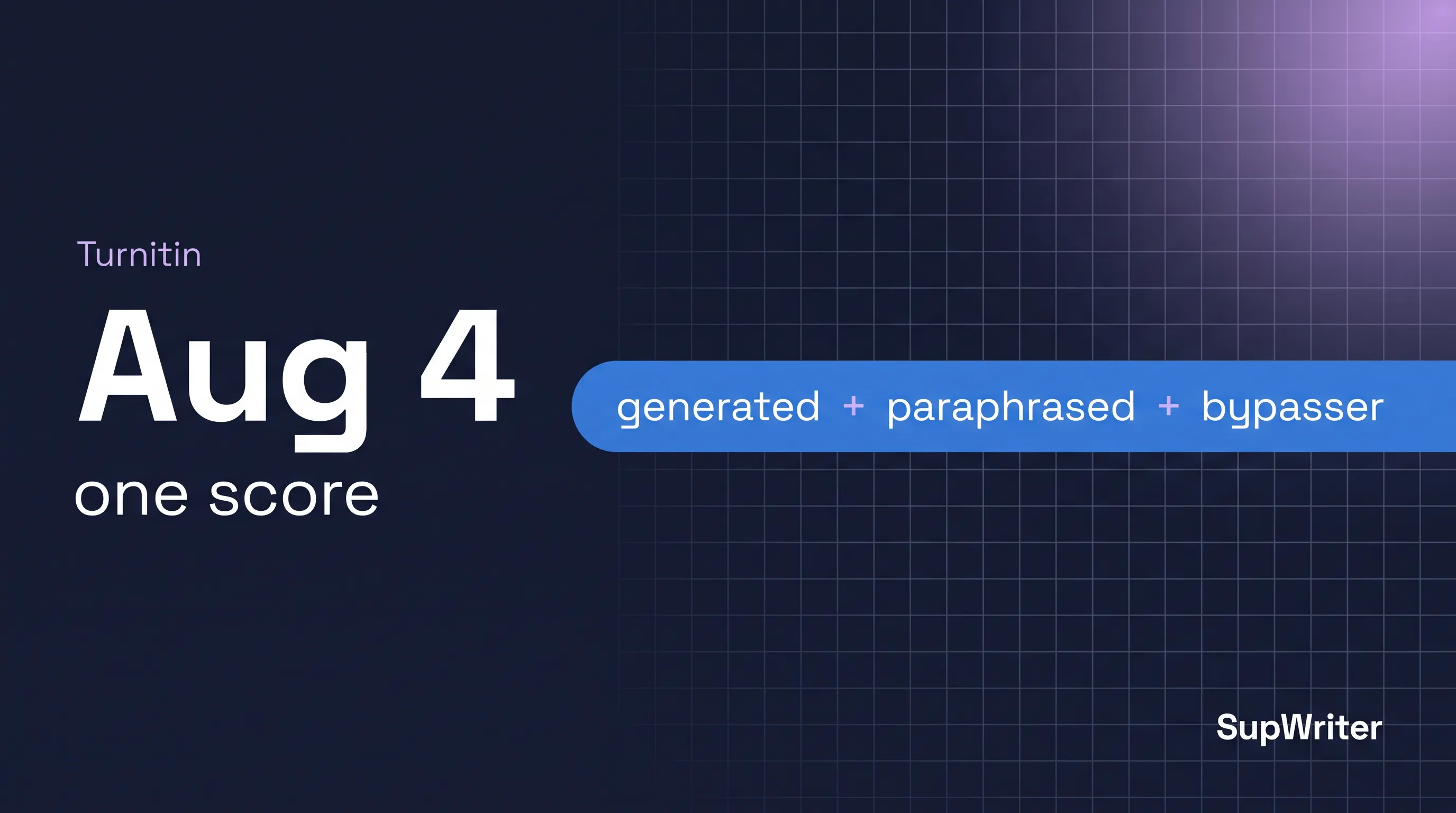
That is not the same as "Turnitin thinks 20% is fine." It is the opposite. Turnitin will not take the decision. The August 2026 report redesign makes the number even less suitable as a bright line, because one blue highlight and one percentage now cover "all likely AI-generated and AI-modified content" (Turnitin). A 35% after 4 August 2026 is not "35% ChatGPT." It is "35% of the qualifying prose looks, to this model, like some mix of generated, paraphrased, and/or humanizer-processed writing."
Two display rules still sit under that percentage:
*%means 1–19%. You will not see 11% or 17% in the current indicator. Turnitin collapses that range to an asterisk and attributes no highlights to it. Treat*%as "the model saw something and will not quantify it," not as a hall pass.- 20% and above show as a number. That is a display threshold, not a misconduct threshold. Nothing in Turnitin's materials says 20% is the point at which a student is in trouble.
The AI report is also instructor-only. Students typically cannot open it. If you are trying to reverse-engineer an acceptable percentage from the student view, you are looking at the wrong report — often the similarity score. See Can Students See Their Turnitin AI Score? and Turnitin Similarity Score vs AI Score.
Named policies, not invented bands
Blog posts love tidy tables: 0–5% ignore, 6–15% review, 25% investigate. Those bands are not Turnitin policy. They are someone else's guess. Below are policies and public decisions we can actually attach to a name. Where the percentage in a rule is a plagiarism similarity percentage being applied to AI use, that is flagged.
India: UGC PhD norms treat unacknowledged AI as plagiarism
India's University Grants Commission revised PhD norms so that unacknowledged AI use is treated as plagiarism. Reporting in the Times of India (9 June 2026) describes the same percentage bands UGC already uses for plagiarism similarity:
- 10–40%: returned for revision within six months
- 40–60%: barred from submitting the thesis for a year
- Above 60%: PhD registration may be cancelled
Read that carefully. These are UGC plagiarism-style thresholds being applied to unacknowledged AI use. They are not Turnitin AI-indicator bands, and the Times of India piece does not say that a 41% Turnitin AI score maps onto a one-year bar. A thesis can have a high similarity score from quoted literature and a low AI score, or the reverse. If you are a PhD candidate in India, the operative rules are disclosure and your university's plagiarism ordinance — not a number you saw on a humanizer landing page. For tool context aimed at Indian students, see best AI humanizer in India.
Malaysia: disclosure is mandatory
Malaysia's rule is about declaring AI use, not about a percentage. On 22 July 2026, Deputy Higher Education Minister Adam Adli Abdul Halim said students are required to declare their use of AI in academic assignments "to allow the level of usage to be identified and assessed," under the ministry's generative AI guidelines (Bernama).
Universities apply that locally. Universiti Malaya's policy says that where AI tools are permitted in assignments or assessments, students must "acknowledge and declare how the tool was used" (Universiti Malaya).
The practical stack in Malaysia is therefore: declare what you used, do not treat a Turnitin AI number as a verdict (Turnitin itself says not to), and read your own university's policy rather than assuming UM's wording applies to every Malaysian campus.
UAE: Cabinet Resolution 143 of 2026 (effective 12 September 2026)
UAE Cabinet Resolution No. 143 of 2026 took effect on 12 September 2026. It sets out violations, penalties and administrative measures for higher education institutions, including failures of academic integrity and examination security and assessment practices "deliberately designed to enable students to pass," with fines of up to Dh500,000 (Khaleej Times). It is a rule for institutions, not a "keep your Turnitin AI score under X" rule for students. The "AI-resilient assessment" idea attached to it came from the director of the Commission for Academic Accreditation, not from a numeric cap. Gulf students submitting Arabic will also be on Turnitin's Arabic detection, which launched 18 August 2026 and does not include the English-only bypasser layer. Details: Turnitin's Arabic AI Detection.
Universities that stopped using the score
A percentage cannot be "acceptable" if the institution has turned the indicator off.
| Institution | Date | What changed | Source |
|---|---|---|---|
| Vanderbilt University | 16 Aug 2023 | Disabled Turnitin's AI detector | Vanderbilt |
| University of Queensland | Mid-2025 | Disabled Turnitin's AI detection tool | UQ |
| University of Waterloo | Sept 2025 | Discontinued Turnitin's AI detection | Waterloo |
| Curtin University | 1 Jan 2026 | Disabled AI detection across all campuses | Curtin |
| Singapore University of Social Sciences (SUSS) | Announced Aug 2026 | Stopping use of AI detection tools | The Straits Times |
| Nanyang Technological University (NTU) | 31 Dec 2026 | Scheduled deactivation of its AI detector | CNA |
The longer list and the reasons — false positives, ESL risk, process rights — are in universities dropping AI detection. If your faculty handbook still says "Turnitin AI must be under 15%," that is a local rule, and it can exist on the same calendar as another research university abandoning the tool.
Why a universal cutoff would be a bad idea anyway
Even if Turnitin published a recommended threshold tomorrow, three documented problems would still make it a poor misconduct line.
The score is a blend. After 4 August 2026 you cannot see generated versus paraphrased versus humanizer-processed as separate claims. Two students with 40% can have done completely different things. One number cannot encode that.
False positives are not evenly distributed. Stanford researchers ran seven detectors over 91 TOEFL essays by non-native English speakers, and on average the detectors flagged 61% of them as AI-generated (Liang et al., 2023). Formulaic lab reports, non-native syntax, and highly structured IRAC memos all push statistical detectors toward "this looks like a machine." We keep that evidence in AI detection and ESL students and the false-positive crisis. A 30% on an ESL paper is not the same event as a 30% on a native-speaker creative essay.
Courts and hearings do not treat 100% as automatic proof. In Newby v. Adelphi, reported in February 2026, a court ordered Adelphi University to remove a plagiarism finding against a student whose essay Turnitin's detector had marked as fully AI-written; two other detectors had called the same essay human-written (Inside Higher Ed). That case is not a DIY legal strategy. It is evidence that institutions which treat a percentage as a verdict can end up defending it in court. If you have already been accused, how to prove your writing is human is the process piece.
Turnitin still claims a false positive rate under 1% for documents with more than 20% AI writing, and says its July 2026 move from a multi-model ensemble to a single model maintained that rate (Turnitin's FAQ). Detector accuracy as a category is messier; see Are AI detectors accurate in 2026? and why two detectors disagree.
What universities actually do when they still use the indicator
Where the feature is on, the pattern in faculty guidance is more consistent than the percentages:
- The AI indicator is a conversation starter, not a finding. Instructors are told to look at the highlighted passages, compare with the student's other work, and ask for drafts. The similarity report is a separate input: copied sources versus suspected machine prose.
- Disclosure beats a number. Malaysia's declaration rule is the clean version of something many syllabi already say: if you used ChatGPT, say so. An acknowledged outline is a different integrity question from a ghostwritten essay.
- Local cutoffs exist, and they are local. Some departments tell staff to look twice above a round number. Those memos are almost never Turnitin's. Ask for the written policy. If it does not exist, there is no official number at your school either.
- Process evidence matters more than the report. Version history, outlines, notes, and the ability to explain a citation will do more in a meeting than arguing that 19% would have displayed as
*%.
None of that gives you a target to game. If your goal is "land in the asterisk band," you are optimizing for a display quirk on a model that already refuses to quantify 1–19%.
What to do instead of hunting a percentage
Read the syllabus and the integrity page. If your school names a number, that number is the policy — with the UGC caveat above if you are under those PhD norms. If it does not, do not borrow one from a blog.
Keep drafts. Google Docs version history, dated outlines, and exported notes are what hearings actually use. Turnitin will not show you the AI score before you submit, and it will not rescore an old file when the model changes.
Check independently if you need a preview. Because students cannot see Turnitin's AI score, the only pre-submit check is a third-party detector. Our AI detector is one scoring model; the named detector labels it shows are a guide mapped from that one score, not separate checks. It is not Turnitin. A low score there is information, not a shield.
Do not confuse similarity with AI. A 28% similarity from a methods section that quotes a protocol is a sourcing problem. A 28% AI indicator is a statistical classification. They can both be on the same paper and mean different things.
If you use AI, follow the course rule. Allowed-with-citation, banned, or "brainstorming only" are three different assignments. Humanizing English text does not create an official Turnitin percentage that is "safe." Full disclosure: we build SupWriter. We have not published live bypass tests against Turnitin (how we test), and no humanizer, ours included, can hand you an "acceptable %" on Turnitin.
The free humanizer is 300 lifetime words and no card. Paid plans: Basic $9.99/month (5,000 words), Pro $19.99 (15,000), Ultra $39.99 (30,000); annual roughly half, on /pricing. None of those budgets is a Turnitin setting. Companion reads: Can Turnitin detect ChatGPT in 2026?, best AI humanizer for students 2026.
Frequently Asked Questions
Is 20% AI acceptable on Turnitin?
Turnitin does not say so. 20% is simply the point at which the indicator starts showing a number instead of *%. Whether 20% matters is entirely your institution's policy. Some universities have disabled the indicator; others have no published cutoff at all.
What does *% mean on a Turnitin AI report?
It means the model assigned the qualifying prose a score in the 1–19% range and Turnitin will not display the integer. It is not an official safe zone. Students usually cannot see it anyway; the AI report is instructor-only.
Does Turnitin have a different acceptable % for paraphrasing or humanizers?
Not as a published policy. As of 4 August 2026, generated, paraphrased, and bypasser-modified text share one percentage. There is no separate "humanizer allowance." Bypasser detection itself launched 27 August 2025 and is English-only.
Do India's UGC 10% / 40% / 60% bands apply to my Turnitin AI score?
Not on the evidence we have. Those bands are UGC plagiarism-style thresholds being applied to unacknowledged AI use in PhD work, as reported by the Times of India. They are not documented as Turnitin AI-indicator cutoffs.
If my university dropped AI detection, can I ignore the percentage?
If the indicator is disabled, instructors on that campus should not be using it as evidence. Confirm the current policy; NTU's deactivation is dated 31 December 2026, not retroactive to the start of the year. Similarity checking can still be on.
What if I was flagged at 100%?
A 100% indicator is still a model output. In Newby v. Adelphi, a student whose essay Turnitin had marked as fully AI-written won in court (reported February 2026). Keep drafts, ask for the written policy, and do not treat the screenshot as the hearing. Start with prove your writing is human.
Turnitin will not show you the AI percentage before you submit — pre-check the text yourself with an AI detector rather than guessing at a cutoff that Turnitin has never published.
Related Articles

What SupWriter's AI Detector Actually Checks (vs Turnitin and Originality.ai)
How SupWriter's AI Detector Score Is Produced
How We Test AI Detectors: Method and Results So Far