By ShriprasannaPublished July 30, 2026Updated September 26, 2026
How to Bypass GPTZero: Step-by-Step Guide + Tools (2026)
GPTZero is the detector most people meet first. It is free to start, it is the one professors bookmark, and it is the one that turns a finished draft into a problem at 11pm on a Sunday. If your text came back highlighted and you are trying to work out what to do next, this guide is the honest version: what GPTZero actually measures, which fixes change the text in ways it can see, which ones waste your evening, and what the tools actually offer. Check your school's AI policy first; many allow AI for brainstorming but not for final text.
One note on sources before we start. The product facts below come from each vendor's own pages, checked in September 2026. We have not run a GPTZero bypass benchmark, and we do not quote anyone's pass rate as if it were our own result (how we test).
How GPTZero Actually Decides Your Text Is AI
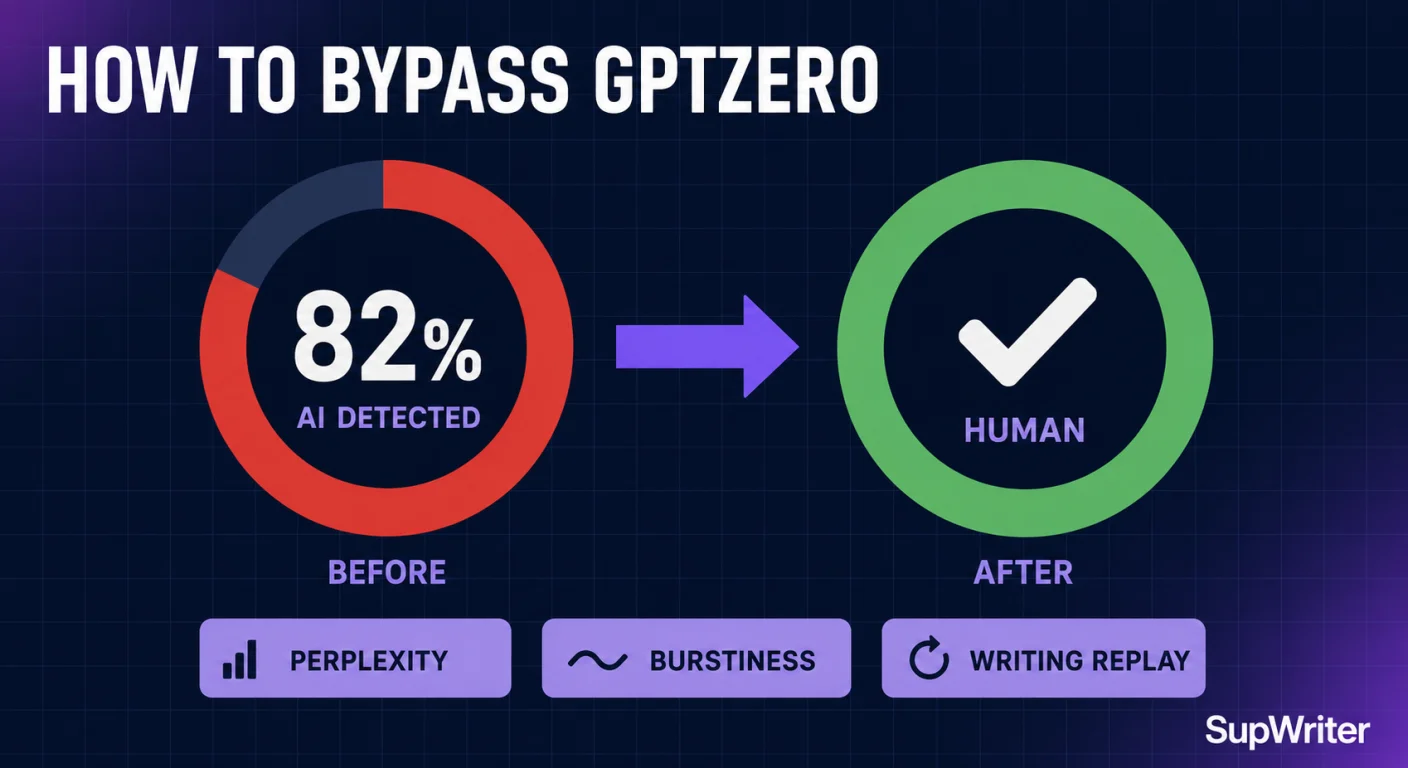
You cannot work with a scoring system you do not understand, so start here. GPTZero built its reputation on two measurements, and although the company now describes its model as multilayered, those two are still the load-bearing walls.
Perplexity: how predictable your words are
Perplexity measures how surprising each word is given the words before it. Language models pick statistically likely next tokens by design, so their output sits at consistently low perplexity. Human writing wanders. We reach for the odd metaphor, drop in a specific detail nobody could have predicted, and occasionally write a clumsy sentence because it lands better.
The detail that trips people up: GPTZero is not only checking whether your perplexity is low. It is checking whether it is uniformly low across the whole document. Our deep dive on what AI detectors look for walks through why a flat perplexity curve is a stronger signal than any single predictable sentence.
Burstiness: the rhythm of your sentences
Burstiness measures variation, mostly in sentence length. Skilled human writers swing between a 40-word sentence and a 3-word one. Models settle into a comfortable middle band and stay there. Four sentences of 12, 12, 13 and 11 words in a row is a fingerprint.
Sentence-level highlighting
This is the part that makes GPTZero harder to game than a single overall score. It color-codes the passages it thinks are AI, so you cannot hide three AI paragraphs inside a mostly human essay and let the average rescue you. GPTZero will point at the exact sentences.
What GPTZero looks like in 2026
The current product is broader than the 2023 version that made it famous:
| Capability | What it does |
|---|---|
| Free tier | Free scans; texts over 10,000 characters need a free account |
| Paid individual plans | Premium at $12.99/month for 300,000 words and Professional at $24.99/month for 500,000 words, both billed annually |
| Sentence-level highlighting | Color-coded highlights on the passages it scores as AI |
| Mixed documents | Says it can detect documents that combine human and AI writing |
| Plagiarism, feedback and integrations | Plagiarism checker, writing feedback, Canvas and Google Classroom integrations, and an API |
| Authorship and Writing Replay | Records typing and editing history in Google Docs through its Chrome extension |
Source: GPTZero and its pricing page, checked September 2026 (a back-to-school discount code was running at the time).
That last row matters more than anything else in this article, and we come back to it at the end. Text-level techniques address text-level analysis. They do nothing about a recording of how the document was written.
GPTZero is also candid about its limits. Its own site says no AI detector is 100% accurate, that results "should not be used to punish or as the final verdict," and that accuracy is strongest on longer English prose (GPTZero). For a fuller comparison against the other detector students actually face, see our GPTZero vs Turnitin breakdown.
Why the Obvious Tricks Fail
Before the techniques that help, here is where most people burn two hours.
Synonym swapping. Replacing "important" with "crucial" and "however" with "nevertheless" changes the surface and leaves the structure intact. Perplexity barely moves, because the substitute word is usually the model's second-most-likely token anyway. Burstiness does not move at all, because sentence lengths are identical. Expect little change for a lot of effort.
Paraphrasing tools. This is the big one. QuillBot is the tool most often recommended for this job, and it is a good paraphraser, but paraphrasers rewrite sentences one at a time and leave most of the document-level pattern in place. Detector makers also target this route directly: Turnitin, for example, says it looks for AI text modified by AI paraphrasers and "bypasser" tools in English submissions (Turnitin's AI detection FAQ). Our QuillBot humanizer review goes into more detail. Paraphrasers are good tools built for a different problem.
Invisible characters and unicode tricks. Homoglyph substitution and zero-width characters had a moment as a trick. They are easy to detect, and getting caught using them is considerably worse than getting flagged in the first place. Skip it.
Asking the model to "write like a human." Prompting for casual tone changes the vocabulary register while preserving the underlying token distribution. It changes how the text sounds more than how it scores.
Step-by-Step: The Manual Techniques That Actually Move the Number
These change the text in the ways GPTZero measures. They take time, so read the summary table before you commit an afternoon to them.
Step 1: Scan first and read the highlights, not the score. Run your draft through GPTZero or SupWriter's AI detector and look at which sentences are flagged. You will often find that a minority of sentences are carrying most of the score. Those are your targets. Rewriting everything is wasted effort.
Step 2: Break the sentence-length pattern deliberately. Go through the flagged paragraphs and count words per sentence. If you see four sentences within three words of each other, split one and merge two others. Add a fragment. Let one sentence run long enough to feel slightly indulgent. You are engineering burstiness on purpose, which feels artificial while you do it and reads naturally afterward.
Step 3: Add something only you could have written. A specific number from your own work, a conversation you actually had, an opinion you would defend. This is the edit that tends to hold up best, because it introduces genuinely unpredictable word sequences instead of rearranging predictable ones. A model can write about remote work productivity. It cannot write about the Tuesday your team's standup ran 50 minutes because nobody would admit the sprint had slipped.
Step 4: Cut the connective scaffolding. Models lean hard on "It is important to note that," "Furthermore," "In today's rapidly evolving landscape," and "This underscores the importance of." Readers notice these, and so do detectors. Delete them. Most sentences work better without the runway.
Step 5: Read it aloud and fix what you stumble on. Anywhere your voice flattens out is usually a low-perplexity stretch. This is the crudest test in the article and one of the more reliable ones.
Here is what each technique targets:
| Technique | What it targets | Why it helps (or doesn't) |
|---|---|---|
| Synonym swapping | Vocabulary | Leaves sentence structure and rhythm untouched |
| Sentence restructuring for burstiness | Sentence-length variation | Breaks the uniform rhythm detectors look for |
| Adding personal specifics | Predictability | Adds details a model could not have predicted |
| Cutting AI vocabulary and scaffolding | Stock phrases | Removes phrases readers and detectors associate with models |
| All of the above, combined | The whole document | The combination is what changes a document's overall profile |
There is no published pass mark to aim for. GPTZero returns a probability and leaves the threshold to whoever is reading it, and because it flags sentence by sentence, the practical target is a document where nothing important stays highlighted. Even then, remember GPTZero's own warning that a result should not be the final verdict, and that a teacher reading your work has other evidence too.
Manual editing is slow, which is the main reason humanizers exist. The same editing logic applies to other detectors; see our Originality.ai guide.
Before and After: One Flagged Paragraph
Here is a typical AI-written paragraph of the kind GPTZero flags:
Effective time management is essential for academic success. Students who develop strong organizational habits are better positioned to handle competing deadlines and maintain consistent performance across multiple courses. Research consistently demonstrates that structured scheduling reduces stress levels and improves retention of course material. By implementing these strategies, students can significantly enhance their overall academic outcomes.
Sentence lengths: 8, 20, 15, 12. Uniform structure, zero specifics, four flat declaratives in a row with no fragment, question or aside to break the rhythm. Nothing here would surprise a language model.
Here is the same paragraph after a rewrite:
Time management gets recommended so often it has stopped meaning anything. Here is the version that actually helped me: I stopped keeping a to-do list and started blocking hours in a calendar, because a list lets you lie to yourself about how long things take and a calendar does not. Three courses, four deadlines, one weekend — the calendar makes the collision visible before it happens. The research on structured scheduling backs this up, though what the studies measure is stress reduction, which is a slightly different claim than better grades. Both matter. Only one of them shows up on a transcript.
Sentence lengths: 11, 39, 15, 25, 2, 9. The meaning survived, the claim got more precise rather than less, and the rhythm now varies the way a person's does. That variation is burstiness, and the specific detail about calendars versus lists is perplexity. One caution: the specifics have to be true. A tool can vary rhythm, but only you can supply the real detail.
The Tools: What They Offer
We have not benchmarked these tools against GPTZero, and vendor pass rates are not independent results, so this section sticks to what you can check: price, free allowance and what each tool is built to do (vendor pages, checked September 2026). We have left out tools whose current pricing we could not confirm.
| Tool | Price | Free way to try | Notes |
|---|---|---|---|
| SupWriter | $9.99/mo for 5,000 words (list price; Pro is $19.99 for 15,000) | 300 words, no credit card (sign-in required) | Built-in AI detector as a single-model pre-check |
| Undetectable AI | $9.99/mo for 10,000 words, or $5/mo billed annually | 250-word trial | Money-back guarantee "if output flagged is not human" (check the conditions) |
| Phrasly | $19.99/mo, or $10.99/mo billed annually; unlimited humanizations | $2 three-day trial | 5,000 words per process |
| QuillBot | $8.33/mo billed annually (QuillBot labels it 58% off; its Premium page doesn't show the month-to-month price) | Humanizer and paraphraser up to 125 words | A paraphraser first; humanizer included in Premium |
1. SupWriter
SupWriter rewrites AI-assisted drafts so they read naturally, reshaping sentence rhythm and phrasing rather than swapping words one for one. Before you submit, check the result with the built-in AI detector. It is a pre-check based on one scoring model, not GPTZero itself, and results vary by detector, text length and topic; no tool can guarantee a result. You can test it on 300 words through the free humanizer, no credit card required, before deciding whether it suits your writing.
2. Undetectable AI
Entry pricing is $9.99 per month billed monthly for 10,000 words, or $5 a month on annual billing, and the free trial is 250 words in total (Undetectable AI pricing): enough to see the interface, not enough to judge it on a real assignment. Its money-back guarantee applies "if output flagged is not human," so read the conditions before counting on it. Our Undetectable AI review has more.
3. Phrasly
Phrasly is now a flat-rate plan: $19.99 a month, or $10.99 billed annually, for unlimited humanizations with a 5,000-word cap per run (Phrasly pricing). Its $2 three-day trial says it continues at "$19.99 per month, billed annually", so confirm the renewal price before you start. Details in our Phrasly pricing breakdown.
4. QuillBot
QuillBot is a paraphraser first, with a humanizer included in Premium at $8.33 a month billed annually (QuillBot labels it 58% off; its Premium page doesn't show the month-to-month price); the free versions cap input at 125 words (QuillBot Premium). Paraphrased AI text is exactly what Turnitin says it screens for in English, and paraphrasing does little for the document-level rhythm GPTZero scores. Our QuillBot humanizer review goes deeper.
The One Thing No Tool Beats
Here is the part most bypass guides leave out, and it is the most important thing in this article.
GPTZero's Writing Replay and authorship reporting do not analyze your text at all. They look at the process: typing patterns, paste events, editing history, and a replayable timeline of how the document was written. If your institution or client has that enabled inside Google Docs, a document that appears fully formed in a single paste is going to look exactly like what it is, and no amount of statistical humanization changes that.
The practical response is not a better tool. It is to actually work in the document: draft, revise, cut, rewrite, and leave a trail. If your course allows AI help, say how you used it; then the process record works for you instead of against you.
What This Means in Practice
GPTZero has a real weakness and one genuinely strong feature. The weakness is that it scores statistical properties of text, and those can be changed. The strength is Writing Replay, where text-level techniques simply do not apply.
If your problem is a text-level score, the path is short: draft with whatever model your course allows, run it through a purpose-built humanizer, pre-check it with our AI detector (one scoring model, not GPTZero), and read the output before you submit it. Manual editing works too; it just takes much longer. No tool, ours included, can guarantee what GPTZero will say.
And if you are here because your own writing got falsely flagged, that happens, and disproportionately to non-native English writers: in one Stanford study, seven detectors flagged more than half of 91 human-written TOEFL essays as AI (Liang et al. 2023). GPTZero says it has since trained its model to cut ESL false positives to 1% by its own figures. Either way, you are not bypassing anything. You are correcting a bad measurement. Same solution, different problem, and detector accuracy is a genuinely unsettled question rather than a solved one.
Want a faster rewrite than doing it all by hand? Humanize your first 300 words free, no credit card required.
Related Articles

What SupWriter's AI Detector Actually Checks (vs Turnitin and Originality.ai)
How SupWriter's AI Detector Score Is Produced
How We Test AI Detectors: Method and Results So Far