By ShriprasannaPublished September 14, 2026Updated September 26, 2026
How to Humanize GPT-6 Astra Text So It Reads Like You (2026)
OpenAI released GPT-6 Astra on 3 September 2026. It is one flagship, not another Luna/Terra/Sol trio. The Verge reported it going first to cybersecurity customers, then to Plus, Pro, Business and Enterprise users within days, and to developers through the API and AWS. OpenAI is selling a jump in agentic work and polished documents. The sentences still sound like ChatGPT. Detectors grade predictability and a house voice, not launch hype. Astra is new; the dialect is not. This guide covers why Astra still gets flagged and how to humanize it. We do not have an Astra bypass percentage. Nobody honest does, this soon after launch.
One flagship, same GPT fingerprint
The Verge's 3 September write-up is the launch piece to cite. GPT-5.6, on 9 July 2026, made the lineup feel like a knob: Luna, Terra, Sol, smallest to largest. We already wrote the punchline in the GPT-5.6 humanizer guide: three sizes, one voice. Astra collapses the branding back to a single name and does not fix the voice problem.
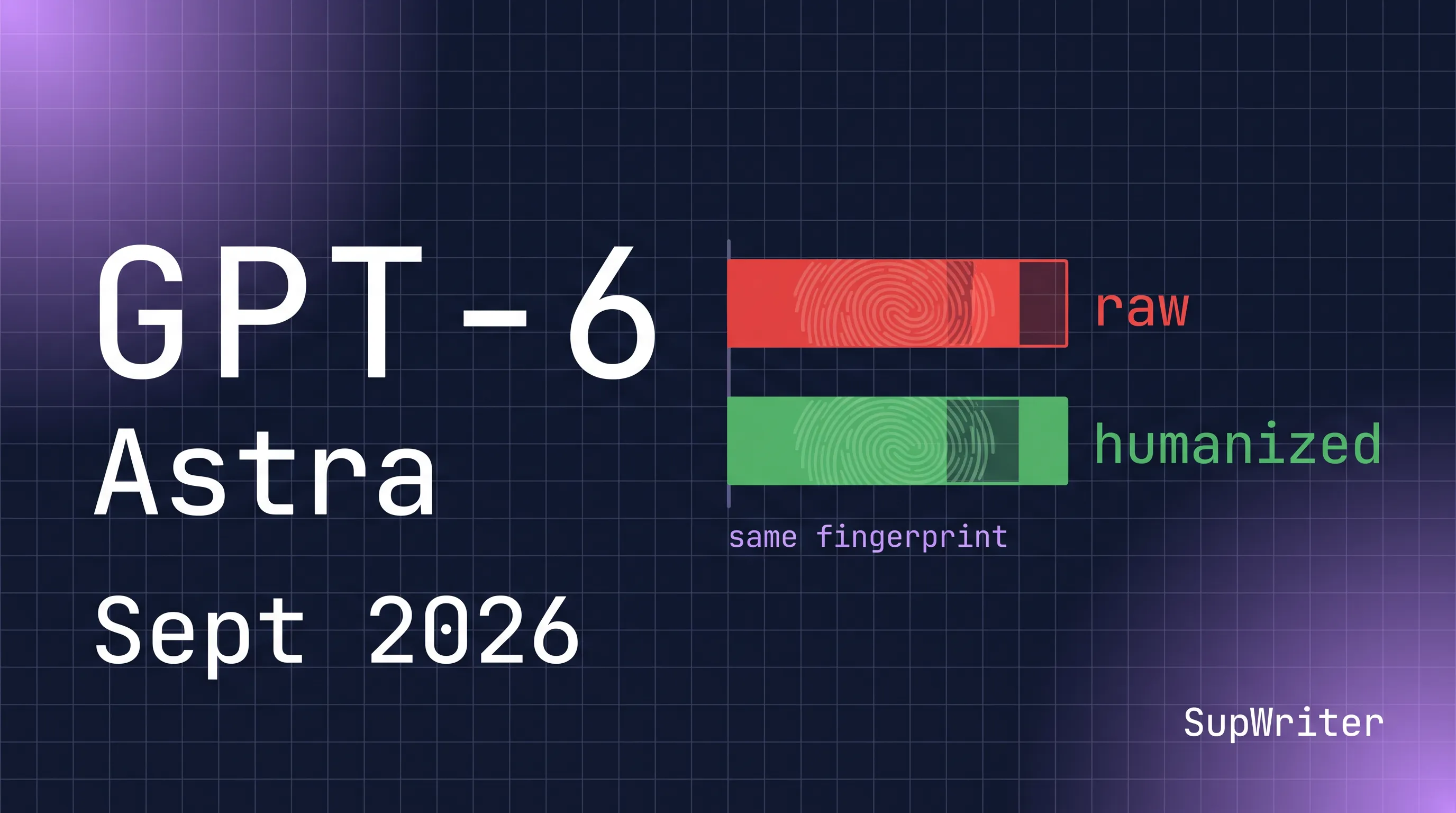
For a human editor, Astra may be sharper on a messy brief, a spreadsheet, or a multi-step agent run. For a detector, it is still next-token prose from the same lab, post-trained on the same family recipe. The habits GPT-5 made famous — tidy tricolons, the not-X-but-Y pivot, Latinate pile-ups, wrap-up paragraphs that restate the thesis — are family traits. A new checkpoint does not burn them down.
If anything, the marketing makes the detection problem easier. OpenAI is pitching Astra on polished documents, spreadsheets, presentations, and working websites. Polish is the tell. Classifiers like Originality, Turnitin, GPTZero, and Copyleaks are tuned on text that is evenly fluent, evenly structured, and allergic to a wrong word that a tired human would leave in. The most capable GPT has always been easy to catch for that reason. Fable 5 taught the same lesson on Anthropic's side: the best model is often the most detectable.
Astra is also not a stealth model in the watermark sense. OpenAI has not announced a text watermark for Astra, and The Verge's launch coverage does not mention one. Claude's watermark question is a different article (Does Claude watermark text?). Do not mix a missing watermark with "detectors cannot see this." Watermark and classifier are different tools.
And if a thread tells you Astra is "as undetectable as" some other new model, check whether that model, and that comparison, actually exist.
The agent flood is the detection problem
The Verge piece, quoting OpenAI, stresses Astra's agentic loop: multistep tasks, working websites, polished documents, spreadsheets and presentations, and stronger software engineering on real codebases. That is the product. It is also more finished text per hour, with less babysitting per paragraph.
We already watched this movie with Sol's ultra mode and with Claude's agent harness. When you chat one message at a time, you at least skim. When an agent returns a report, an appendix, a summary, and the follow-up email in one run, most of that stack ships with the same cadence. Volume up, human edits down, fingerprint constant.
At that scale, humanizing cannot be a Sunday-night paste into a paraphraser. It has to sit after generation, before anything leaves the folder. If you are driving models from ChatGPT itself, the MCP humanizer-in-chat path is the version of that idea that does not involve a second window. The Chrome extension is the page-level version. Neither is an Astra-only trick. They are how you stop raw agent output from becoming the thing you submitted.
Code is a partial exception: syntax has fewer free choices. Comments, READMEs, design docs, and the English in a PR description are not an exception. Those are the passages detectors actually see.
What detectors can and cannot say about Astra yet
There is no independent, published detection study on GPT-6 Astra as of mid-September 2026. We are not going to invent one. We will not quote an "Astra vs Turnitin" percentage, and we will not backfill GPT-6 into a 2025 table. We have not published live bypass tests of our own on any model, Astra included (how we test).
What we can say without making up a test:
- Family prior. No lab has contributed more detector training data than OpenAI. A new GPT that still writes in-distribution is not a cold start. Detectors also generalize to launches they have not seen: Originality.ai reported that its detectors flagged 95% to 97.8% of 1,000 Claude Fable 5 articles despite not being trained on Fable 5 data (Originality.ai). That is a vendor testing its own tool, but the GPT family is an even easier generalization target than a surprise launch from another lab.
- Vendors keep retraining. Turnitin's release notes list an English model update on 12 February 2026 "to improve recall while maintaining a low false positive rate" (Turnitin), and other detectors ship updates too. None of that is an Astra result. Do read it as "classifiers are still being pointed at the current frontier, including the GPT voice Astra is extending."
- Turnitin and Copyleaks do not need a blog post titled "we now detect GPT-6" to score smooth GPT prose. A detector that has not announced Astra coverage is not a free pass.
- A knowledge cutoff is a hallucination risk, not a stealth feature. If an Astra draft cites a very recent paper, check that it exists and says what the draft claims. A fabricated citation is a factual miss, and it will not hide you from GPTZero.
If you want the honest detector landscape rather than a model-by-model myth, use are AI detectors accurate in 2026 and does Turnitin detect AI writing. Then score your text. A blog's reputation is not a report.
Killing the Astra / GPT voice
The instinct is a paraphraser. Don't. Synonym-swapping barely moves the predictability and burstiness scores that actually flag you, and on prose this clean it is close to useless. What works is a pattern-level rewrite: put human unevenness back without touching the claims.
Do this once by hand on a short passage so you can see the tells:
- Break the list of three. If the sentence is "reduce costs, accelerate delivery, and maintain quality," pick a fight with one of those verbs or drop it.
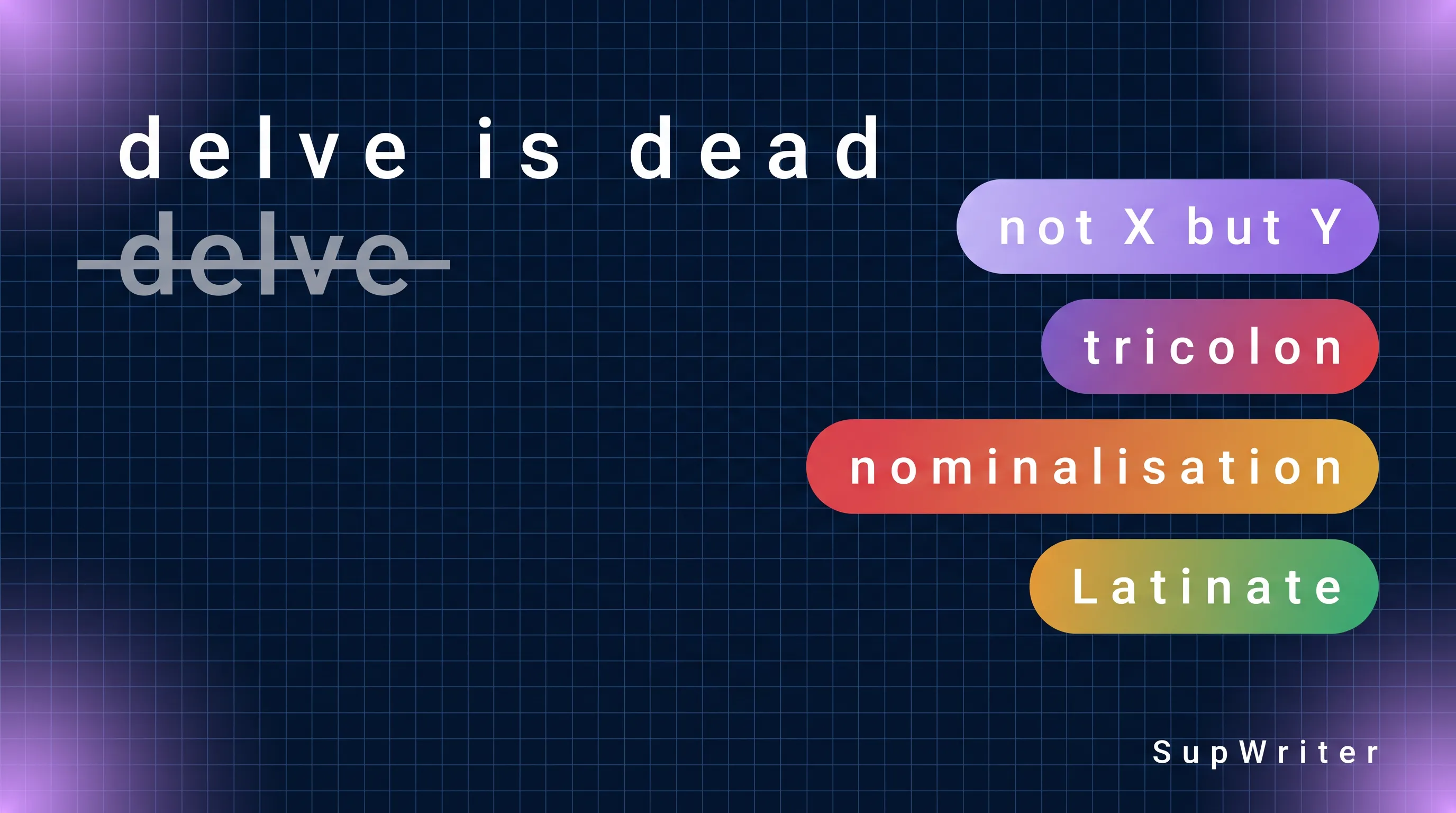
- Take a side. "It's not just X — it's Y" is still a machine hinge, and so are Latinate pile-ups, nominalisations, and tidy tricolons. Single words matter less than they used to; "delve" on its own proves nothing. And don't strip every dash on reflex: humans use them too, and punctuation alone will not change the rhythm. See AI words to avoid in 2026.
- Cut the robotic opener and the recap ending.
- Put in a number you actually have, an objection you actually believe, a limitation from your notes. Specificity is expensive to fake.
That does not scale to an agent dump. SupWriter's humanizer is the pattern-level version of the same edit. Disclosure: we build it. Feel the shift on 300 lifetime words through the free humanizer (no card). Paid tiers are Basic $9.99, Pro $19.99 and Ultra $39.99 a month. Those prices are not an Astra guarantee, and no tool can promise how a detector will score your text. After the rewrite, add the one thing the model cannot steal from you — the measurement from your lab, the client constraint, the sentence you would say out loud in a viva.
Humanizing is editing. If a class or client bans AI assistance, the ban still applies. If the policy allows a draft, you still need to survive the non-detector channels: Docs history, Clarity paste events, Grammarly Authorship, a conversation. A rewrite does not un-paste 2,000 words at 11:58 p.m.
Before and after (illustrative example)
This pair is an example of the voice shift, not a screenshot from an Astra detector run. We have not published Astra scores. Do not treat the second paragraph as "measured 0% on Turnitin."
Example — GPT-6 Astra-style raw: "Deploying an agentic workflow isn't just an efficiency gain — it's a structural advantage. By delegating multistep tasks, teams can reduce coordination costs, accelerate delivery timelines, and maintain a consistently high standard of quality across documents, code, and client communication."
Example — humanized: "We let the agent draft the first packet and our calendar actually opened up. The surprise wasn't speed. It was how many 'strategy' docs were just the same three paragraphs in a nicer font. We still write the recommendation by hand. The model can assemble the appendix."
Same claim: agents take grunt work, people keep the call. The rewrite drops not-just-X, drops the tricolon, and commits to an opinion a manager could disagree with. That is the texture a classifier is starved of — and the texture Astra's "polished document" mode sands off.
For other house styles in the same family, the GPT-5 and GPT-5.6 Sol/Terra/Luna guides are the same edit with older wrappers. Copilot is the Microsoft-flavored cousin. Gemini is a different lab and a different tell stack, including Google's SynthID text watermark.
Check it before it ships
Do not trust a model's launch blog, and do not trust a humanizer's landing page — ours included. Detectors disagree and they patch. Run the exact text you will submit through an AI detector. SupWriter's gives you one score plus sentence highlights; it is a pre-check from one scoring model, not a poll of Turnitin and GPTZero, so treat it as a guide. Anything still highlighted gets another pass on that span, not a blind re-roll of the whole file.
Remember the rest of the room. Canvas is not a detector; Copyleaks or Turnitin might be. Google Classroom is a dropbox unless your school has added Turnitin's add-on. Version history still looks like version history after you humanize. If you need to prove the writing is human, keep drafts.
FAQ
Is GPT-6 Astra undetectable because it's new? No. Newness is not stealth. There is no public Astra detection study yet, and a missing study is not a pass. The GPT house voice is the most-studied target in this category.
Does picking Astra over Sol or Luna help? Not for detection. Luna/Terra/Sol already shared a fingerprint. Astra is a newer flagship in the same family. Bigger and cleaner usually reads more machine, not less.
Do you have Turnitin percentages for Astra? No. We will not invent them, and we have not published live Turnitin tests for any model. Score your draft.
Does OpenAI watermark Astra text? OpenAI has not announced a text watermark for Astra, and the launch coverage does not mention one. Classifiers are the practical check.
Will humanizing wreck technical accuracy? A real humanizer should keep meaning, numbers, and structure and change rhythm. Check terms of art after any rewrite. The cheap paraphraser is what mangles quality. And humanizing will not fix a citation the model got wrong in the first place.
Is this against OpenAI's terms? Editing your own generated text to read naturally is editing. Follow the rules of the place you are submitting. A banned-AI classroom is a policy problem, not a detector problem.
Astra writes a finished-looking draft. Detectors still read GPT. Check the real text with the AI detector, then give it a human cadence — 300 words on the free humanizer, no card. We do not have Astra bypass percentages to sell you, and we are not going to make them up.
Related Articles

Is Using an AI Humanizer Cheating? When to Disclose AI Assistance
What Is an AI Humanizer (and What It Is Not)
AI Words to Avoid in 2026: "Delve" Is Dead — Here's What Detectors Flag Now