By ShriprasannaPublished September 22, 2026
What Is an AI Humanizer (and What It Is Not)
An AI humanizer rewrites an existing AI-generated draft so it reads like a person wrote it. It keeps your meaning, facts, and argument. It changes the statistical patterns — sentence rhythm, word predictability, uniform paragraph blocks — that AI detectors measure. It does not write a new essay from a prompt, and it does not merely swap synonyms.
That definition is the whole product category. Everything below is contrast: what a paraphraser does, what a generator does, and when you actually need a humanizer.
If you already have a draft and you want it to sound human, use the AI humanizer. If you only need different wording, use the paraphraser. If you need a blank page filled, you need a generator — which SupWriter is not.
Humanizer vs paraphraser vs generator
| AI humanizer | Paraphraser | Generator | |
|---|---|---|---|
| Input | Your existing draft | Your existing draft | A prompt |
| Job | Rewrite so the draft reads as human writing | Restate with different words | Produce new text |
| What changes | Rhythm, predictability, sentence-length mix, voice | Vocabulary and sometimes clause order | Everything — it invents content |
| What stays | Meaning, claims, citations, structure of the argument | Meaning, if it is a good paraphraser | Nothing you already wrote |
| Typical use | ChatGPT/Claude output you want to keep | Avoiding repetitive phrasing; citation restatement | Starting from zero |
| Detector-facing | Built to change the patterns detectors score | Usually leaves those patterns intact | Creates the patterns detectors score |
| SupWriter tool | AI humanizer | AI paraphraser | Not offered |
A paraphraser and a humanizer both take a draft in. The difference is the rewrite target. A paraphraser optimizes for wording variety. A humanizer optimizes for how the writing is distributed — the burstiness and perplexity profile that makes human prose uneven and AI prose smooth. We walk through the detector side of that gap in how AI detection works.
A generator does a different job entirely. Tools like ChatGPT, Claude, or StealthGPT's writer produce text you did not already have. That is useful when you have nothing. It is the wrong tool when you already have a chapter, a client brief, or a paper with citations you need intact. Our StealthGPT vs SupWriter landing is the product-level version of that split.
What an AI humanizer is not
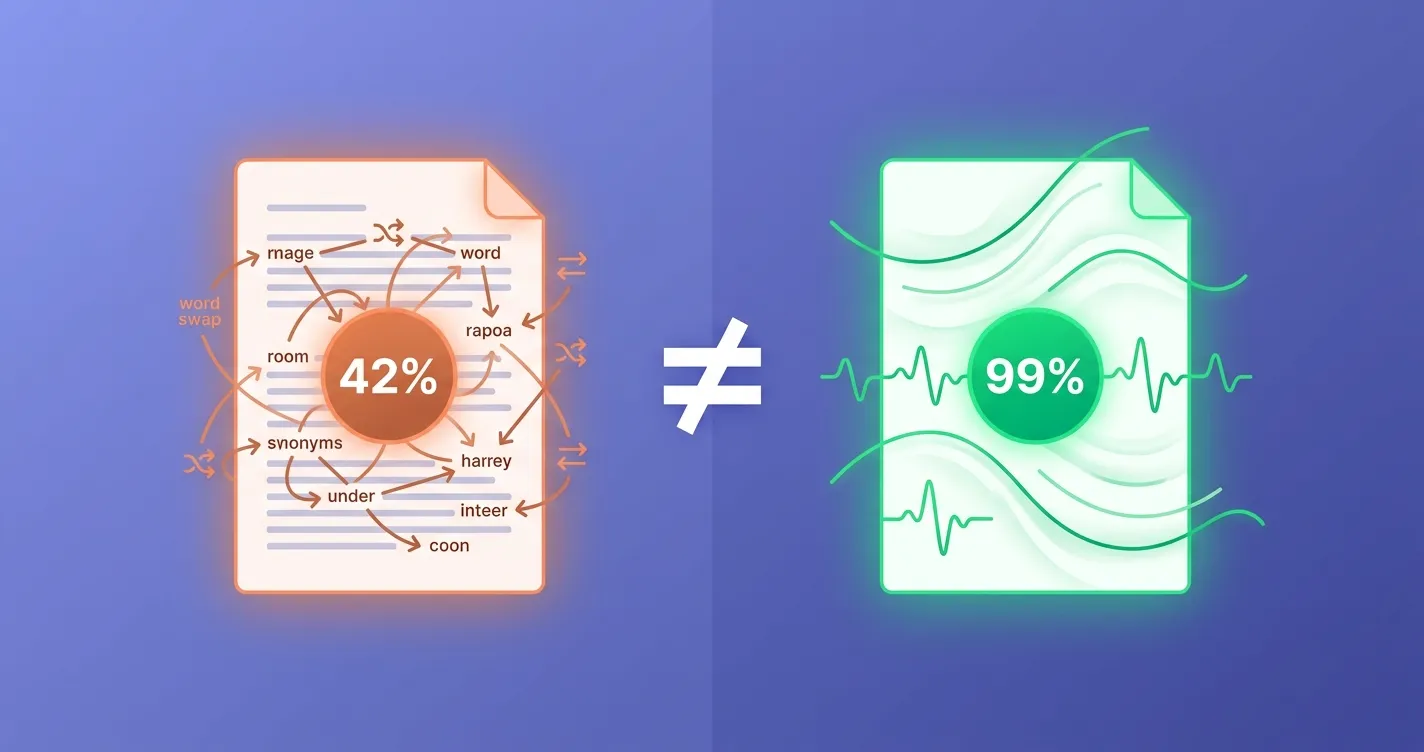
Not a paraphraser. Synonym swap keeps the fingerprint. "The implementation of artificial intelligence in healthcare has significantly improved diagnostic accuracy" becoming "The application of AI in the medical field has greatly enhanced the precision of diagnoses" is a paraphraser move. Different words, same cadence, same predictability. Detectors do not grade vocabulary. They grade patterns.
Not a generator. A humanizer will not invent a thesis, a literature review, or a case study. If the input is empty, the output is empty. If you need that, open a model. Then, if the draft reads like a model, bring it back here.
Not a detector bypass guarantee. Detectors disagree with each other, update, and false-positive human writers. A humanizer is an editing tool aimed at those signals. It is not a promise that a specific school, publisher, or vendor will never flag you. For how we score text in-product, see how the detector score is produced.
Not a plagiarism washer. Humanizing does not replace citing sources. If you pasted someone else's work, rewriting the style does not make it yours.
When to use which tool
Use a humanizer when the draft is already yours — or already the text you intend to stand behind — and it sounds like a model wrote it: even sentence lengths, "furthermore / moreover / in conclusion" scaffolding, no asides, no bursts.
Use a paraphraser when the text is already human and you need a second phrasing: a quote restated, a paragraph you do not want to repeat, a sentence that is just clumsy. Start at the paraphraser.
Use a generator when you do not have a draft. Then treat the output as a first pass, not a submission.
The practical sequence for most people paying for this category: generate or write → detect → humanize the spans that still read as AI → detect again. You can do that in one workspace from signup. Plans and word limits are on pricing.
A short extractable definition
AI humanizer: software that rewrites AI-generated text so it reads as human writing, preserving meaning while changing the statistical patterns detectors measure. It is not a paraphraser (synonym-level restatement) and not a generator (prompt-to-new-text).
The contrast table above is the rest of the answer. The product that does the rewrite is SupWriter's AI humanizer — 300 free words to try, no card, on signup.
Related Articles

Is Using an AI Humanizer Cheating? When to Disclose AI Assistance
AI Words to Avoid in 2026: "Delve" Is Dead — Here's What Detectors Flag Now
How to Humanize GPT-6 Astra Text So It Reads Like You (2026)