By ShriprasannaPublished September 14, 2026Updated September 26, 2026
AI Words to Avoid in 2026: "Delve" Is Dead — Here's What Detectors Flag Now
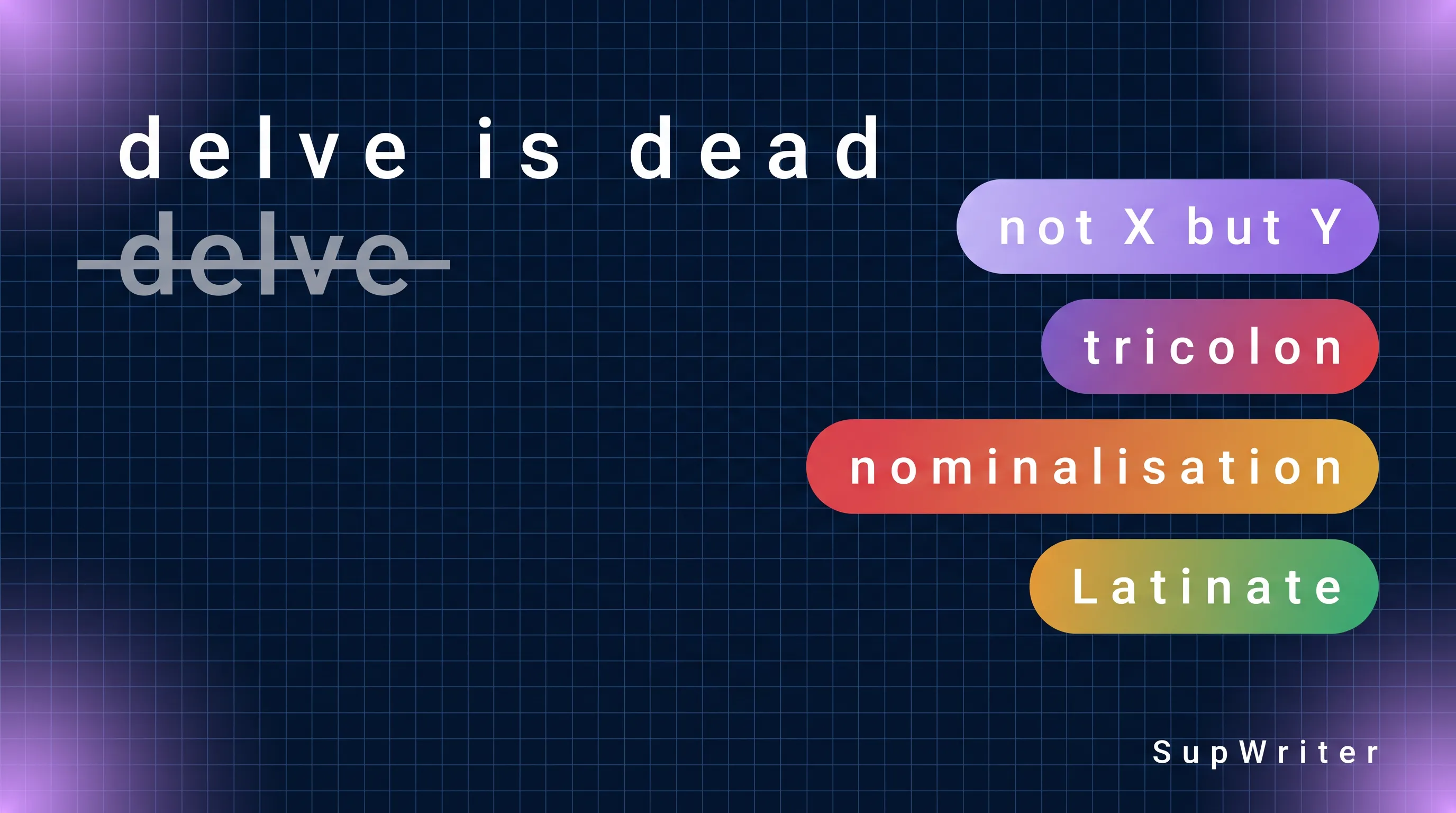
"Delve" is no longer the tell. The 2023–24 lists — delve, tapestry, furthermore — aged out as the labs patched their house style. What 2026 detectors and corpus studies flag now is rhetorical architecture: Latinate diction and nominalisations, the not-X-but-Y pivot, tricolons, and GPTZero-named patterns that appear more often in machine prose. The em dash is not a ChatGPT tell anymore. The Economist's August 2026 comparison found only Claude still over-uses dashes; ChatGPT uses markedly fewer than any other writer in that study. Formal words in an ESL thesis are not automatically AI tells — Stanford work already showed detectors misclassify non-native English at high rates.
The 2023 list aged out
For two years the internet ran on a word-swap religion. Delete "delve." Swap "tapestry." Never open with "Furthermore." Those words really did pile up in early ChatGPT, and they became a folk detector. Instructors circled them. Tools sold banned-word lists as if a synonym table were a detection model. It is stale.
The August 2026 Economist study — summarised on Daring Fireball on 11 August 2026 — is the cleanest public statement of that. Hallmarks moved when the software moved. Labs saw the memes and down-weighted the famous tells. A draft scrubbed of delve and tapestry can still be the most machine-looking file in the inbox.
We are not going to replace the old list with a new fifty-word table and fake frequencies. Word-swapping was always a shallow edit. The live signals sit one layer up: how the sentence is built, whether anyone is actually quoted. For the mechanics — perplexity, burstiness, token curves — see what AI detectors look for and how AI detection works.
What the Economist actually measured
The Economist did not scrape the open web and guess. They took their own journalism, asked ChatGPT, Claude, Gemini, and Grok to write versions from AI-generated summaries, kept the models off the web, and compared the bot drafts with the human Economist prose. The corpus: 55,940 sentences and 1.2 million words. They also checked the same hallmarks against CNN, New York Times, and Washington Post journalism, and novels from 1950 to 2022.
The famous tells moved. Bots no longer "delve" as the celebrity giveaway. Find-and-replace on those words is last year's model.
Pretentious diction is the live lexical signal. Orwell's complaint: Latin or Greek words chosen because they sound grander than the Saxon alternative. Bot writing, in this corpus, carried more Latinate suffixes than the human Economist copy. That is a density problem, not "never use a long word." Humans reach for facilitate and implementation when the discipline demands it. Models reach for them as a default register.
Nominalisations travel with that habit. "The conducting of the analysis" instead of "we analysed" is respectable academic English and also a machine comfort zone. Detectors do not keep an illegal-word list. They prefer the shape of prose language models emit when nobody pushed back.
Punctuation, not dashes, is the better cheap tell. A more useful fingerprint than any single word is text without much punctuation. The models used fewer commas and semicolons, hardly any parentheses, and longer sentences. "And" was their most overused word. They did not quote experts. A 2,000-word draft that never lets a named person speak is doing something human academic writing almost never does.
The rhetorical kit they still lean on. Latinate / nominalised phrasing, the not-X-but-Y pivot ("it is not merely a policy change, but a paradigm shift"), and tricolons (everything in threes). GPTZero later named several of those constructions outright. Architecture, not a naughty-word glossary.
A new checkpoint does not reset this. GPT-5.6 and GPT-6 Astra still write in a house voice. Claude Fable 5 still does. A model update can retire "delve." It does not retire evenly fluent, evenly hedged prose.
The em dash: Pew and the Economist are not arguing
If you have been deleting every em dash because a thread said "ChatGPT loves dashes," stop. That advice can now make a draft more machine-looking.
The Economist is explicit: "Many believe LLMs stuff their prose with em-dashes, but that is not true after the most recent updates. Today only Claude uses more em-dashes than human writers, with ChatGPT using markedly fewer than any other writer in our study."
ChatGPT, in that comparison, is the stingiest dash user. Stripping dashes from a GPT draft can push it further from human magazine prose. Claude is the remaining over-user, so if you draft with Fable 5, the dash habit is worth a look. Claude's text watermark is a different tool: a provenance API, not a dash count.
Then there is Pew. In August 2026, Pew Research published an analysis of 490,000 English-language web pages sampled from Common Crawl. Em-dash frequency rose from 5.79 per 10,000 words in January 2023 to 11.19 in January 2026. That measures the web as a whole, which now includes plenty of AI-assisted text. It is not a controlled test of how today's ChatGPT writes.
Those findings sit together if you do not flatten them. Pew counts dashes across everything on the web, whoever or whatever wrote it. The Economist put each model's output next to human prose, head to head. A web corpus can show more dashes while a controlled study shows ChatGPT using fewer. Neither makes a dash a confession.
Stop performing dash deletion. If a dash is doing real work, leave it. Pasting Claude: the dash habit is still worth a pass. Pasting ChatGPT: missing commas and missing quotes matter more.
GPTZero's ten patterns (19 August 2026)
On 19 August 2026, GPTZero published AI Patterns under Edwin Thomas (Advanced Scan). Ten constructions that appear more often in AI writing. None is exclusive to AI, and "an AI writing pattern is not proof of AI authorship." A pattern is a raised prior. It is not a hearing.
- Overblown Importance — "marks a pivotal moment," "represents a significant shift," every paragraph as a hinge in history.
- Name Dropping — piles of Wired, Forbes, BBC, as if a list of mastheads were a citation.
- Empty Commentary — sentences that sound like analysis and contain none.
- Sales-pitch Tone — "Nestled in the heart," "vibrant," brochure English wearing an essay's clothes.
- Phantom Experts — "Experts argue," "studies have shown," with no names and no papers.
- Dressed-up Verbs — "serves as" instead of "is," "plays a crucial role in" instead of a verb that does work.
- Not just X, but Y — the hinge the Economist conversation also keeps pointing at.
- Everything in Threes — tricolons. Reduce costs, accelerate delivery, and maintain quality. Always three. Always balanced.
- Unnecessary Caveats — hedging that protects the model, not the claim.
- Chatbot Language — "As an AI language model." Rare in 2026 student drafts, still a dead giveaway when it survives.
Read it as a revision checklist, not a score. You can write "serves as" and be human. You cannot write a chapter where every verb is dressed, every claim is a tricolon, every source is "experts," and every paragraph is a pivotal moment, then be surprised when GPTZero lights up.
Phantom experts collide with the Economist observation that bots do not quote people. If your literature review never names a researcher, you have a citation problem before you have a detector problem. Overblown importance is how a model writes a discussion section when it has no result it will defend. This list is style features, not a Turnitin feature set. Turnitin still scores the statistical layer in does Turnitin detect AI writing.
What to do instead of word-swapping
The replacement for the old list is not a new list. It is a different edit.
Put people on the page. Quote them. Name the paper. The Economist bots did not.
Prefer Saxon verbs when the discipline allows it. "We ran," "we measured." If a sentence can lose "-ation" and stay accurate, cut it. If the term of art is the term, leave it.
Break the tricolon. Three balanced clauses: drop one. Detectors are allergic to the metronome, not to lists.
Kill not-X-but-Y unless you mean it. If the second half is the real claim, lead with it. If it is decoration, delete it.
Put punctuation back. Commas, semicolons, parentheses. The Economist bots ran lean on all three.
Vary length on purpose. One short sentence after a long one is how people finish a thought. How to avoid AI detection in writing is the longer version.
Take a side a viva could poke. A limitation you actually believe is cheaper than "it is important to note."
None of this is a guarantee. Detectors retrain as new models ship, and Turnitin's August 2026 report redesign folded generated, paraphrased, and bypasser-modified text into one score. Check the exact text you will submit. Our AI detector is built for that pass: a pre-check based on one scoring model. It is not Turnitin.
ESL and thesis writing: formal is not a confession
A thesis in a second language is supposed to sound formal. "It may be noted that" and "the implementation of the framework" are taught. They are also Latinate, nominalised, and predictable. That overlap is why Stanford researchers found leading detectors misclassified about 61 percent of TOEFL essays written by non-native speakers. Native-speaker essays in the same work were classified almost cleanly. See AI detection and ESL students and the false-positive crisis.
Do not run a "ban Latinate words" pass on a dissertation you wrote yourself. You will flatten the register your examiner expects and you may not move the score. The Economist finding is about bots preferring Latinate suffixes more than human journalists do — not a warrant to treat every formal noun as machine-generated.
What is worth a pass is the GPTZero layer that is not "being formal": phantom experts, empty commentary, everything in threes, not-X-but-Y as a reflex. Those are padding, not a style guide.
If a supervisor has flagged your own draft, keep the version history. A humanizer can restore variation that formal second-language writing loses. It cannot explain a one-paste file, and it cannot file a declaration. Same point in the India and Malaysia pieces.
When a humanizer helps — and when it does not
Full disclosure: we build SupWriter. We sell a rewrite engine.
A humanizer helps when the problem is voice: even fluency, dressed-up verbs, tricolons, the not-X-but-Y hinge, a Claude dash habit, a GPT wrap-up that restates the thesis. Synonym tools do not do that job. We do not publish a bypass rate for SupWriter: we have not run the controlled, per-detector tests that would support one (how we test). Results vary by detector, text length and topic, and no tool can guarantee one. Check the rewrite before you rely on it.
A humanizer does not help — or does not help enough — when:
- The course bans AI assistance. A smoother draft is still a policy problem.
- The university requires a declaration. Malaysia's MOHE rule is the clearest public version. A lower score does not file the form.
- The "AI" in the draft is your own formal ESL. You may want variation. You do not want a tool that also strips the terms of art your examiner needs.
- The evidence problem is process, not prose. Teachers can still see paste events, version history, and a viva that does not match the page. No rewrite undoes 2,000 words appearing at 11:58 p.m.
If you want to feel the difference on a short passage, the free humanizer is 300 lifetime words and no card. Paid plans are Basic $9.99 / 5,000 words a month, Pro $19.99 / 15,000, Ultra $39.99 / 30,000 (list prices). The editor covers 50+ languages, Malay among them. None of those prices is a detector setting, and none of them is a new word list.
The honest sequence is still: make the argument yours, quote the people you actually read, then score the submission text. If a span still reads like a chatbot, rewrite that span. Do not hunt "delve."
Frequently Asked Questions
Is "delve" still an AI giveaway in 2026?
No. The Economist's August 2026 comparison is the public source for that retirement. Labs patched the 2023–24 celebrity words. A draft can be free of "delve," "tapestry," and "furthermore" and still trip a detector on Latinate density, tricolons, and missing punctuation. Treat the old list as history.
Are em dashes a ChatGPT tell?
Not anymore, on the evidence we have. The Economist found only Claude still using more em dashes than human writers, and ChatGPT using markedly fewer than anyone else in that study. Pew's rise from 5.79 to 11.19 dashes per 10,000 words (January 2023 to January 2026) describes English web pages overall, AI-assisted ones included. It is not a measurement that today's ChatGPT over-uses dashes.
Which words should I actually avoid?
There is no honest 2026 frequency table we can publish without inventing one. The live signals are constructions: Latinate / nominalised default register, not-X-but-Y, tricolons, dressed-up verbs, phantom experts, and the rest of GPTZero's ten patterns. Swap those habits, not a glossary. If a word is the correct term of art, keep it.
Will formal words in my thesis get me flagged?
They can contribute to a false positive, especially if you are a non-native writer. That is a detector-accuracy problem, documented in Stanford's roughly 61% TOEFL misclassification finding, not proof you used a chatbot. Do not strip academic vocabulary to appease a model. See AI detection and ESL students.
Does a humanizer replace declaring AI use?
No. A rewrite can change the statistical and rhetorical fingerprint. It cannot satisfy a course or ministry rule that says you must disclose assistance. If the assignment forbade AI, stop at the policy.
How do I check my own draft?
Run the exact text you will submit through an AI detector. Detectors disagree; one green score is not a verdict. If you then want a pattern-level rewrite on a short sample, start with 300 lifetime words on the free humanizer — no card.
The old word list will not save a 2026 draft. Check the actual prose with the AI detector, then — if you are editing voice, not hiding a banned tool — try 300 words on the AI humanizer. No credit card.
Related Articles
Is Using an AI Humanizer Cheating? When to Disclose AI Assistance
What Is an AI Humanizer (and What It Is Not)
How to Humanize GPT-6 Astra Text So It Reads Like You (2026)