
By ShriprasannaPublished September 14, 2026Updated September 27, 2026
Best AI Humanizer for Malaysian Students (2026): UM, USM, UKM, UTM, UiTM Turnitin Rules and the MOHE Declaration
For Malaysian students, the humanizer we would point you toward is SupWriter. We build it, so weigh that. It handles English and Bahasa Melayu in one editor, publishes its prices, and lets you try 300 words free without a credit card. What no tool here has, us included, is a Malay pass rate you can trust. Malaysia is different from a generic ranking because the Ministry of Higher Education's 2024 generative-AI guidelines, reaffirmed on 22 July 2026 by Deputy Minister Adam Adli Abdul Halim, require students to declare AI use. A humanizer can loosen a formal register that detectors misread. It cannot replace that declaration.
Why Malaysian Students Need This More Than a Generic List Admits
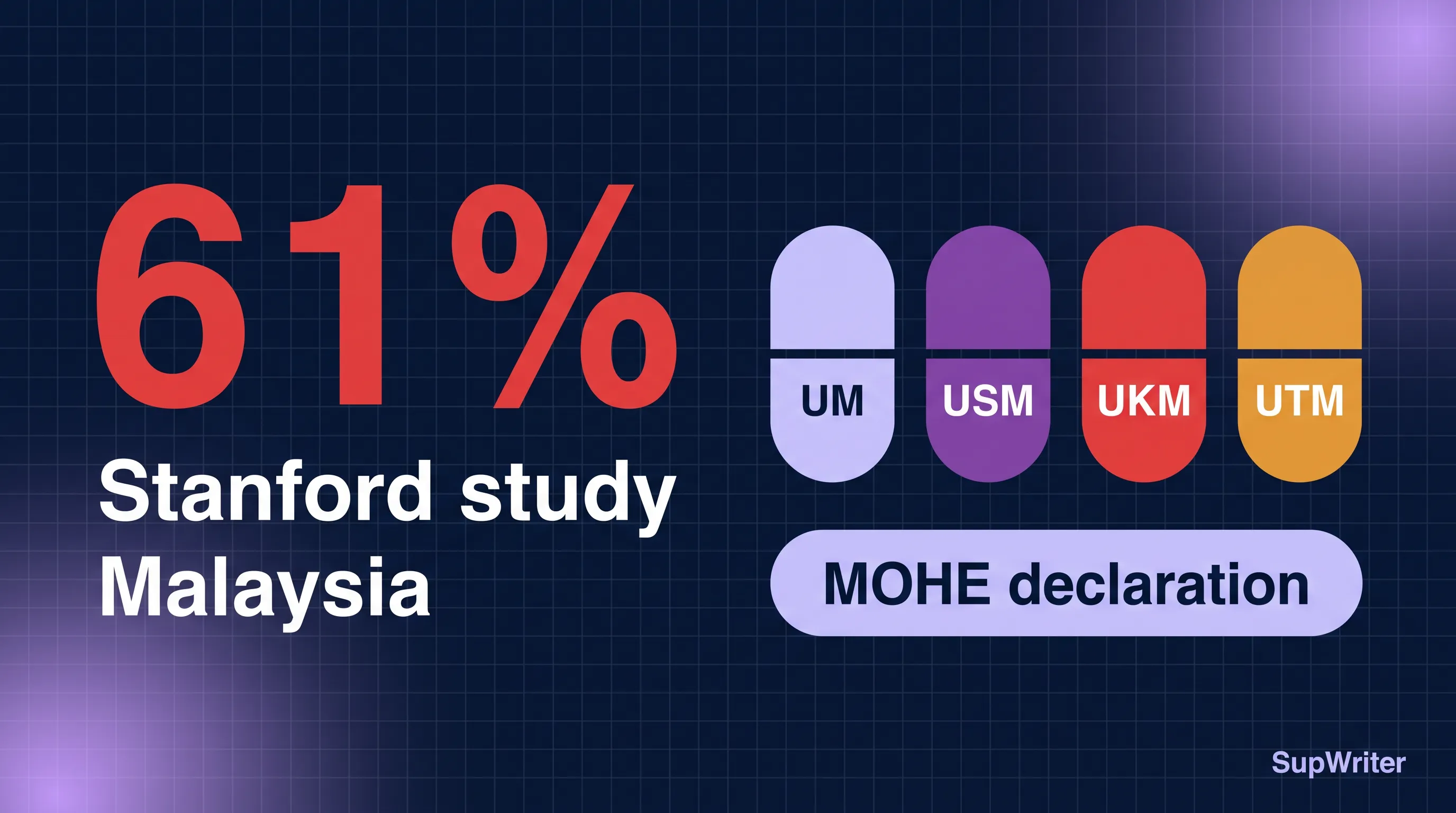
Turnitin is widely licensed across Malaysian higher education, including at Universiti Malaya (UM), Universiti Sains Malaysia (USM), Universiti Kebangsaan Malaysia (UKM), Universiti Teknologi Malaysia (UTM), and Universiti Teknologi MARA (UiTM). It arrived as a similarity checker. The AI writing indicator arrived later as an administrator setting.
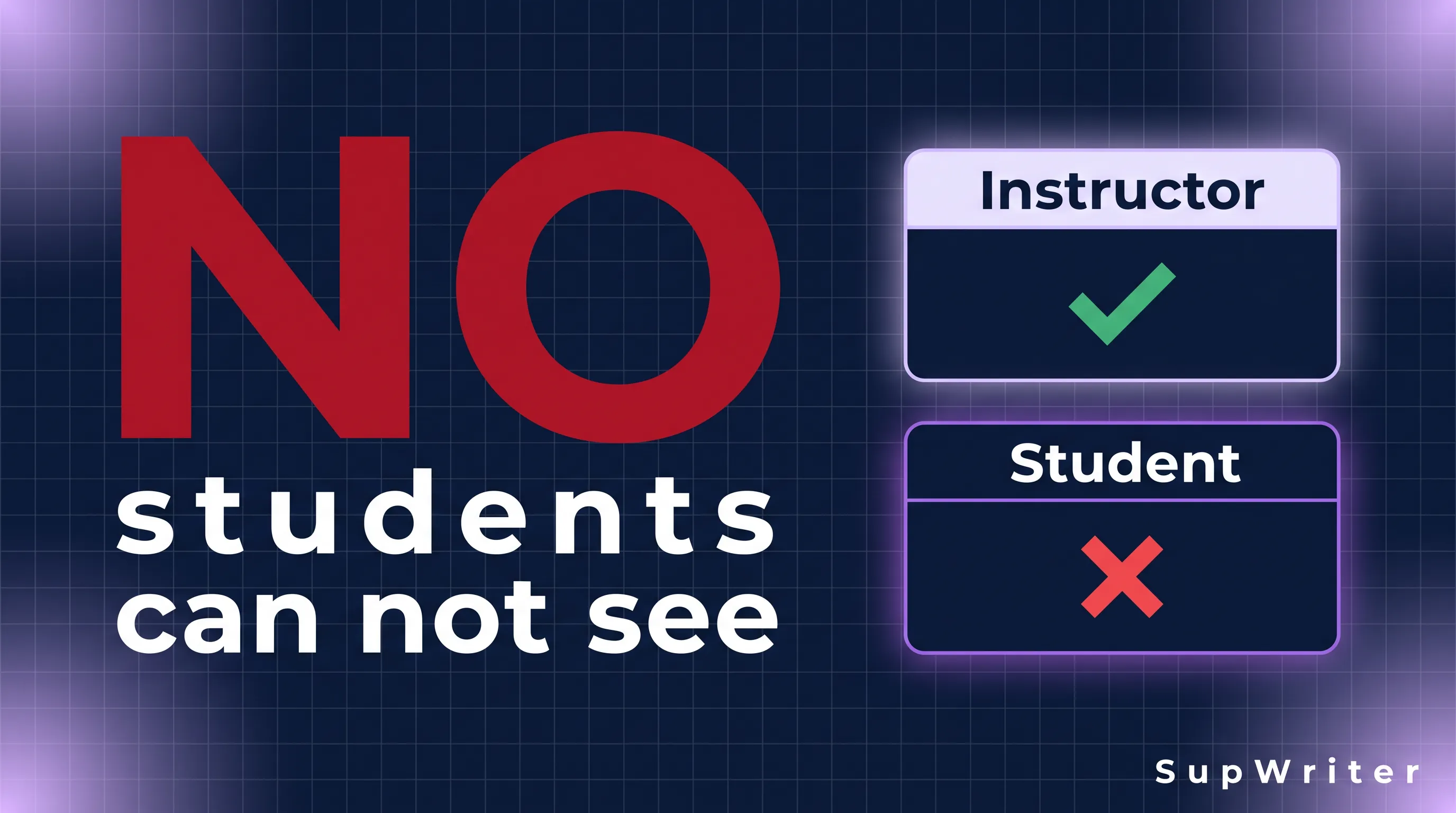
We are not going to tell you which of those five have the indicator switched on. We do not know. Some humanizer sites claim these universities have all activated AI detection; we have not seen evidence for that, and we will not repeat it. Your faculty decides whether a number appears. Students typically cannot open the AI report; see whether students can see a Turnitin AI score. Similarity and AI are not interchangeable.
The ministry layer is clearer. MOHE's generative-AI guidelines, first issued in 2024, were reaffirmed on 22 July 2026 by Deputy Minister Adam Adli Abdul Halim. In those remarks, students must declare AI use, still do proper research and referencing, and must not rely entirely on AI-generated content. The 2024 guideline itself says AI-generated content in academic work must be properly acknowledged, and leaves the method of referencing it to each institution (MOHE guideline, PDF); Universiti Malaya, for example, requires a written declaration. Unethical AI-produced essays or journals may be academic-integrity violations, including possible qualification cancellation. Universities write their own SOPs from that KPT/MOHE framework.
As of September 2026, MOHE has not published a national acceptable AI-detection percentage. Anyone quoting "the Malaysia Turnitin limit" is inventing a number the ministry did not issue. See what percentage of AI is acceptable on Turnitin and the August 2026 Turnitin update.
Universiti Malaya is the campus we can quote without guessing. The compiled AI policy says detection software should not be used as conclusive evidence to justify academic misconduct charges against students. Findings are reviewed by Responsibility Centres, and the same document refers to an AI-use declaration form for teaching and learning activities. The Library AI integrity guide points at the same compilation, which sets no AI percentage. If someone quotes you a review threshold, ask which document it comes from: it will be local practice, not a national MOHE number, and it does not transfer to USM, UKM, UTM, or UiTM.
The Malaysian English, Bahasa Melayu, and Manglish Problem
Stanford researchers who ran TOEFL essays by non-native English speakers through seven detectors found the tools misclassified about 61 percent of them as AI-generated on average (Liang et al. 2023). Native-speaker essays were classified almost perfectly. We summarise the wider evidence in are AI detectors accurate. The gap lands on Malaysian writers who submit in English, and Bahasa Melayu has its own, bigger problem, covered in the next section.
Detectors measure perplexity and burstiness. Malaysian academic English and formal Bahasa Melayu tend to score badly on both, for reasons that are taught:
- Formal register by default. "It is noteworthy that" and the BM equivalents your lecturer marked as correct are trained Bahasa Baku. They are also extremely predictable to a language model.
- Consistent sentence length. Second-language writers keep sentences uniform. Detectors read that as machine output.
- Curated vocabulary. You use the word you are sure about. Low variance, high suspicion.
Formal academic English or Bahasa Melayu is not automatically an "AI tell." Those words are a trained register. Why ESL students get falsely flagged walks through the mechanism.
Manglish leaks into drafts: particles such as lah and kan, English clauses inside a BM paragraph. Detectors trained on monolingual English corpora have no coherent model for a sentence that switches language halfway through.
The uncomfortable summary: a Malaysian student writing in English may want a humanizer to loosen a formal register that detectors misread. In Bahasa Melayu, no detector score is trustworthy either way, ours included. The MOHE declaration is still required regardless.
Malay Language Support, Said Up Front
Most humanizers list Malay on a features page. Far fewer process it as Malay rather than as Indonesian-adjacent English with the labels swapped. The distinction that matters is a language-specific model versus a translate-humanize-translate pipeline. The pipeline produces BM a native reader clocks as translated: correct-ish grammar, wrong rhythm. We walk through that pattern in our non-English humanization guide.
Does it handle Bahasa Melayu natively? Does it keep formal Bahasa Baku? What happens to Manglish? Honest answer on the last one: no tool we know of handles code-mixed text reliably. If the piece will be checked, commit to one language per paragraph.
SupWriter's editor includes Malay, and there is a dedicated Malay humanizer page. What we cannot give you is a Malay pass rate, and here is why. In a September 2026 check with SupWriter's own detector, we ran eight human-written Malay passages taken from pre-2020 Wikipedia revisions, written before ChatGPT existed. All eight scored 100% AI. Our detector, like most, is unreliable for Malay: it flags human-written Malay as AI. That means Malay before-and-after scores from our tool are not evidence that a rewrite reads as human, and we will not present them that way.
The wider picture is the same:
- Turnitin covers AI writing detection in long-form English, Spanish, Japanese and Modern Arabic only. A paper in another language, Bahasa Melayu included, is not processed; the AI indicator shows an empty state instead of a score (Turnitin's AI detection FAQ).
- Originality.ai's multi-language detector lists 31 languages, and Malay is not one of them (Originality.ai help).
- GPTZero says it "fully supports" English, German, Portuguese, French and Spanish (GPTZero).
So treat any detector's Malay score, high or low, as noise rather than proof, whether it comes from us, a competitor or a lecturer's side tool. Judge a Malay rewrite by reading it: does it sound like Bahasa Baku your lecturer would accept, and does it still say what you meant?
What These Prices Feel Like When the Sticker Is in Dollars
Almost every tool here prices in US dollars. Your bank converts at its own rate and adds a forex markup. The ringgit averaged about 4.06 to the dollar in September 2026 (X-Rates monthly average); treat that as a rough guide to your bank's conversion, not a checkout price. Where a tool offers local-currency checkout, compare the final amount before you pay.
| Tool | USD list price | Allowance | Malay / BM | Free option |
|---|---|---|---|---|
| SupWriter | Basic 9.99 / Pro 19.99 / Ultra 39.99 per month | 5k / 15k / 30k words per month | Malay in the editor (50+ languages) | 300 words, no card (sign-in required) |
| MegaHumanizer | Pro 19 / Unlimited 29 per month | 10k / 50k words per month | Bahasa Melayu listed; Malaysia page | 500 words per run, 2 runs a day |
| HumanTone | Not shown on its Malay page | 750 to 1,500 words per process, by plan | Dedicated Malay page; "60+ languages" | 1,000 words, no card |
| Smodin | Starter 10 / Premium 16 per month, billed annually | Not stated on its pricing page | "100+ languages" claimed | Free humanizer; limits not published |
| Undetectable AI | 9.99 per month (5.00 billed annually) | 10,000 words per month | Not stated on its pricing page | 250-word trial |
| Humbot | See the vendor's current pricing | Tiers split "Basic" and "Advanced" words | Not verified | Not verified |
| QuillBot | Premium 19.95 per month (8.33 billed annually) | Humanizer included in Premium | Paraphrasing in 23 languages | Humanizer and paraphraser up to 125 words |
Prices from each vendor's own site, checked September 2026: MegaHumanizer, HumanTone, Smodin, Undetectable AI, Humbot, QuillBot. SupWriter figures are list prices; student and promo discounts can apply at checkout.
A no-card free tier matters here because paying usually means an international card. SupWriter tiers: /pricing.
The Ranking
We order this list by what we can actually check: a real Malay path, a free way to test without a card, and published prices. Not by a detector pass rate, because nobody on this list, us included, has an independent one for Malay.
1. SupWriter
Why it tops the list for Malaysia: Malay sits in the same editor as English, the prices are published (see the table above), and you can try 300 words free with no credit card (you do need to sign in). Full disclosure, again: we build it. The built-in AI detector is a pre-check based on one scoring model, not the detector your lecturer uses. For English drafts it is a rough guide; for Malay, as explained above, it is not reliable at all.
Pros: Malay and English in one editor, published prices, a no-card trial, and a built-in detector for English drafts.
Cons: three hundred free words let you judge the rewrite, not finish a chapter, and you have to judge BM output by reading it.
Best for: English or Bahasa Melayu submissions where you still file the AI-use declaration.
2. MegaHumanizer
The most explicitly Malaysia-targeted tool here. It lists Bahasa Melayu among its languages and runs a Malaysia page aimed at local students (MegaHumanizer).
Pros: Malay and English are the headline, not a buried dropdown. Published prices (Pro 19 USD for 10,000 words, Unlimited 29 USD for 50,000 words a month) and a free tier of 500 words per run, twice a day.
Cons: its bypass figures are self-published, including "80%+ to under 5%" across Turnitin, GPTZero and Originality.ai. We have not seen that independently verified, and for Bahasa Melayu the Turnitin part means little, since Turnitin does not score Malay text. We will not repeat claims about which named universities have AI detection switched on.
Best for: a Malaysia-first interface you will evaluate yourself.
3. HumanTone
HumanTone has a Malay language page that promises natural Bahasa Melayu rather than translation.
Pros: a real Malay URL rather than a generic "100+ languages" line, and 1,000 free words with no credit card.
Cons: we have not tested it, and prices are not shown on its Malay page. Its before-and-after detector example is marketing; detector scores for Malay are not proof either way. Same position as in our India guide.
Best for: confirming a Malay page exists, then running your own sample.
4. Smodin
Smodin offers a free humanizer and claims support for 100+ languages. Our Smodin Malay page is the Malaysia-specific entry.
Pros: a free humanizer to try, multilingual, and published paid prices: Starter 10 USD and Premium 16 USD a month, both billed annually (Smodin pricing).
Cons: the free allowance isn't stated on its pricing page, and the paid prices shown are annual. Its "95%+ detection bypass rate" is a vendor claim (Smodin humanizer) that we have not seen independently verified.
Best for: light Malay or English volume, if the free tier covers you.
5. Undetectable AI
An English-first humanizer with clear pricing: 9.99 USD a month for 10,000 words, or 5.00 USD a month billed annually (Undetectable AI pricing).
Pros: purpose-built for detection avoidance, with checking in the interface, and a money-back guarantee "if output flagged is not human" (read the conditions before relying on it).
Cons: the free trial is 250 words in total. Its pricing page does not mention Malay, so test BM output yourself before paying. Tables: Undetectable AI review and head-to-head.
Best for: English-only work.
6. Humbot
Pros: a straightforward humanizer for short English pieces.
Cons: its pricing page lists several tiers with separate "Basic" and "Advanced" word allowances, and the figures were hard to pin down when we checked in September 2026, so confirm the current price before paying. We have not verified its Malay output.
Best for: short English pieces where a flag is an inconvenience.
7. QuillBot
A familiar name for many Malaysian students. It is a paraphraser first.
Pros: familiar, solid paraphrasing in 23 languages (per QuillBot), and a humanizer included in Premium.
Cons: Premium is 19.95 USD a month, or 8.33 USD a month billed annually (QuillBot Premium). The free humanizer and paraphraser cap each input at 125 words. And AI text run through a paraphraser is exactly what Turnitin says it looks for in English submissions. See the student-focused ranking.
Best for: vocabulary help. Not for clearing a detector, and not a substitute for the declaration.
How to Choose, Practically
If your faculty runs Turnitin and you write in English, protect a draft you can defend: keep your notes and versions, and declare any AI use. You can check the finished draft with an AI detector before you upload, but that check is not Turnitin, results vary by detector, length and topic, and no tool can promise how Turnitin will score your work.
If you are writing in Bahasa Melayu, narrow the list to tools with an actual Malay path, then judge the output by reading it. SupWriter, MegaHumanizer and HumanTone all advertise Malay; Smodin is multilingual. No detector score, ours included, tells you whether BM reads as human, and Turnitin does not score Malay at all.
If money is the constraint, start with free tiers that don't need a card. Run the same 300-word paragraph through the free humanizer, HumanTone and Smodin, and compare. Budget in dollars; your bank sets the ringgit amount.
If you are being falsely flagged on your own writing, keep drafts, learn whether the number is similarity or AI, restore variation to writing that was already yours, and declare any AI assistance the course actually used.
If a lecturer quotes an AI percentage limit, ask which document it comes from. It will be a faculty or university rule, not a national MOHE number, because MOHE has not published one.
The Bottom Line
Malaysia combines a ministry declaration rule, widely licensed Turnitin, and no published national AI percentage. Keep the jobs separate: declare what you used, do not rely entirely on generated text, and use a humanizer where the problem is register, not concealment.
SupWriter takes the top spot because it answers the Malaysia-specific questions plainly: Malay alongside English, published prices, 300 free words without a card, and a straight answer about what detectors cannot tell you about Malay. MegaHumanizer is the most visible Malaysia-first alternative. HumanTone has a Malay page and a no-card free tier. Smodin is a reasonable free option for small volume. For the same ESL-and-Turnitin shape with no national percentage, see India and Nigeria.
A humanizer does not replace the MOHE or university AI-use declaration. Test the tool on your own writing before the deadline exists.
Frequently Asked Questions
Does a humanizer replace the MOHE or university AI-use declaration?
No. The 2024 MOHE guidelines, reaffirmed on 22 July 2026, require students to declare AI use, keep doing their own research and referencing, and not rely entirely on AI-generated content. A lower detector score does not file that declaration. If the course forbade AI entirely, a humanizer does not create permission.
Do UM, USM, UKM, UTM, and UiTM all have Turnitin AI detection switched on?
We do not know. The AI writing indicator is an administrator setting. We will not copy third-party claims that named universities have "all activated" it. Ask your lecturer. Even when it is on, students usually cannot see the AI percentage, and for work written in Bahasa Melayu Turnitin's AI indicator does not produce a score at all.
Is there a national AI percentage threshold in Malaysia?
No published MOHE number. The ministry's public position is declaration, research, referencing, and not submitting wholly generated work. Any percentage a faculty or Responsibility Centre uses is local practice, not a national limit.
Does Universiti Malaya treat a detector score as proof of misconduct?
No. UM's compiled AI policy says detection software should not be used as conclusive evidence to justify academic misconduct charges against students. Findings are reviewed by Responsibility Centres. Do not assume every Malaysian university copied that sentence.
Can I try SupWriter in Malay for free?
You can try SupWriter with 300 free words, no credit card required (you need to sign in), and Malay is one of the 50+ languages in the editor: /malay-humanize. Check /pricing for what each plan includes when you sign up.
How much does SupWriter cost?
Free is 300 words, one-time. Basic is 9.99 USD for 5,000 words a month, Pro 19.99 USD for 15,000, and Ultra 39.99 USD for 30,000. Those are US-dollar list prices; annual billing roughly halves the monthly rate, and student or promo discounts can apply at checkout. Your bank converts them to ringgit. See /pricing.
Try SupWriter's AI humanizer on your next assignment: 300 words free, no credit card required.
Related Articles
Can Students See Their Turnitin AI Score? (No — Here's How to Check Before You Submit)
Can Teachers See If You Use ChatGPT? The 7 Ways They Actually Find Out
Best AI Humanizers for Students in 2026