By ShriprasannaPublished September 14, 2026Updated September 26, 2026
Does Claude Watermark Text? What the Sept 2026 Claude 5.1 Watermark Means for Students
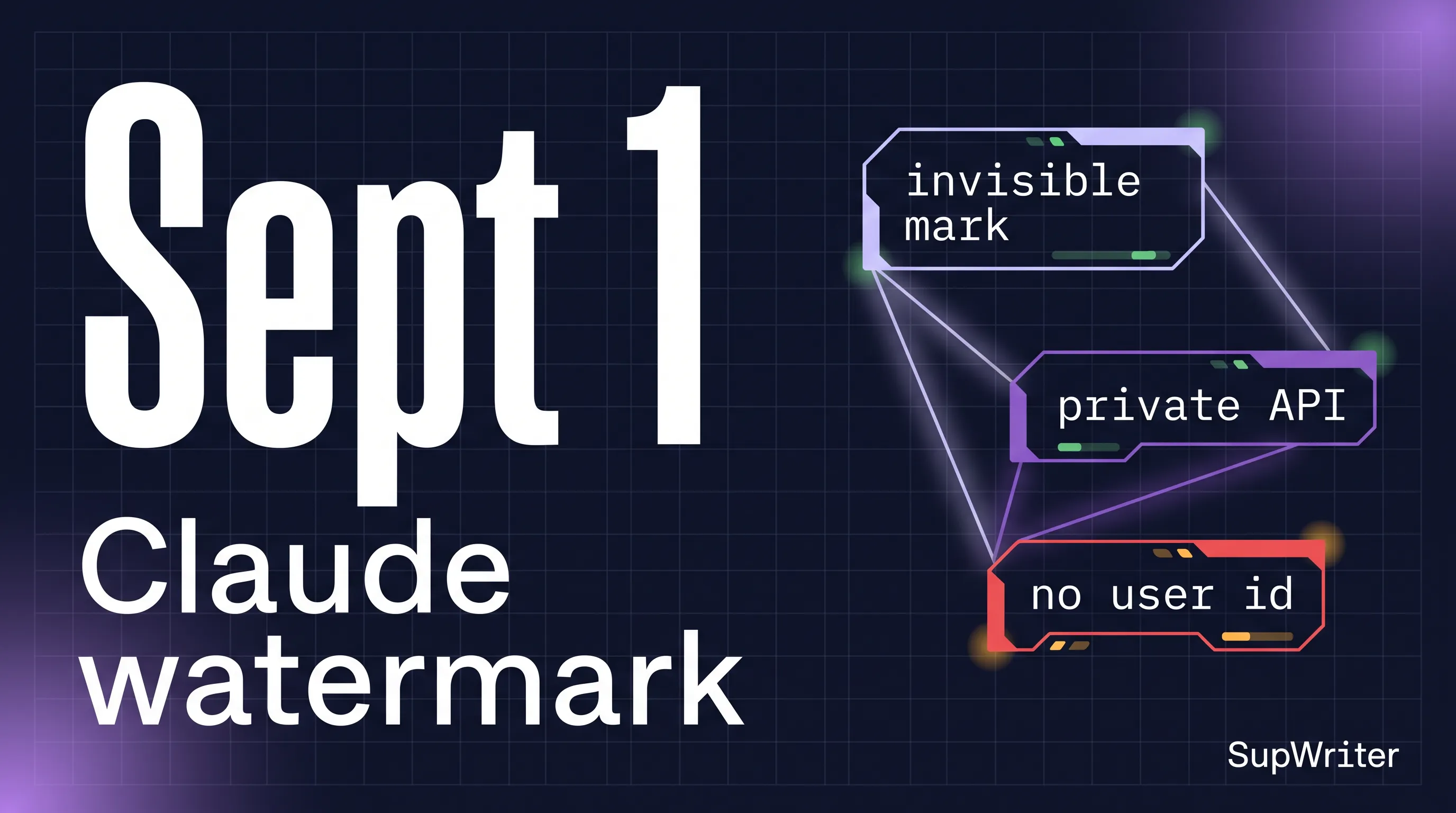
Yes — but only for Claude models Anthropic released after 2 August 2026, and only in a way almost no student will ever see. The first watermarked models are Claude Fable 5.1 and Mythos 5.1 (1 September 2026). The mark is statistical, invisible, and carries no user identity. Checking it requires Anthropic’s Detection API, still a private preview for regulators, law enforcement, media, fact-checkers, researchers, educational organizations, EU civil society, and compliance-obligated enterprises. It is not a Turnitin score and not a public paste box. A June Fable 5 draft is not the same as a Fable 5.1 draft. Watermarking and AI detection are different tools.
What actually changed in August and September 2026
The legal trigger is Article 50 of the EU AI Act, which started applying on 2 August 2026. Providers that serve the EU market have to mark AI-generated content so it is machine-readable. Anthropic signed the EU Code of Practice on Transparency of AI-Generated Content in July 2026, one of roughly 190 signatories. Its chosen method for text is a watermark.
Anthropic’s own explainer, How Claude’s text watermark works (published 14 August 2026, updated 1 September), is unusually specific. Future Claude models generate text that contains a watermark. Nothing is inserted into the file. There are no hidden characters, no extra tokens, and no quality tax. A reader cannot tell watermarked prose from unwatermarked prose. The watermark also cannot be traced back to a person, a school account, or a chat.
The cutoff is the model’s release date, not the day you opened Claude. Models released after 2 August 2026 are watermarked at launch. The first of those are Fable 5.1 and Mythos 5.1 on 1 September 2026; Anthropic’s notes for those models say their text carries the watermark on every platform where they are available. Fable 5, which landed on 9 June 2026, sits on the other side of the line. Anthropic says it is working to add watermarking to older models and will roll it out over the coming months. Until that happens, “I used Claude” is not the same as “this text carries a Claude 5.1 watermark.”
They are applying the watermark globally because they do not yet have a durable way to scope it by region. If you are writing from a U.S. campus, that does not exempt Fable 5.1 output. The geography of the law is Europe; the deployment is everywhere.
How the watermark actually works
Large language models pick the next word from a list of plausible candidates. A lot of those choices are low-stakes: “overcast” versus “grey” after “the weather was cold and.” The meaning barely moves. Ordinary sampling uses an arbitrary random number to break the tie.
Claude’s watermark, a version of Google DeepMind’s SynthID-Text, changes the source of that randomness. It uses a key plus a few preceding words to settle which candidate wins. Over a long passage, those choices form a pattern. Anyone with the key can score how consistent the text is with that pattern and assign a probability that Claude was involved.
That is a provenance check, not a style check. It does not look for em dashes, “delve,” or the “not X, but Y” pivot. GPTZero and Turnitin do that other job: they score predictability and burstiness from the outside, without Anthropic’s key. Anthropic is explicit about the difference. Detector companies do not have the key. They hunt phrasing tells. The watermark answers a narrower question: how likely is it that Claude left this statistical pattern?
Limitations that matter for students, all from Anthropic’s own page:
- Short samples do not carry enough choices. Confidence rises with length.
- Factual passages are sparser. If the next word has to be “Mathematica,” there is nothing for the watermark to sit on.
- Light proofreading of human text leaves almost no mark, because Claude only watermarks words it chooses.
- Code is weakly marked. Comments can carry a pattern; exact syntax generally cannot.
- A translation written by Claude is fully watermarked, because every word is Claude’s.
A positive watermark result also does not mean “Claude wrote this from a blank page.” Anthropic says it cannot distinguish “Claude wrote this” from “Claude heavily edited this.” It does not identify a different lab’s model, even if that lab watermarks too — different key, maybe a different method. And it says nothing about ownership or academic honesty policy. Those are your school’s rules, not Anthropic’s. Images are separate: PNG/JPG can get a C2PA note in metadata — a signed label, not this text watermark.
Who can actually run the Detection API
You cannot. Not as a student with a free Claude account, and not as a professor with a public “paste text here” toy.
As of the 1 September 2026 update, Anthropic’s Detection API is a private preview. Eligible organizations under EU law include regulators, law enforcement, media, fact-checkers, independent researchers, educational organizations, and EU civil society groups. Enterprises that are themselves obligated to verify watermarking for Act compliance can also get it. Anthropic says they plan to expand access over time.
“Educational organizations” is the clause that makes campuses nervous, and it should. A university that qualifies could, in principle, query the API. That is still not the same as the watermark appearing inside a Turnitin report. We have not seen any announced Turnitin integration of Anthropic’s watermark API. If your school turns on a Claude watermark check, it will be a separate vendor conversation, not a new column that silently appears next to similarity percent.
Until a school publishes that it has API access, assume your instructor is still using the tools they already had: Turnitin, Copyleaks, GPTZero, Grammarly Authorship, version history, and a viva. The watermark is real. It is also, for now, mostly offstage.
Watermark vs Turnitin vs GPTZero
Treat these as three different questions.
Watermark (Anthropic key): “Was Claude likely involved in choosing these words?” Requires the private API. Invisible in the document. No user identity. First live on Fable 5.1 / Mythos 5.1.
Classifier detectors (Turnitin, GPTZero, Originality.ai, Copyleaks): “Does this read like machine-generated text?” No key. They score statistical smoothness and known house style, and they score Claude output — including raw Fable 5 — whether or not it carries a watermark. GPTZero’s release notes say its model 4.9b, released 12 August 2026, improved recall on Claude 5, GPT 5.6, Gemini 3.6, and Grok 4.5 series models. That update is a classifier refresh. It is not Anthropic’s watermark.
Human reading: paste jumps, version history, a viva that does not match the prose. None of that needs a watermark.
The practical risk on a September 2026 paper is still the classifier and the process evidence. A watermark API that your school does not have cannot flag you. A Turnitin report your school does have still can. If you want the current Turnitin picture, start with whether Turnitin detects AI writing and the August 2026 detection update.
What OpenAI and Gemini do instead
Do not generalize Claude’s watermark to every chatbot.
OpenAI: as of September 2026, there is no text watermark on ChatGPT / GPT output. OpenAI’s provenance help page lists C2PA and SynthID signals for images and SynthID for audio, and describes extending provenance to text as a goal. If a teacher claims “ChatGPT is watermarked like Claude 5.1,” that is not a claim you can source to OpenAI. GPT-5.6 and GPT-6 Astra are still judged the old way — by classifiers trained on the GPT house voice — which is why we have separate humanizing guides for GPT-5 and GPT-5.6.
Google: Google says SynthID watermarks text generated in the Gemini app and web experience. Same family of technique. Its SynthID Detector portal is limited to early testers, and the page does not say that Gemini API output is watermarked. In-app marking is not a school-facing score.
Fable 5 vs Fable 5.1: what you should actually worry about
If the draft came from Fable 5 (June 2026), the watermark is not the 1 September system. Anthropic may backfill older models later. Today, Fable 5’s problem is the same as it was in June: it writes extremely clean, high-probability prose, and that is exactly what classifiers look for. A more capable model does not automatically read as more human. See the Fable 5 humanizer guide.
If the draft came from Fable 5.1 or Mythos 5.1, you now have two layers:
- The same classifier risk as every other Claude (and GPTZero says its 4.9b model improved recall on Claude 5 specifically).
- A watermark that a qualifying educational organization could query, if they have preview access.
Layer 2 is new. It is also not how most assignments are graded this month. Do not ignore it, and do not treat it as a Turnitin clone. Mythos 5.1 follows the same rule as Fable 5.1, though Anthropic offers it only to Project Glasswing participants, so most students will never see it in a model picker.
What this does not mean for humanizers
We build SupWriter. Full disclosure, because this is the paragraph where vendors usually lie.
SupWriter does not remove Anthropic watermarks. We will not sell a “Claude watermark remover,” we will not quote a bypass percentage against the Detection API, and we have not tested — and will not invent — a number for how often a rewrite clears Anthropic’s key. Anyone selling that product in September 2026 is ahead of the public evidence.
Anthropic’s own FAQ is the honest version: light editing probably will not strip the watermark; a complete rewrite that replaces every word can, and at that point it is arguable whether the text is still AI-generated. Statistical watermarks live in the pattern of choices. Heavy paraphrase can degrade that pattern. That is a property of the method, not a feature we market, and it is not the same as beating Turnitin.
What a humanizer is for: the classifier layer. Claude still has a house voice — including the em-dash habit: a July 2026 Economist study, as quoted by Daring Fireball, found that only Claude used more em-dashes than human writers, while ChatGPT used markedly fewer. Detectors still score that voice. SupWriter rewrites drafts so they read more naturally, but we have not published live-detector bypass tests for Turnitin, GPTZero, or anyone else (how we test), and no tool can guarantee a score. Our built-in AI detector is a pre-check based on one scoring model, not the detector your school uses, and results vary by detector, text length, and topic. If you want to feel the rewrite on a short passage, the free humanizer is 300 lifetime words, no card. Paid plans list at Basic $9.99, Pro $19.99, and Ultra $39.99 a month.
If the assignment bans AI assistance, a humanizer does not lift the ban. If drafting help is allowed, you still have to defend the argument in a viva — the check no API replaces. See prove this writing is human.
What to do before you submit
- Know which Claude you used. 5.1 / Mythos 5.1 is watermarked. June Fable 5 is not, yet.
- Assume the detector is in play if your LMS uses Turnitin, Copyleaks, or GPTZero. Run the actual submission through an AI detector rather than guessing from a model’s reputation. Detectors disagree and they are wrong in both directions.
- Do not buy a watermark stripper. There is no honest public tool for Anthropic’s key.
- Keep process evidence: notes, drafts, version history. If a professor asks, process beats a screenshot of a chatbot.
- If you did use Claude for a first draft under a policy that allows it, edit until the argument is yours. Specific numbers, a real stance, and a sentence you would actually say out loud do more for a viva than any tool.
FAQ
Does Claude watermark all of my chats now? No. Watermarking applies to models released after 2 August 2026. The first are Fable 5.1 and Mythos 5.1 (1 September 2026). Older models are on a transition timeline Anthropic said will roll out over coming months.
Can my professor see the watermark in Turnitin? Not through any announced Turnitin integration. The Detection API is a separate, private preview. An educational organization could get API access; that still would not automatically appear as a Turnitin AI percentage.
If I rewrite Claude 5.1 output, is the watermark gone? Anthropic says light edits probably will not remove it and a full word-by-word rewrite can. That is their limitation note, not a product we sell. SupWriter does not claim to strip the watermark.
Is this the same as GPTZero or Originality.ai? No. Those tools do not have Anthropic’s key. They classify writing style. GPTZero says its 4.9b model (12 August 2026) improved recall on Claude 5; that is a detector update, independent of the watermark.
Does ChatGPT have the same watermark? Not as of September 2026. OpenAI’s provenance signals cover images and audio, not text. Gemini uses SynthID-Text in the app, and Google’s detector portal is limited to early testers.
Will a grammar pass in Claude watermark my essay? Usually not in a way that registers. Anthropic says proofreading human text leaves few Claude-chosen words, and short or constrained edits may not be enough to detect. A full rewrite or translation is a different case.
The Claude 5.1 watermark is a restricted provenance API, not a student-facing detector. If your actual problem is Turnitin, GPTZero, or Copyleaks, check the draft with the AI detector and, if you are editing voice rather than chasing a watermark, try 300 words on the free humanizer.
Related Articles

What SupWriter's AI Detector Actually Checks (vs Turnitin and Originality.ai)
How SupWriter's AI Detector Score Is Produced
How We Test AI Detectors: Method and Results So Far