By SarathPublished July 30, 2026Updated September 26, 2026
Best Undetectable AI Alternatives (2026)
Undetectable AI did a lot to make humanizers mainstream. It also made a lot of people go looking for something else.
The complaints we hear most often are boringly consistent: the word credits run out faster than expected, academic and non-English text comes back either flagged or mangled, and results that worked fine six months ago suddenly do not. None of that means the tool is bad. It means the category moved and a lot of users now want different tradeoffs.
This ranking is based on what each tool documents: features, limits, free tiers and list prices checked on vendor pages in September 2026. It is not based on bypass rates, and you won't find any below, for competitors or for us. Full disclosure up front: we build SupWriter, and we put it first. The reasoning is below, along with fair cons for it and everything else on the list.
Why People Switch in the First Place
Word credits are the number one reason. Most humanizers sell you a monthly word bucket, and the bucket assumes you'll run each text once. In practice you often won't: some passages need a second pass or a manual fix, and every rerun comes out of the same bucket. We broke the math down in our AI humanizer pricing comparison, and the gap between sticker price and effective price is bigger than most people expect.
Academic and multilingual text is where tools break. Feed a humanizer a literature review with 30 APA citations or a German methodology section and you may get mangled references, changed terminology, or output that reads worse than the input. Detection is uneven outside English too: Turnitin's AI detection covers only long-form English, Spanish, Japanese and Modern Arabic (Turnitin FAQ), and GPTZero says its accuracy is strongest on English prose (GPTZero). Our guide to humanizing non-English content covers what that means in practice.
Detectors drift. Turnitin, GPTZero, Originality.ai, and Copyleaks all update their models; Turnitin, for one, consolidated its detection models into a single model in July 2026. A humanizer that doesn't keep pace can quietly degrade, which is why "it worked in January" is such a common refrain. Whichever tool you pick, check every output yourself instead of trusting last quarter's reputation. An AI detector pre-check helps, but the detector you'll actually face is the one that counts.
How We Compared These Tools
We compared these tools on what you can verify: list price on monthly billing, words per month, per-request limits, the free tier, and notable features or policies. Prices come from each vendor's own pricing page, checked in September 2026. Where a page didn't show a figure, we say so rather than guess.
We don't quote bypass rates for any tool, including our own. SupWriter hasn't published tests against live detectors (how we test), and a vendor's own claim is not a measured result. The only test that matters is yours: run a real draft through each free tier, then check it on the detector you'll actually face.
The 8 Best Undetectable AI Alternatives
1. SupWriter
SupWriter is the tool we build, and it's first here for reasons we can point at rather than assert. It rewrites AI-assisted drafts so they read naturally, and you can check the result with the built-in AI detector before you submit. That detector is a pre-check based on one scoring model: its 12 named labels are a guide mapped from that single score, not the detectors your school uses. Results vary by detector, text length and topic, and no tool can guarantee a result.
The practical differentiators are range and verification. The editor supports 50+ languages, there's a built-in detector so you can check before you submit, a Fix Selection feature humanizes only a highlighted passage, and the free tier gives you 300 words with no credit card required (you do need a free account). Paid plans add more writing tones, including Academic; Pro and Ultra add Writing DNA, fine-tuning sliders and API access, and every paid plan can connect to AI assistants over MCP. List prices start at $9.99/month for 5,000 words (Basic), or $4.99/month billed annually (pricing).
Pros: 50+ languages, built-in detector for pre-checks, Fix Selection for targeted rewrites, a free tier you can evaluate without a card, API and MCP access
Cons: we built it, so test it yourself before you trust our framing; Basic's 5,000 words a month is half of Undetectable AI's entry allowance at the same monthly price; the best tones and tuning controls are on paid plans; our detector is a pre-check, not a stand-in for Turnitin
Best for: writers who want 50+ language support and humanize-and-check in one place
Try it: AI Humanizer or the free humanizer
2. Humbot
Humbot is a focused, minimal tool with almost no learning curve, which is genuinely part of the appeal. Its pricing page, checked in September 2026, splits allowances into "Basic" and "Advanced" words. The entry Basic plan lists $7.99/month for 3,000 Basic words plus 1,000 Advanced words, with a 500-word cap per humanizer request. Higher plans raise both allowances and the per-request cap.
The split allowance is the part to read carefully: only part of the allowance is "Advanced" words, so check which mode you'll actually use. The page we opened also didn't label whether its prices were monthly or annual, so confirm the billing period at checkout.
Pros: fast, simple interface, low listed entry price, clear per-request limits
Cons: split Basic/Advanced word allowances are easy to misread, a small per-request cap on the entry plan, billing period not labeled on the pricing page we saw
Best for: short ChatGPT passages where you will review the output anyway
We compare the two tools side by side on our Humbot alternative page.
3. Phrasly
Phrasly is the student-budget pick if you pay annually. Its main plan markets unlimited humanizations alongside other writing tools.
The pricing is the part to read carefully. As of September 2026, its Unlimited plan is $24.99 billed monthly or $10.99/month billed annually, with up to 5,000 words per process. There's also a $2.00 "3 Day Access" trial that converts to a paid plan, so set a calendar reminder if you only want to test it (Phrasly pricing).
Pros: unlimited humanizations on its main plan, a low effective price on annual billing, a cheap way to trial it
Cons: monthly billing costs more than twice the annual rate, the trial converts automatically, and the trial has tighter limits than the full plan
Best for: students on a budget who commit annually and mostly write standard English essays
4. WriteHuman
WriteHuman is built around a clean, distraction-free editor. Given its per-request limits, it suits shorter pieces, such as creative and narrative writing where preserving a personal voice matters more than processing a whole dissertation.
The pricing model is requests-based rather than word-based: each plan gives you a number of humanizer requests per month with a word ceiling per request. As of September 2026, Basic is $20/month billed monthly or $12/month billed annually for 80 requests of up to 600 words; Pro is $29/month ($19 annually) for 200 requests of up to 1,200 words; and a free plan allows 3 requests a month of up to 250 words (WriteHuman pricing). That's fine for essays and awkward for anything long.
Pros: clean editor, simple requests-based plans, a free plan you can test with
Cons: requests-based limits are restrictive for long documents, per-request word caps are low on the cheaper plans, monthly billing costs noticeably more than annual
Best for: bloggers and creative writers who care more about tone than about processing long documents
5. StealthGPT
StealthGPT is one of the older names in the space and remains popular for quick, short-form rewrites. Tone selection is straightforward and the interface stays out of your way.
Its pricing page wouldn't load for us in September 2026, so we can't quote current plans. Check StealthGPT's pricing page directly, and read the limits, not the headline: in this category, a plan marketed as "unlimited" can still carry daily or per-request caps.
Pros: fast, easy to use, established track record, tone selection
Cons: we couldn't verify current pricing, and any "unlimited" plan deserves a close look for caps
Best for: short-form casual content where a re-run is cheap
6. Walter Writes AI
Walter Writes competes on price for volume. As of September 2026, its Starter plan lists $8 per month billed annually ($96/year) for 30,000 words a month, with up to 750 words per request; Pro is $13/month billed annually for 70,000 words (Walter Writes pricing). It says it offers some free usage, though the pricing page doesn't spell out how much.
We haven't tested its output against live detectors, so treat any bypass claims as the vendor's own, and check its register on your own writing before relying on it for formal or academic work.
Pros: low entry price for the word volume on annual billing, generous allowances per plan, some free usage
Cons: headline prices assume annual billing, the free allowance isn't spelled out on the pricing page, bypass claims are the vendor's own
Best for: content marketers and bloggers who want volume at a low per-word cost
7. BypassGPT
BypassGPT targets detector bypass specifically, with several rewrite modes (fast, creative and enhanced, per its free-plan listing). Its free plan is small: 150 words a month, with up to 80 words per input. The pricing page we opened in September 2026 didn't display paid prices, so check them before you commit; it does mention a 3-day money-back guarantee.
As with every tool here, the vendor's own detection claims aren't a measured result, so check its output on your own drafts.
Pros: several rewrite modes, a small free allowance for testing, a 3-day money-back guarantee
Cons: the free tier is too small to evaluate properly, and paid prices weren't shown on the pricing page we saw
Best for: quick edits and short assignments
8. QuillBot Humanizer
QuillBot is the safest name on this list, and its humanizer is an add-on to a paraphraser that was built long before detection became a concern.
What you actually get is a solid writing suite: paraphraser, grammar checker, plagiarism checker, summarizer, and translator in one dashboard. The free plan caps both the paraphraser and the AI Humanizer at 125 words at a time, with limited humanizer usage (QuillBot Premium page). Premium is $19.95/month on monthly billing or $8.33/month billed annually ($99.95/year) (QuillBot pricing FAQ), which is the cheapest way on this list to get a full writing suite if you treat humanization as a bonus.
Pros: excellent all-round writing suite, cheap on annual billing, polished and well-supported, free paraphrasing and humanizing for short passages
Cons: 125-word free limits, the humanizer isn't its core product, and Turnitin says it looks for AI text run through paraphrasers (in English)
Best for: writers who want a general-purpose suite and are not relying on it to pass Turnitin
Summary Comparison
| Tool | Entry price (monthly billing) | Annual billing | Free tier | Best For |
|---|---|---|---|---|
| SupWriter | $9.99/mo for 5,000 words | $4.99/mo | 300 words, no card | Humanize-and-check, 50+ languages |
| Humbot | $7.99/mo listed (billing period not labeled) | See vendor | See vendor | Short ChatGPT passages |
| Phrasly | $24.99/mo (Unlimited) | $10.99/mo | $2 three-day trial | Budget-conscious students |
| WriteHuman | $20/mo for 80 requests | $12/mo | 3 requests/month | Creative and narrative writing |
| StealthGPT | See vendor | See vendor | See vendor | Quick short-form rewrites |
| Walter Writes | See vendor | $8/mo for 30,000 words | Some free usage | High-volume blog content |
| BypassGPT | See vendor | See vendor | 150 words/month | Short assignments |
| QuillBot | $19.95/mo | $8.33/mo | 125 words at a time | All-round writing suite |
Figures are from each vendor's pricing page, checked September 2026. Prices move constantly in this category, so verify on the vendor's page before subscribing.
How to Actually Pick One
Start with the constraint that bites you hardest.
If your work is academic, check citation handling before anything else. A tool that rewrites fluently but garbles a dozen references has created a different problem. Our guide to AI humanizers for academic papers covers what to look for. Check your school's AI policy first, too; many allow AI for brainstorming but not for final text.
If you write in more than one language, test your actual language first. Detection itself is uneven outside English, as the Turnitin and GPTZero documentation above shows, and a humanizer that reads well in English may not in your language.
If cost is the driver, calculate cost per thousand words and allow for reruns. SupWriter's list prices, for example, work out to $2.00 per 1,000 words on monthly Basic and $1.33 on monthly Pro or Ultra, and half that on annual billing. Check whether an advertised monthly price is actually the annual rate divided by twelve, because it often is.
If you only need occasional humanization, do not subscribe yet. Several tools here have free tiers you can try first, and we cover them in our roundup of free AI humanizer tools.
Frequently Asked Questions
Is there a free alternative to Undetectable AI?
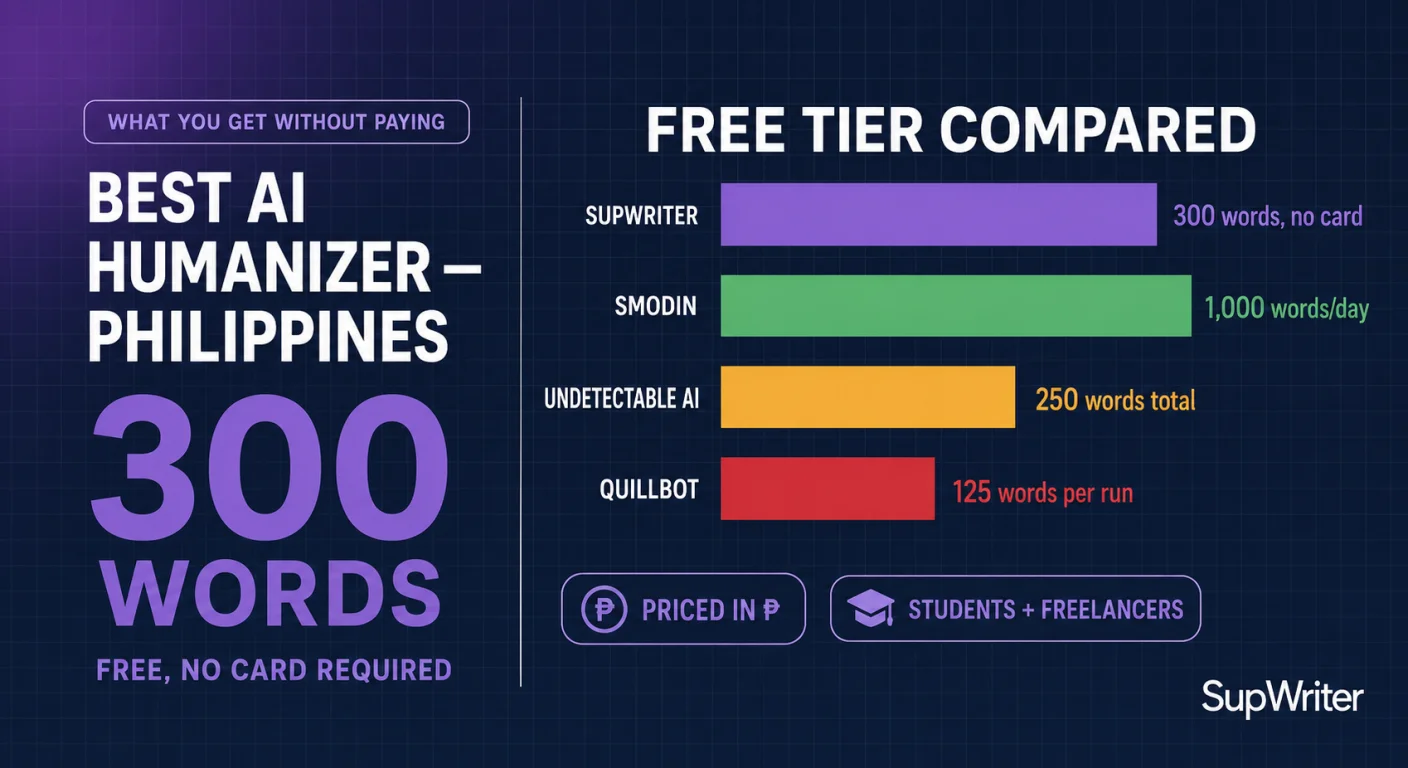
Yes, several. SupWriter gives you 300 words with no credit card (you need a free account). WriteHuman's free plan allows 3 requests a month of up to 250 words, QuillBot's free plan lets you paraphrase or humanize up to 125 words at a time, and BypassGPT's free plan is 150 words a month. None of them are large enough for production volume, but the bigger ones are enough to judge output quality before you pay.
Which alternative works best on Turnitin?
Nobody can honestly answer that with a number. Turnitin's AI score is visible only to instructors, so it's hard for outside testers to measure at scale, and we haven't published such a test for any tool, including SupWriter. Turnitin also says it looks for AI text that has been run through paraphrasers and bypasser tools (in English), and it consolidated its models in July 2026. No tool should be treated as guaranteed. Pre-check with an AI detector, keep your drafts, and remember that students can't see their own Turnitin AI score.
Do I need to switch at all?
Not necessarily. If Undetectable AI is clearing your detector, preserving your meaning, and not running you out of credits, it is doing its job. Switch when one of those three fails consistently.
Will running text through two humanizers improve results?
Usually not, and it often makes things worse. Stacking humanizers compounds semantic drift and produces the flat, over-paraphrased prose that some detectors flag on its own. Run one good pass, check it, then edit the remaining flagged sentences by hand.
Test the difference yourself with SupWriter's AI Humanizer — 300 words free, no credit card required.
Make an AI-assisted draft sound like you
Rewrite stiff, AI-sounding passages in a natural voice.
Free account, no card · 300 free words