By ShriPublished July 30, 2026Updated September 26, 2026
Best StealthGPT Alternatives (2026)
StealthGPT was one of the first tools to make "undetectable AI writing" a category. It got a lot of people through a lot of deadlines. But if you have landed on this page, something about it stopped working for you: the bill, the output, or a Turnitin report that came back red anyway.
This post compares StealthGPT alternatives on the things you can actually check: current pricing from each vendor's own page, word allowances, per-request caps, free options, and features. It does not rank tools by bypass rate. We haven't run the kind of controlled, per-detector test that would support a number like that, and we explain what such a test needs in how we test AI detectors.
Fair warning on bias: we build SupWriter, and it is listed first. We explain why below, including where competitors beat it. If this is for coursework, check your school's AI policy first; many allow AI for brainstorming but not for final text.
Why People Switch Away From StealthGPT
Four complaints come up over and over. Some are specific to one tool, and most apply to the whole category.
1. Pricing is confusing, and the real price is higher than the headline
We couldn't load StealthGPT's pricing page when we checked in September 2026, so this post doesn't quote its current plans. Check the page yourself before you buy, and look for three things: the billing cycle (weekly, monthly or annual), the words or requests included, and the per-request cap. If a tool's pricing is hard to pin down, budgeting for it is guesswork.
Watch for the "unlimited" label too. Daily request caps and per-request word ceilings are common in this category, so a plan that looks unlimited on the pricing page is usually metered somewhere else.
2. Output quality on academic text
Every humanizer can slip on grammar, phrasing, or word choices no human would make. For a blog post you can edit around that. For a thesis chapter with technical vocabulary and citations, cleanup takes real time.
Citation handling deserves its own check. Rewriting tools treat reference markers and author-date citations as ordinary text, so they can move, merge or drop them. Whatever you use, compare the reference list and in-text citations against your original after each pass. Our guide to AI humanizers for academic papers covers the academic workflow in more detail.
3. Turnitin now looks for humanized text
Turnitin's AI writing FAQ says it flags "likely AI-generated content that may have been modified by a word spinner/AI paraphrasing or bypassing tool to evade detection". That layer covers English submissions only. Since 4 August 2026, generated and modified text share a single blue highlight and one percentage. We covered the bypasser layer in our breakdown of Turnitin's bypasser detection.
The practical effect is that tools which mostly swap synonyms are exactly what that layer was built to catch. If your school uses Turnitin, re-check whatever tool you are on right now with a real draft of your own.
4. Weak support for non-English writing
Most humanizers are built English-first, and so are most detectors. Turnitin's AI detection covers only long-form English, Spanish, Japanese and Arabic, according to the same FAQ. GPTZero says it fully supports five languages. If you write in German, Arabic or Tagalog, both the rewriting and the checking get less predictable. Our non-English humanizer guide goes into what that means in practice.
How We Compared These Tools
For each tool we opened the vendor's own pricing page in September 2026 and recorded the list price, the words or requests included, the per-request cap, any free option, whether a detector is built in, and API or MCP access. Where a page didn't show a figure, we left it out rather than guess. Discounts, regional prices and promotions change often, so treat every number here as a list price on the date we checked.
What we did not do: run each tool's output through live Turnitin, GPTZero or Originality.ai accounts and publish pass rates. You can run that test yourself in a few minutes, and it will tell you more than any vendor chart (see "How to Pick the Right One" below).
6 StealthGPT Alternatives Worth a Look
The order weighs pricing transparency, how easy it is to test before paying, and the features around the humanizer. We list our own tool first, and we say so.
1. SupWriter: Our Pick (Disclosure: We Build It)
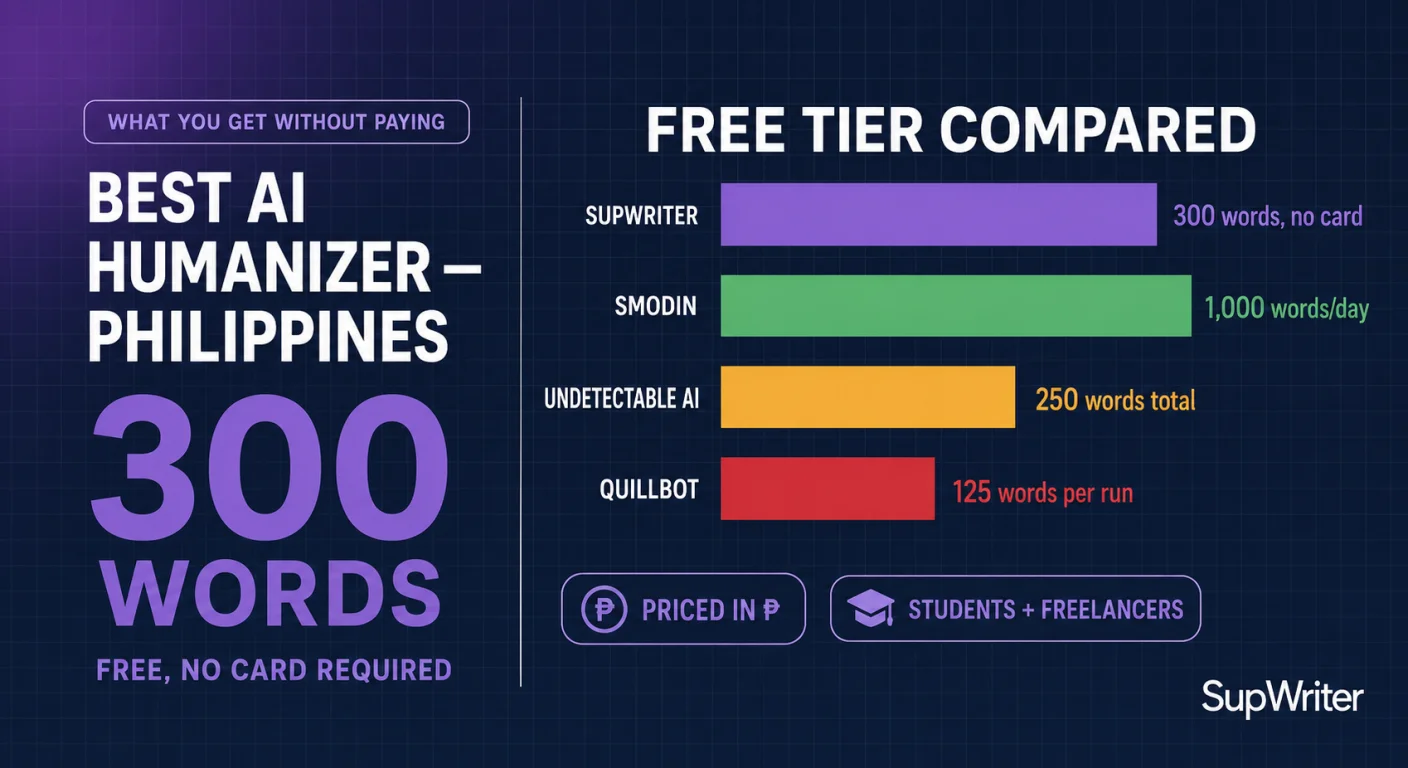
Pricing (list prices): Basic $9.99/month for 5,000 words, Pro $19.99/month for 15,000, Ultra $39.99/month for 30,000. Annual billing halves those: Basic works out to $4.99/month. Free tier: 300 words in total, one-time, with an account but no credit card.
We put SupWriter first because it's the tool we can vouch for end to end: we know exactly how it bills and what its detector does and doesn't do.
How it bills. Credits are per word, not per request: humanizing costs one credit per input word, so a 150-word paragraph doesn't burn a whole "request". Annual plans load 12 months of credits upfront, and extra credits can be bought.
What's around the humanizer. A built-in AI detector that is free on paid plans in the web app. It is a pre-check based on one scoring model with sentence highlights, not a copy of the detector your school uses. You also get 50+ languages in the editor, an API (keys on Pro and Ultra), an MCP server, a Chrome extension, an iOS app and a command-line tool.
Pros: per-word billing; free test with no card; monthly billing at every tier; built-in pre-check detector; developer tools.
Cons: not the cheapest per word. At list price, Basic costs $2.00 per 1,000 words monthly and $1.00 annually, and several tools below cost less per word on annual plans. The per-request cap is 500 words on Free and Basic, 2,000 on Pro and 5,000 on Ultra, so long documents on Basic need splitting. And no humanizer, ours included, can guarantee a detector result.
Best for: students and writers who want to test on their own text first, then pay by the word, month to month.
2. Undetectable AI: The Established Name
Pricing (vendor pricing page, checked Sept 2026): Starter is $9.99/month for 10,000 words, or $5.00/month billed annually ($60/year). Higher tiers run to 50,000 words at $42.50/month. Free trial: 250 words.
The most established name on this list. Every listed tier includes the humanizer, an AI detector with unlimited scans, the Human Auto Typer and API compatibility. The homepage says it supports 50+ languages, with English "offering the highest accuracy".
Pros: mature product with a wide tool suite; annual pricing is low per word ($0.50 per 1,000 words on annual Starter); detector included.
Cons: the 250-word trial is too short to judge much. Its terms limit refunds: credits are refunded only if a submission "provably flags as less than 75% human on a reputable AI detector". Its help center says to cancel by email. Our full Undetectable AI review covers the details.
Best for: marketers and content teams who want a suite and will commit to annual billing.
3. Walter Writes: Most Words for the Money on Annual Plans
Pricing (vendor pricing page, checked Sept 2026): Starter $96/year (about $8/month) for 30,000 words a month and 750 words per request; Pro $156/year (about $13/month) for 70,000 words and 1,500 per request. The page shows annual billing.
Walter Writes has been aggressive on word allowances. Its plans list a built-in AI detector, MCP server access, and "80+ languages" (the vendor's figure).
Pros: a lot of words for the money, about $0.27 per 1,000 words on annual Starter; detector included.
Cons: the prices we saw are annual commitments. The per-request cap on Starter (750 words) means splitting longer pieces. We didn't see a free trial listed on the pricing page.
Best for: bloggers and content teams working at volume who are happy to pay yearly.
4. WriteHuman: Request-Based Plans With a Free Tier
Pricing (vendor pricing page, checked Sept 2026): Basic $20/month or $12/month billed annually, for 80 requests a month at up to 600 words each. Pro $29/month ($19 annually) for 200 requests at up to 1,200 words. Free plan: 3 requests a month, 250 words each.
WriteHuman meters by request rather than by word. Every plan includes the humanizer and an AI detector, and paid plans include MCP access. There is also a Chrome extension.
Pros: a genuine free tier; detector on every plan; high per-request caps on upper tiers.
Cons: request-based limits reward long inputs. If you humanize short paragraphs, you use up requests quickly. Its monthly prices are higher than the other monthly-priced tools here.
Best for: writers who humanize full documents in a few large passes.
5. Rephrasy: Cheap at Volume, Counted in Humanizations
Pricing (vendor homepage, checked Sept 2026): Growth $99/year (about $8.25/month) for 100 humanizations a month of up to 2,000 words each. Business $120/year adds API access. A $12.99 Quick Pass gives 24 hours of unlimited use, and a lifetime plan is listed at $199.
Rephrasy's terms say it offers a free trial. Its Growth plan includes free re-humanizing and a Chrome extension.
Pros: very low cost per word if your runs are long; a short paid pass for one-off deadlines.
Cons: limits count runs, not words, so short inputs cost more per word. The plan prices shown are annual. Its terms rule out refunds on lifetime deals. We break the numbers down in Rephrasy pricing.
Best for: heavy users who process long documents and are comfortable paying yearly.
6. Humbot: Low Entry Price, Two Word Pools
Pricing (vendor pricing page, checked Sept 2026): Basic starts at $7.99/month for 3,000 "Basic" words plus 1,000 "Advanced" words a month, at up to 500 words per request. Higher tiers add more words; check the page for current prices. The page advertises a 30-day money-back guarantee.
Humbot bundles the humanizer with an AI checker and a long list of study tools (summarizer, grammar checker, citation generator and more), plus an API.
Pros: low entry price; money-back guarantee; lots of extras.
Cons: two separate word pools take some reading to understand, and the Basic plan's allowance is small. We compare it with SupWriter on our Humbot alternative page.
Best for: short, occasional rewrites alongside other study tools.
Also on the shortlist: Grubby AI, Phrasly, Netus AI and BypassGPT are all active in this category. We didn't re-check their pricing for this update, so see each vendor's current pricing page before comparing. Phrasly's plans are covered in our Phrasly pricing post.
Comparison Table
All figures are entry-plan list prices from each vendor's pricing page, checked September 2026. "Not listed" means the page didn't show it.
| Tool | Entry price | Included | Per-request cap | Free option | Built-in detector | API / MCP |
|---|---|---|---|---|---|---|
| SupWriter | $9.99/mo ($4.99/mo annual) | 5,000 words/mo | 500 words (Basic) | 300 words once, no card | Yes, free on paid web plans | API on Pro and Ultra; MCP |
| Undetectable AI | $9.99/mo ($5.00/mo annual) | 10,000 words/mo | Not listed | 250-word trial | Yes | API listed |
| Walter Writes | $96/yr (about $8/mo) | 30,000 words/mo | 750 words | Not listed | Yes | MCP listed |
| WriteHuman | $20/mo ($12/mo annual) | 80 requests/mo | 600 words | 3 requests/mo | Yes | MCP on paid plans |
| Rephrasy | $99/yr (about $8.25/mo) | 100 humanizations/mo | 2,000 words | Free trial (per terms) | Yes | API from Business |
| Humbot | $7.99/mo | 3,000 + 1,000 words/mo | 500 words | Not listed | Yes | API listed |
How to Pick the Right One
Start with your detector, not the tool. If your institution runs Turnitin, a strong result on some other free checker tells you little. Test against the detector you will actually face, or at least treat any other score as a rough pre-check.
Check the free option before you pay. Run a real sample of your own writing, not the demo text on the homepage. Check the result in the AI detector you trust, and remember that scores vary by detector, text length and topic.
Do the cost-per-word math, not the sticker math. Divide the price by the words you will really use. Request-based plans are cheap if your inputs are long and expensive if they are short. Annual plans are cheap if you use them all year and wasteful if you don't. Our AI humanizer pricing comparison sets out the arithmetic across the market.
If you write academically, test citations first. Paste in a paragraph with three references in your citation style and see what comes back. This one test rules out a lot of tools in about ninety seconds.
If you write in another language, test in that language. English performance tells you very little about Spanish or Arabic performance, and detector coverage outside English is patchy too.
The Honest Summary
StealthGPT is not a scam and it is not useless. It is a first-generation tool in a category where detection keeps moving. Turnitin now screens English text for bypass tools, and since August 2026 it folds that into a single score. If StealthGPT still works for your content and your detector, there is no urgent reason to switch.
If it does not work for you any more, the alternatives above are meaningfully different products, not clones: per-word versus per-request billing, monthly versus annual, suites versus single tools. Whether the problem was a red Turnitin report, an hour of cleanup, or a bill you couldn't explain, match the tool to the stakes. Casual blog copy and a graded dissertation are not the same job, and they don't need the same tool.
Test SupWriter against your own writing before you decide — 300 words free, no credit card required. Try the AI Humanizer.
Make an AI-assisted draft sound like you
Rewrite stiff, AI-sounding passages in a natural voice.
Free account, no card · 300 free words