By SarathPublished July 30, 2026Updated September 26, 2026
Best AI Humanizer in Australia (2026)
Australia is the country that started switching the detectors off.
That is not a figure of speech. The University of Queensland disabled Turnitin's AI detection tool in mid-2025, on the blunt reasoning that AI detection tools "are flawed and unreliable" and "cannot definitively determine whether text, ideas, or structures were generated by AI" (UQ's rules for using AI in assessment). Curtin University followed: from 1 January 2026, Turnitin's AI writing detection was disabled "with effect across all campuses and study periods," while text-matching stays on (Curtin's announcement). Across the sector, the AI writing indicator increasingly comes with caveats, or with an explicit instruction to markers that a score is not evidence.
So why does anyone in Australia still need a humanizer? Because the detectors did not vanish. They got quieter, more uneven, and much harder to predict. And what replaced them is arguably a bigger problem for the average student.
What Actually Changed: The Australian Detection Retreat
The regulator drove a lot of this. In June 2024 TEQSA, the national higher education regulator, asked every Australian higher education provider for "a credible institutional action plan addressing the risk generative artificial intelligence (gen AI) poses to award integrity." It received a 100% response rate and turned the results into a toolkit, Gen AI strategies for Australian higher education: Emerging practice, published in November 2024, followed by a research-training edition in June 2025 (TEQSA). The through-line is consistent: institutions are expected to protect the integrity of their awards through how they assess, not by leaning on a detector score.
The practical result is a fragmented map. Some universities have disabled the AI indicator outright. Some never enabled it. Some still run it but wrap it in policy stating it cannot be the sole basis of an allegation, which is also Turnitin's own guidance (Turnitin's AI detection FAQ). Our post on universities dropping AI detection keeps the running list, and the dates matter: UQ's switch-off came in mid-2025, Curtin's announcement in September 2025, and Curtin's switch-off itself on 1 January 2026.
Here is the catch for you as a student. You almost certainly do not know which category your unit sits in. Policy is set at faculty and sometimes unit level, tutors have discretion, and settings change between semesters. Turnitin is still the plagiarism infrastructure of the sector; only the AI indicator is contested. For the mechanics of what it measures when it is switched on, see our guide to whether Turnitin detects AI writing.
The Thing That Replaced Detection Is Harder
The direction TEQSA has pushed is not "trust students more." It is assessment that holds up without a detector: vivas, oral defences, supervised in-person writing, process portfolios, and program-level assurance points. That is a rational response to an unreliable detector. It is also a much steeper ask than a similarity report.
If your mark now partly depends on defending your own paragraph out loud in a ten-minute viva, you need to genuinely own the text you submitted. Pasting machine output and hoping fails harder in this system than it did under detection.
This reframes what a humanizer is legitimately for here. Not as a way to launder text you cannot explain — a viva will find that in ninety seconds. But as a way to make writing you researched and understand read in your own register rather than the flattened cadence AI-assisted drafting leaves behind, and as insurance against being wrongly flagged in the units that still have the indicator on.
Australia's International-Student False Positive Problem
Australia had 687,810 international students in the first half of 2026, across 771,270 enrolments. That total was down 7% on the same period of 2025, even as higher education enrolments grew 2% (Department of Education). Proportional to population, it is one of the most international student bodies on earth, which means Australia carries an unusually heavy share of the false positive problem.
Stanford researchers who ran seven GPT detectors over 91 TOEFL essays by non-native English writers found the detectors flagged 61% of them as AI-generated on average, while native speakers' essays were accurately identified (Liang et al., 2023; see our post on AI detection and ESL students). Detectors measure perplexity — how predictable your word choices are — and burstiness, how much your sentence lengths vary. Second-language writers score badly on both for entirely respectable reasons: careful vocabulary, safe uniform sentence length, formal register learned from textbooks.
UQ named the same equity problem when it switched its detector off: AI detection tools "generate false positives and disproportionally flag certain cohorts of students." It is the same pattern we documented for the Indian market, where the falsely-flagged writer is often the one who never used AI at all. If you are in that position, our guide on how to prove your writing is human walks through what actually convinces an integrity panel.
The Spelling Tell Nobody Warns You About
Here is a small, distinctly Australian issue that costs marks quietly.
Almost every major language model defaults to American spelling and American academic idiom. Ask for an essay and you get "analyze," "behavior," "defense," "toward." Australian academic English runs on "analyse," "behaviour," "defence," "towards," and the -ise ending almost universally.
Your marker may not consciously register the spelling. They will register that the writing feels imported. In a unit where the tutor is already alert to AI use, US-flavoured prose in an Australian assignment is a soft signal that invites a closer look, before any detector is involved.
Three practical steps, regardless of which tool you pick:
- Set your word processor's language to English (Australia), not English (US). That catches most of it.
- Watch what spellcheck will not flag: "program" is correct in Australian usage, "licence" is the noun and "license" the verb, "practice" the noun and "practise" the verb.
- Check citation style separately. Australian units commonly run APA 7, Harvard, or AGLC for law, and models reach for whatever was most common in training.
None of the tools below advertises an Australian English locale mode, so treat this as a manual pass you do after humanising rather than something to outsource.
The Ranking
How we ordered this list: by what you can check, not by bypass claims. We compared list prices, word allowances, per-request limits and free-trial terms on each vendor's pricing page in September 2026, plus built-in checking and fit for assessed writing. We have not published live bypass tests against Turnitin or any other detector (how we test), so there are no pass rates here. We make SupWriter, so weigh our first pick accordingly.
1. SupWriter
Why it tops the list for Australia: in a sector where you often cannot tell whether your unit runs the detector, it lets you rewrite and pre-check in the same place. The built-in AI detector gives one score plus sentence highlights, so you can see which lines still read as machine-written. It is a pre-check based on one scoring model, not Turnitin, and no tool can guarantee how your university's detector will score your work.
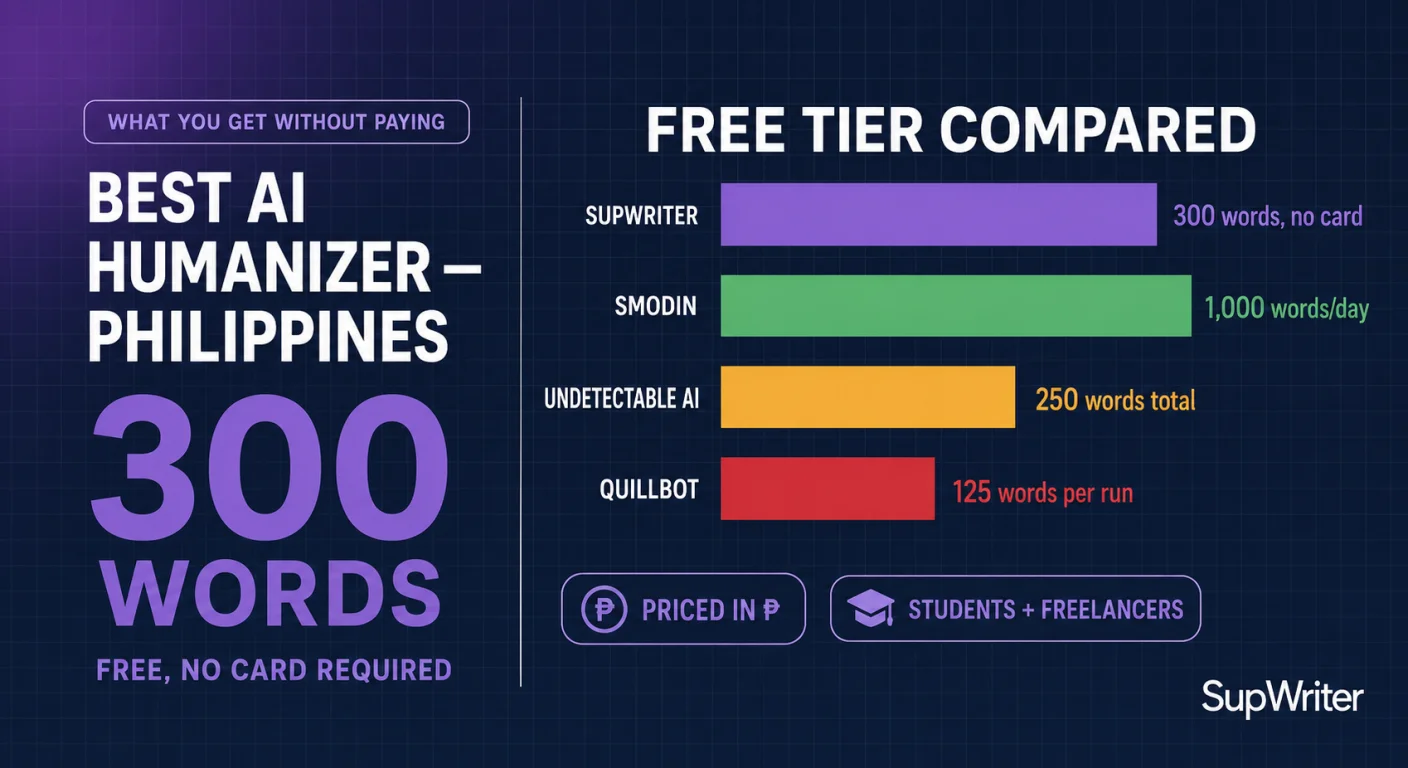
Basic is 9.99 USD a month for 5,000 words (500 words per request), and Pro is 19.99 USD for 15,000 words (2,000 per request). Annual billing halves those list prices. The 300 free words need a sign-in but no card — which matters when you are testing from Australia and do not want an international recurring charge sitting on your card.
Pros: detector and humanizer in one place, an Academic writing tone on paid plans that suits Australian assignment registers, 50+ languages for an international cohort, no card to trial.
Cons: 300 free words is a sanity check, not an essay. Basic's 5,000 words a month and 500-word requests are tight for a heavy semester, and at 2.00 USD per 1,000 words on monthly billing it is not the cheapest per word here. No Australian English locale switch, so you still do the spelling pass yourself.
Best for: students at universities where detector policy is unclear, and anyone whose own writing keeps getting flagged.
2. Undetectable AI
The best-known of the mainstream alternatives, at 9.99 USD a month for 10,000 words, or 5.00 USD a month billed annually.
Pros: twice SupWriter Basic's monthly words for the same monthly price, a mature product, and a pricing page that advertises a money-back guarantee tied to flagged output (read the conditions before relying on it).
Cons: the free trial is limited to 250 words, and the pricing page does not state a per-request limit, so check how it handles a full assignment before paying.
Best for: general content work and regular, predictable volume.
3. Humbot
Pros: simple and fast to use, with Basic listed at 7.99 USD a month and a free plan mentioned in its FAQ.
Cons: Basic's allowance is split into 3,000 "Basic" and 1,000 "Advanced" words a month, with a 500-word input limit per request. That is thin for assessed writing.
Best for: short English passages where the stakes are low.
4. Phrasly
Unlimited humanizing at 10.99 USD a month billed annually, with up to 5,000 words per run and a 2 USD three-day pass to try it.
Pros: no word bank to ration, a clean interface, and a long per-run limit.
Cons: the headline price means paying for a year upfront in US dollars, and the pricing page does not clearly show a month-to-month rate.
Best for: heavy users who are comfortable with an annual commitment.
5. Smodin
An all-in-one writing toolkit rather than a dedicated humanizer, with Starter at 10 USD a month billed annually and Premium at 16 USD.
Pros: a broad toolkit for the price, with a more advanced humanizer tier on Premium.
Cons: the pricing page does not spell out humanizer word limits or a free allowance, so check the live site before you plan a semester around it, and read the renewal terms before you subscribe from overseas.
Best for: students who want a general toolkit and only occasional humanizing.
6. WriteHuman
Pros: straightforward to use, with an AI detector on every plan and a Chrome extension. Basic is 12 USD a month on annual billing, or 20 USD month-to-month.
Cons: Basic caps each request at 600 words across 80 requests a month, so long essays get chunked and stitched back together. The free plan is three 250-word requests a month.
Best for: creative pieces and personal writing.
7. NaturalWrite
Pros: Pro is 9.99 USD a month billed annually for 15,000 words, and Basic is 4.99 USD for 5,000 — the same annual prices and allowances as SupWriter's Basic and Pro.
Cons: the pricing page does not state per-request limits or a free allowance.
Best for: casual rewriting where detection is not in play.
8. QuillBot
Probably the most widely used writing tool on Australian campuses, and a paraphraser before it is a humanizer.
Pros: enormous familiarity, genuinely good paraphrasing, solid grammar tools, and the free tier is fine for rewording.
Cons: the free plan paraphrases 125 words at a time in two modes, and its AI Humanizer is also capped at 125 words for free users; Premium is 8.33 USD a month billed annually. That 125-word ceiling is the practical killer in a sector moving toward vivas: you cannot get a feel for how a whole argument reads back to you when the tool only ever sees a sentence and a half of it at a time. And Turnitin says its detector covers AI text run through paraphrasing tools, in English.
Best for: paraphrasing and vocabulary. Not for clearing a detector.
All competitor prices above come from each vendor's pricing page, checked in September 2026.
What These Prices Feel Like in Australian Dollars
Every tool here bills in US dollars. Your bank converts at its own rate, and many cards add a foreign transaction fee on top, which the sticker price never shows you.
The Reserve Bank's rate on 25 September 2026 was 0.7019 US dollars per Australian dollar, so one US dollar cost about 1.42 AUD (RBA exchange rates). Treat the conversions below as indicative — your card's rate and fee will move them.
| Tool | Price (USD) | Approx. AUD | Words included | Free option |
|---|---|---|---|---|
| SupWriter Basic | 9.99 monthly, 4.99 annual | about 14.23, or 7.11 | 5,000 a month (500 per request) | 300 words total, sign-in, no card |
| Undetectable AI Starter | 9.99 monthly, 5.00 annual | about 14.23, or 7.12 | 10,000 a month | 250-word trial |
| Humbot Basic | 7.99 | about 11.38 | 3,000 Basic + 1,000 Advanced | Free plan (allowance not stated) |
| Phrasly Unlimited | 10.99, billed annually | about 15.66 | Unlimited humanizing, 5,000 per run | 2 USD for three days |
| Smodin Starter | 10, billed annually | about 14.25 | Not stated on pricing page | Not stated on pricing page |
| WriteHuman Basic | 20 monthly, 12 annual | about 28.49, or 17.10 | 80 requests of up to 600 words | Three 250-word requests a month |
| NaturalWrite Pro | 9.99, billed annually | about 14.23 | 15,000 a month | Not stated |
| QuillBot Premium | 8.33, billed annually | about 11.87 | No monthly cap listed | 125 words per paraphrase |
Competitor figures: vendor pricing pages, checked Sept 2026. SupWriter figures are list prices; student, regional and promotional discounts exist.
Our full pricing breakdown compares more tools. Two things to keep in mind when you read any table like this. Annual-only prices need a year upfront. And there is deliberately no "bypass rate" column, because no tool can promise how your university's detector will score your specific assignment.
Choosing, Practically
If you do not know your unit's detector policy, and most students do not, assume the indicator is on. The cost of being wrong in that direction is a conversation with an integrity officer.
If your assessment involves a viva or supervised component, the humanizer is the smaller half of the job. Understand your argument well enough to defend it unaided, then use humanisation to make the prose sound like the person sitting in that room.
If you keep getting flagged on writing that is genuinely yours, which happens to Australia's international cohort far too often, ask to talk it through out loud, and ask early. The sector has spent the last few years being pushed by TEQSA toward assessment that does not depend on detection, and the alternative it favours happens to be the fastest way to clear an innocent student: a short oral conversation about your own argument. So offer one before anybody requires it. Walk your tutor through why you structured the second section the way you did, where the counter-argument came from, which source you nearly used and dropped and why. A detector score is a claim nobody in the room can interrogate. Ten minutes of you reasoning aloud is evidence a marker can actually weigh.
If price is the binding constraint, start with the tools that let you test without a card. A free trial that demands card details is telling you something about the company.
The Bottom Line
Australia is further along the post-detection path than almost anywhere else. TEQSA pushed every provider to plan for AI's risk to award integrity. UQ and Curtin switched Turnitin's AI indicator off. Elsewhere in the sector the indicator runs with caveats, or not at all.
That has not made the problem go away — it has made it unpredictable, and shifted the real risk toward assessments you have to defend in person. Meanwhile the false positive problem still lands hardest on the international students Australian universities depend on.
SupWriter takes the top spot because it answers the question Australian conditions actually pose: when you cannot be sure whether a detector is watching, it lets you rewrite and check in one place, with no card needed to try it. It is not the cheapest per word. Undetectable AI gives you twice the words for the same monthly price, and Phrasly's annual Unlimited plan is cheaper still if you write a lot. If you only need a few hundred words cleaned up, start with a free trial on your own draft.
Whichever you choose, test it on your own writing before you need it, and do the Australian spelling pass yourself.
Try SupWriter's AI humanizer on your next assignment: 300 words free, no credit card required.
Make an AI-assisted draft sound like you
Rewrite stiff, AI-sounding passages in a natural voice.
Free account, no card · 300 free words