By ShriprasannaPublished March 1, 2026Updated September 26, 2026
Free Turnitin AI Detector Alternatives: 10 Checkers Compared (2026)
Turnitin's AI writing detector isn't sold to individuals. Turnitin licenses it to schools and organizations, and its own help center says it "does not sell individual licenses or single-use subscriptions" (Turnitin Help Center), so there is no official free Turnitin AI checker. What a student can realistically do instead is pre-check a draft with a free detector that runs its own model, compare two of them, and keep evidence of how the paper was written.
Below: what Turnitin's detector actually does, per Turnitin's own guides; 10 free or free-trial Turnitin AI detector alternatives, each cell checked on the vendor's own pages in September 2026; an honest answer to "which one is closest to Turnitin?"; and a warning about sites that sell "Turnitin checks." Disclosure: SupWriter makes one of the ten tools, and its row follows the same rules.
What Turnitin's AI detector actually does
Unless another link is given, the quotes in this section come from Turnitin's AI writing detection capabilities FAQ, checked on 26 September 2026.
- It's an institutional add-on. AI writing detection is available only to customers that license Turnitin Originality. Turnitin points individuals to iThenticate instead, but iThenticate's individual plans (from $125 for one manuscript of up to 25,000 words) are marked "AI writing detection not available" on iThenticate's own site.
- Four languages. Turnitin detects likely AI text in "long-form English, long-form Spanish, long-form Japanese, and long-form Modern Arabic." Arabic arrived on 18 August 2026 (Turnitin product updates). For any other language, "the detector will not process the submission" and the indicator shows an empty or error state.
- A 300-word floor. A file needs "at least 300 words of prose text in a long-form writing format," and only prose counts: Turnitin analyzes "blocks of text that are written in standard grammatical sentences." Files can't exceed 30,000 words or 100 MB, and must be .docx, .pdf, .txt or .rtf.
- Low scores become an asterisk. From 1% to 19%, Turnitin shows
*%with no highlights, "to avoid potential incidence of false positives." - Not the sole basis for action. Turnitin says the percentage "should not be used as the sole basis for action or a definitive grading measure by instructors." It aims to keep false positives "under 1% for documents with over 20% of AI writing." That is Turnitin's own figure, not an independent measurement.
- Paraphrase and bypasser detection is English-only. Turnitin says it can flag AI text "modified using a word spinner/AI paraphrasing or bypassing tool," but "our AI paraphraser & bypasser detection is currently only available for English language submissions." Bypasser detection was announced on 27 August 2025 (Turnitin press release).
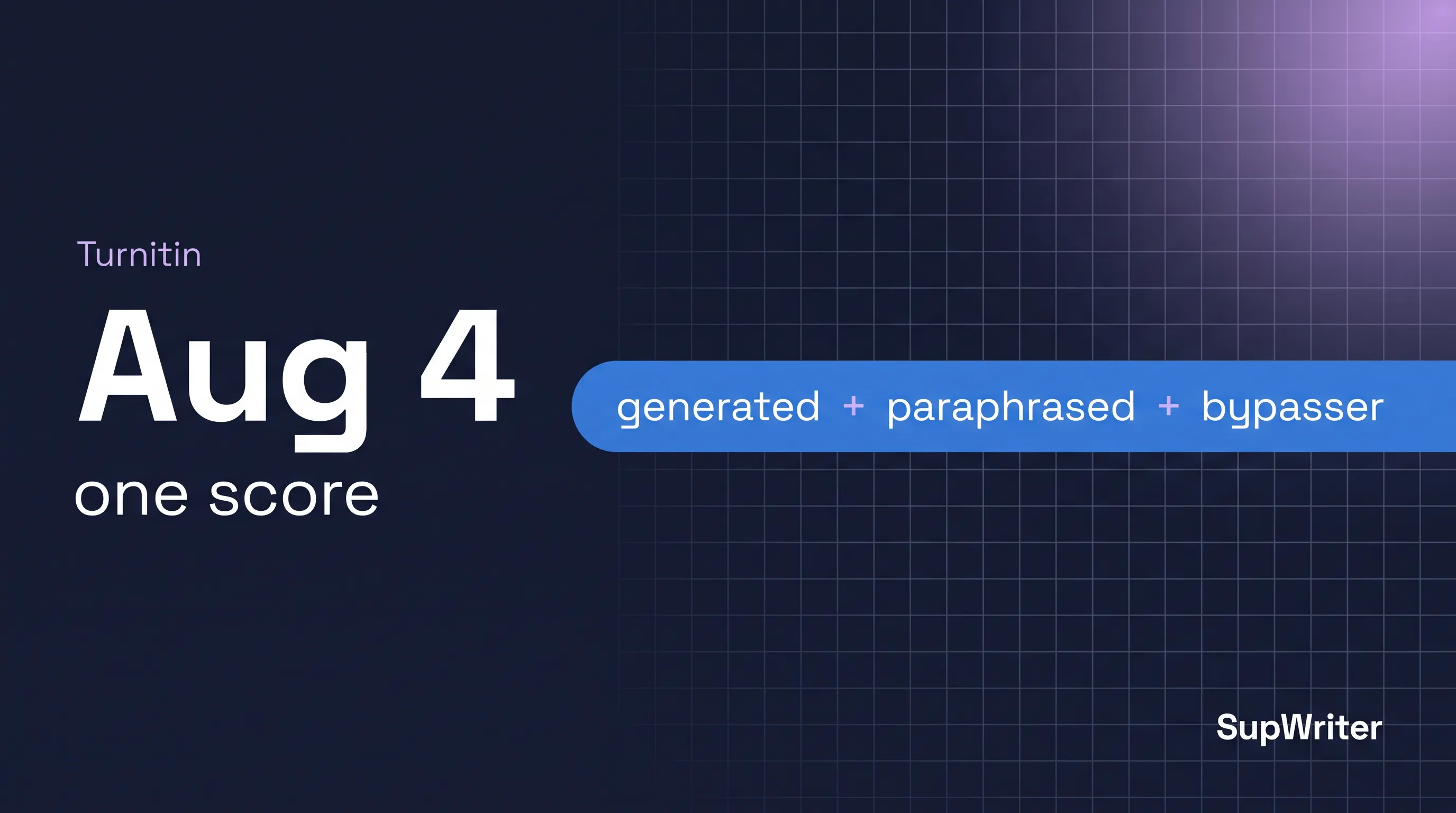
- One model since July 2026. "In July 2026, we updated our model architecture to consolidate a multi-model ensemble into a single model." On 4 August 2026 the report for English submissions switched to "a single, unified set of blue highlights," which also covers text Turnitin attributes to paraphrasers or bypassers (product updates). We walk through the redesign in Turnitin's August 2026 update.
- Students don't see it. "The AI writing detection indicator and report are not visible to students." Instructors can download the report as a PDF and share it. More in Can students see their Turnitin AI score?
On 26 September 2026, the newest AI-detection entries on Turnitin's product-updates page were still the 4 August redesign and the 18 August Arabic launch; the September entries so far don't change the detector.
Two things follow. No outside tool can show you "your Turnitin AI score," because the classifier isn't public. And since the AI indicator is hidden from students, a percentage you see in Turnitin after submitting isn't the AI score; it's usually the similarity (text-matching) score, a different report. See Turnitin similarity score vs AI score.
Free AI detectors compared (checked Sept 2026)
Every cell below was checked on the vendor's own detector, pricing or help pages on 26 September 2026. Limits are in the vendor's own unit (words or characters). Prices are USD list prices for one person, before promo codes. "Not stated" means the page we opened didn't say.
| Tool | Free limit per check | Sign-up needed? | Languages (as the vendor states them) | Sentence highlights | File upload | Paid plan from |
|---|---|---|---|---|---|---|
| Turnitin (reference, not free) | No free or individual access | Only through your school | English, Spanish, Japanese, Arabic | Yes, instructor view only | .docx, .pdf, .txt, .rtf | Institutional quote |
| GPTZero | 10,000 characters; 10,000 words a month | No, up to 10,000 characters | Fully supports English, German, Portuguese, French, Spanish | Yes; 1 free Advanced Scan | Yes | $12.99/mo billed annually (Premium) |
| ZeroGPT | 15,000 characters | No (homepage checker) | "All languages" | Yes | .txt, .docx, text-based .pdf | $13.99/mo, or $9.99/mo billed annually |
| QuillBot | Under 1,200 words | No, under 1,200 words | English, French, Spanish, German, Dutch, Portuguese | Labels sections in 4 categories | Yes; bulk upload is Premium | $8.33/mo billed annually |
| Scribbr | 1,200 words, unlimited checks | No | "Multiple languages, including German, French, and Spanish" | Paragraph-level | Not stated | Not stated |
| Copyleaks | 25,000 characters | No; free account unlocks highlights | "Over 30" | With a free account | Yes | $16.99/mo, or $13.99/mo billed annually |
| Grammarly | Not stated | Not stated (no sign-up step shown) | Not stated | Pro agent shows which parts | Yes | Not stated (regional pricing) |
| Originality.ai | 2,000 words, 3 scans a day | No | 30 (31 in its help center, incl. Japanese, Arabic) | Yes | .docx, .pdf, .doc | $14.95/mo, or $12.95/mo billed annually |
| Winston AI | 2,000 credits for a 14-day trial (1 credit per word) | Yes | 14 listed | Yes (sentence map) | .docx, .pdf, .txt; OCR | $18/mo, or $10/mo billed annually |
| Sapling | First 2,000 characters | Not stated (no sign-up step shown) | Not stated | Yes | PDF, DOCX | $25/mo, or $12/mo billed annually |
| SupWriter (ours) | 300 words in total, one-time | Yes (free account, no card) | No published list for the detector | Yes | .txt, text-based .pdf | $9.99/mo, or $4.99/mo billed annually |
Sources, all checked Sept 2026: Turnitin (AI writing FAQ, product updates); GPTZero (homepage FAQ, pricing); ZeroGPT (checker, pricing, FAQ); QuillBot (AI Detector guide, revised July 2026, Premium); Scribbr (AI Detector); Copyleaks (AI Detector, pricing); Grammarly (AI Detector); Originality.ai (homepage, pricing, languages); Winston AI (homepage, pricing, help center); Sapling (AI Detector, pricing); SupWriter (pricing, AI Detector).
Two things to watch when you read the table:
- Characters are not words. A limit in characters covers far fewer words than the same number in words. Paste your whole paper and check whether the tool cut anything off.
- Some limits are monthly or one-time. GPTZero also caps the free plan at 10,000 words a month, Originality.ai at three scans a day, Winston's credits must last the whole trial, and SupWriter's 300 free words are a one-time allowance.
The ten tools, briefly
These notes add what the table can't show.
GPTZero
Results show a document percentage and highlight the phrases GPTZero flagged, and the one free "Advanced Scan" "shows you how different sentences contribute to your results." GPTZero lists "Multilingual AI detection" as a Premium feature. It also offers Writing Replay in Google Docs, which it calls "video proof of the writing process." Our GPTZero vs Turnitin comparison goes deeper.
ZeroGPT
You can run a check straight from ZeroGPT's homepage (up to 15,000 characters); its free plan is listed at "$0 forever" with "No credit card needed." It says "every sentence written by AI is highlighted," and its FAQ says checked text "is not saved, shared, published online, or used to train" its model. Batch upload starts on paid plans.
QuillBot
Instead of one verdict, QuillBot sorts text into four groups: AI-generated, AI-generated and AI-refined, human-written and AI-refined, and human-written. That's useful if you polished your own draft with an AI editor, because "refined" is a different label from "generated." The six languages come from QuillBot's guide, revised July 2026; QuillBot's detector page separately says it "supports 20+ languages." Its Premium page showed only the annual rate.
Scribbr
Scribbr is candid about its free tier: "Our free AI Detector can detect texts written using GPT2, GPT3, and GPT3.5 with average accuracy, while our Premium AI Detector has high accuracy and the ability to detect GPT4." If your draft involved a newer model, keep that in mind. Feedback is at paragraph level, and the detector page showed no Premium price.
Copyleaks
No login is needed up to 25,000 characters. A free account adds "sentence-by-sentence insights, highlighted AI-written phrases, and pattern breakdowns." The language list on its detector page includes Japanese, one of Turnitin's four; Arabic isn't on that page, though Copyleaks' API documentation lists it. The Personal plan includes 100 credits, which Copyleaks says scan up to 25,000 words.
Grammarly
The free detector shows "what percentage of your text appears to be AI-generated"; seeing "exactly which parts may sound AI-generated" is a feature of the AI Detector agent in Grammarly Pro. Grammarly's plans page showed us regional pricing, so we couldn't confirm a US price. To its credit, its FAQ says "No AI detector is 100% accurate."
Originality.ai
The free tier lets you "run up to 3 free AI scans daily without an account," with file upload. The homepage says "30 languages," while the help center lists 31, including Japanese and Modern Standard Arabic, which makes it one of the few free options that names both. On Pro, 1 credit equals 100 words.
Winston AI
Winston's help center says the AI detector costs 1 credit per word, so the 2,000-credit trial covers about 2,000 words in total, and you register to start. Its "AI Prediction Map" gives a sentence-by-sentence breakdown, though Winston notes the map "is less accurate than the overall Human Score." It can also OCR scanned pages and handwriting. When we checked, it was advertising a 50% discount code.
Sapling
The free check "covers the first 2,000 characters," so on a full essay it reads only the opening; Pro raises that to 100,000. Sapling adds a useful caveat: "Highlights mark local signals. They do not represent the percentage of words written by AI and can differ from the overall score." Better support for more languages is listed as in development.
SupWriter (ours)
Our AI Detector needs a free account, but no credit card. The 300 free words are a one-time allowance shared with our other tools; on paid plans, detection in the web app doesn't use credits. It runs one scoring model with sentence highlights, and the results screen maps that single score onto 12 named labels, including Turnitin and GPTZero, as a rough guide. It does not send your text to those detectors (how the score works). We don't publish a language list for the detector, so treat non-English scores with caution. SupWriter also makes an AI humanizer; we don't claim its output passes any detector.
Which AI detector is closest to Turnitin?
The honest answer: none of them is Turnitin, and none can tell you what Turnitin will say. Turnitin's classifier isn't public, and each tool above runs its own model, with its own training data, thresholds and way of splitting text. What you can do is pick an AI detector similar to Turnitin in the ways that matter for your paper.
What "close" can actually mean
Same languages. Turnitin only scores long-form English, Spanish, Japanese and Modern Arabic. Spanish appears in most vendors' lists above; Copyleaks and Originality.ai name Japanese; Originality.ai lists Modern Standard Arabic, and Copyleaks' API docs list Arabic. If your paper is in any other language, Turnitin won't produce an AI score at all, so there's nothing for a free score to be "close" to. And vendors that claim dozens of languages don't always publish accuracy figures for each one, so look for figures in your language before you trust a score.
Similar length rules. Turnitin won't score fewer than 300 words of prose, and it skips text that isn't in grammatical sentences, such as lists. Check the full prose you'll submit, not one paragraph, in a tool whose free limit covers it. Sapling reads only the first 2,000 characters, and QuillBot and Scribbr stop at 1,200 words.
Similar score presentation. Turnitin gives instructors one percentage plus blue highlights and never displays a number between 1% and 19%. If a free checker shows your draft at 14%, don't read it as a Turnitin prediction: Turnitin wouldn't show that number, and a different model could score the same text quite differently. What matters more is whether long stretches of your prose are highlighted.
What independent research says
Three independent studies are worth knowing. None of them measures how often a free tool agrees with Turnitin's current model.
- Weber-Wulff et al. (2023), "Testing of detection tools for AI-generated text," International Journal for Educational Integrity 19, 26 (paper, preprint). The authors tested 12 publicly available tools and two commercial systems, Turnitin and PlagiarismCheck, between March and May 2023. Their 54 test documents mixed human writing, machine-translated human writing and ChatGPT output, including ChatGPT text edited by hand or paraphrased with QuillBot. They concluded the tools are "neither accurate nor reliable" and "have a main bias towards classifying the output as human-written rather than detecting AI-generated text," and noted that "even the highest accuracy values are below 80%." Turnitin scored highest, but this is a snapshot of early-2023 ChatGPT text, taken before Turnitin added bypasser detection or moved to a single model.
- RAID (Dugan et al., ACL 2024) (arXiv 2405.07940) is a benchmark of "over 6 million generations spanning 11 models, 8 domains, 11 adversarial attacks and 4 decoding strategies." It evaluated 12 detectors, including GPTZero, Originality, Winston and ZeroGPT, but not Turnitin. Its headline finding: "current detectors are easily fooled by adversarial attacks, variations in sampling strategies, repetition penalties, and unseen generative models." The authors add that many detectors "claim to detect machine-generated text with extremely high accuracy (99% or more)," so read vendor accuracy badges with that in mind.
- Liang et al. (2023), "GPT detectors are biased against non-native English writers," Patterns (arXiv 2304.02819). Seven widely used detectors misclassified over half of 91 human-written TOEFL essays as AI-generated (average false-positive rate 61.22%), and 89 of the 91 essays (97.8%) were flagged by at least one detector. Most detectors in that study were built on GPT-2, so newer tools may behave differently, but it's a strong reason never to treat one score as proof.
Our verdict
The closest you can get in practice is a tool that covers your paper's language, reads the whole paper in one check, and shows which sentences drove the score. For a long English essay, compare the per-check limits in the table. Without an account, Copyleaks takes 25,000 characters, ZeroGPT 15,000 characters, GPTZero 10,000 characters and Originality.ai 2,000 words.
Then run a second tool from a different vendor. If both flag the same passages, look at those passages closely. If they disagree, treat the result as uncertain, which is how Turnitin says its own score should be treated too: never as the sole basis for action. For what a fair detector test needs, see how we test AI detectors.
Beware "free Turnitin checker" sites
Search for "Turnitin checker free" and you'll find two kinds of offers that aren't Turnitin:
- Lookalike checkers. Some sites put "Turnitin" in their domain name but run their own model. One we opened is run by a company other than Turnitin and describes its results as "previews aligned with Turnitin's detection approach." That's a free AI detector with a borrowed name, no closer to Turnitin than the tools in the table.
- Resold access. On one digital-goods marketplace we opened, independent sellers list month-long Turnitin accounts with daily file-check allowances, for as little as a few dollars, and none claims to be affiliated with Turnitin.
Turnitin's own documents explain why the second kind is a bad idea:
- It isn't something Turnitin sells to you. Turnitin sells to institutions, not individuals, its individual iThenticate credits exclude AI detection, and only instructors and administrators can see the AI indicator. So a genuine Turnitin AI report sold to a student has to come from an institution's account.
- It goes against Turnitin's terms. Turnitin's user agreement says users "agree not to share Your password with any other person" and not to "market, rent, lease, or re-license the Services, or use the Services for third party commercial use, commercial timesharing, or service bureau use."
- Your paper may be stored. Turnitin assignments can keep submissions in a general repository, where they "can be used for comparison against other submissions from your institution and others" (Turnitin assignment settings). You can't see which setting a stranger's account uses, and if your draft is stored there, your real submission could later match it.
- You lose track of your work. When Vanderbilt disabled Turnitin's AI detector, it cited "real privacy concerns about taking student data and entering it into a detector that is managed by a separate company with unknown privacy and data usage policies" (Vanderbilt). An anonymous seller is a less accountable version of that problem, and you can't verify that a report you receive came from Turnitin at all.
If you want a pre-check, use a detector that says what it is and publishes a privacy policy. If you want to know what Turnitin says, the official route is your instructor.
How to pre-check a draft before you submit
- Read the rules first. Your course and assignment AI policy decides what's allowed, not a detector. Some universities have stopped using Turnitin's AI score altogether; Vanderbilt disabled it in August 2023 "for the foreseeable future" (Vanderbilt). We track others in universities dropping AI detection.
- Write where history is saved. Draft in Google Docs or Word with version history on, save dated copies at each stage, and keep your outlines and reading notes. If your instructor uses Turnitin Clarity, Turnitin says your "writing process—from ideation to final submission—is visible to your instructor and serves as your 'proof of process'" (Turnitin guide).
- Check the whole paper as prose. Turnitin only scores 300 or more words of prose, so check the full text you'll submit, in a tool whose free limit covers it.
- Use two different detectors. Pick one from the table with sentence highlights, then a second from a different vendor, and note the passages both flag.
- Read flagged passages; don't chase a number. If a flagged passage is your own writing, keep it and keep your drafts. If it came from an AI tool in a way your course doesn't allow, rewrite it in your own words or disclose the use, as your policy requires. Turnitin shows anything from 1% to 19% as
*%, so zero isn't the goal; see what percentage of AI is acceptable on Turnitin. - Screenshot the results. Save each result with the date and tool name, next to your drafts.
- If you're flagged anyway, ask for the AI report (instructors can download it as a PDF) and walk through your drafts and version history. Our guide to proving your writing is human covers the evidence pack and the appeal.
A note on academic integrity
If you're a student, the point of these tools is to check that your submission reflects your own understanding and voice, and to catch problems before someone else does. The goal is not to fool a detector. Checking your own work before you hand it in is a responsible habit, not a dishonest one.
Frequently Asked Questions
Can students access Turnitin's AI detector for free?
No. Turnitin sells only to institutions and "does not sell individual licenses or single-use subscriptions," and its individual iThenticate credits exclude AI detection. Even at schools that license it, "the AI writing detection indicator and report are not visible to students," though your instructor can download the report and share it. More in Can students see their Turnitin AI score?
What AI score gets flagged on Turnitin?
Turnitin doesn't set a threshold. It shows 1–19% only as *%, says the percentage "should not be used as the sole basis for action," and leaves decisions to each institution. When the detector launched, Turnitin claimed a 1% false-positive rate; Vanderbilt noted it had submitted 75,000 papers to Turnitin in 2022, so "around 750 student papers could have been incorrectly labeled" (Vanderbilt). See what percentage of AI is acceptable on Turnitin.
Do free AI detectors agree with Turnitin?
Not reliably, and nobody can show you how often. Each tool uses a different model, and the studies above didn't measure agreement with Turnitin's current model: Weber-Wulff et al. tested Turnitin in spring 2023, and RAID didn't include it. Even within one tool, highlights and the overall score can diverge; Sapling says so explicitly. Use free detectors to find passages worth a second look, not to predict a Turnitin number.
Is it safe to upload my paper to a free AI checker?
It depends on the tool, so read the privacy policy before you paste anything sensitive. ZeroGPT's FAQ says checked text "is not saved, shared, published online, or used to train" its model, Scribbr lists "Confidentiality guaranteed," and SupWriter saves each check to your account history. The riskiest option is a stranger running your paper through a Turnitin account: you can't see whether it gets stored in a repository your final submission might later match, and selling that access goes against Turnitin's terms.
Does Turnitin detect humanizers and paraphrasing tools?
Turnitin says it does, for English. It announced AI bypasser detection on 27 August 2025, saying the feature "has been trained and tested to support interactions in English only," and its FAQ still says paraphraser and bypasser detection "is currently only available for English language submissions." Since 4 August 2026, English reports show that text in the same blue highlights as AI-generated text. No tool can guarantee how Turnitin will score a given paper.
SupWriter's AI Detector is a pre-check based on one scoring model, not the detector your school uses. 300 words free, no credit card required.
Related Articles

What SupWriter's AI Detector Actually Checks (vs Turnitin and Originality.ai)
How SupWriter's AI Detector Score Is Produced
How We Test AI Detectors: Method and Results So Far