By ShriprasannaPublished March 20, 2026Updated September 26, 2026
AI Detection in Medical Schools: 2026 Policy Guide
Medical schools treat AI differently than almost every other graduate program, and the reason is straightforward: a poorly trained doctor can kill someone. That's not hyperbole. It's the foundational argument that shapes policy decisions about AI in medical education, from first-year anatomy courses through fourth-year clinical rotations.
This distinction matters because it means the arguments that work in business school or law school (the ones where you can say "AI literacy is a professional skill") don't carry the same weight in medical education. Patient safety tends to win over efficiency arguments.
Policies vary by school and often by course, so this guide doesn't rank programs or claim a count of who allows what. Instead it covers the reasoning behind medical schools' caution, the national rules that apply to every applicant and researcher, where AI helps and where it gets students in trouble, and how detection actually works in 2026.
Why Medical Schools Take a Harder Line
The patient safety argument isn't just rhetoric. It reflects a genuine teaching concern that separates medical education from most other fields.
When a medical student writes a clinical case analysis, they're not just demonstrating writing ability. They're demonstrating clinical reasoning: the cognitive process of synthesizing patient data, forming differential diagnoses, and selecting appropriate interventions. This is the same thinking they'll need at 2 AM on a long call shift, when a patient's condition changes and there's no attending immediately available.
If an AI does that reasoning for a student, the student never develops the cognitive pathways that make clinical decision-making automatic. And unlike a business student who can look up a framework during a meeting, a resident can't ask a chatbot for a differential while a patient is coding.
There's also an integrity dimension that starts before you arrive. The AAMC's AMCAS application for the 2027 cycle asks every medical school applicant to certify: "Although I may utilize mentors, peers, advisors, and/or AI tools for brainstorming, proofreading, or editing, my final submission is a true reflection of my own work and represents my experiences" (AMCAS certification statements). The AAMC's ERAS guidance for residency personal statements draws the same line: "The use of AI tools is acceptable for brainstorming, proofreading, or editing the personal statement, but the final submission should represent your own work" (ERAS personal statement guidance). Brainstorming and editing help is allowed; the substance has to be yours.
How Medical School AI Policies Differ
Most medical school AI policies fall into one of four broad approaches. Knowing which one your program uses, and whether individual courses override it, is the first thing to check.
Full Prohibition
Some programs prohibit AI-generated content in any submitted work. These policies are unambiguous: using AI to generate text for assignments, case write-ups, clinical documentation, or research papers counts as academic dishonesty.
The reasoning is that clinical reasoning must be developed through practice, and offloading that practice to AI undermines the purpose of every written assignment. Enforcement can include Turnitin checks on written submissions and oral follow-up: you write the paper, then explain your reasoning to the course director. If you can't articulate what you wrote, that becomes evidence in its own right.
Restrictive with Exceptions
Other programs acknowledge AI's usefulness in certain contexts while drawing a firm line around clinical work.
A typical policy in this group looks something like: AI tools may be used for literature searches, study material, and organizing preliminary research. AI-generated text may not be submitted for any clinical assignment or patient case analysis.
This approach reflects a pragmatic view that banning AI entirely is hard to enforce and arguably counterproductive, since medical researchers already use AI tools, while holding that clinical education requires unassisted cognitive work.
Disclosure-Based (Moderate)
Some programs allow AI for a broader range of tasks but require disclosure and limit its use in clinical contexts.
A common mechanism is an "AI use statement" submitted with major assignments, describing which tools you used, how, and which portions of the work were AI-assisted. This transparency-first approach treats AI as a tool to be used responsibly rather than a temptation to be eliminated.
No Specific Policy
Some programs have no AI-specific language in their academic integrity documents. That doesn't mean AI use is safe. Broad honor codes that prohibit submitting work that isn't your own logically cover AI-generated text. The absence of specific guidance creates ambiguity that students often interpret, sometimes wrongly, as permission.
Where AI Is Useful in Medical Education
Medical school isn't monolithic. Some tasks genuinely benefit from AI assistance, and even cautious programs increasingly acknowledge this.
Research Proposals and Literature Reviews
This is often the safest and most productive use of AI for medical students. Using AI to search databases, summarize papers, identify gaps in the literature, and structure a research proposal mirrors how many researchers now work.
AI is particularly good at synthesizing large volumes of medical literature, a task that could take a student days. For systematic review preparation, it can help screen abstracts against inclusion criteria, extract key data points, and spot methodological patterns across studies. Verify every citation and data point it gives you.
If your research heads to a journal, the ICMJE's recommendations apply: "Chatbots (such as ChatGPT) should not be listed as authors because they cannot be responsible for the accuracy, integrity, and originality of the work." Authors who use AI should describe it in both the cover letter and the submitted work, with writing assistance described in the acknowledgments and AI used for data collection, analysis or figures described in the methods, and "humans are responsible for any submitted material that included the use of AI-assisted technologies" (ICMJE). If you're a medical researcher using AI for literature work, disclosure is the norm, not the exception.
Study Material Generation
Creating flashcards, practice questions, concept summaries, and study guides with AI is generally tolerated even under strict policies, because these materials are for personal use, not submission. Some policies explicitly carve out this kind of use.
AI-generated practice questions are especially popular for board prep. A model can generate USMLE-style questions on any topic, explain the reasoning behind each answer choice, and help you find knowledge gaps based on what you get wrong. Check its explanations against trusted resources, because a confident wrong explanation is worse than none.
Clinical Documentation Training
One promising approach is using AI as a training aid for clinical documentation: students write their own SOAP notes first, then compare them with an AI-generated version to see what they missed or structured poorly. Done under supervision, this builds documentation skills without replacing the student's independent clinical reasoning.
High-Risk Areas: Where AI Gets You in Trouble
Clinical Case Write-Ups
This is the highest-risk category in medical education. Clinical case write-ups require students to demonstrate their analysis of a real or simulated patient encounter, integrating history, physical findings, lab results, and imaging into a coherent assessment and plan.
AI can produce technically competent case write-ups. It can generate plausible differential diagnoses, suggest appropriate workups, and recommend evidence-based treatments. The problem is threefold:
First, AI case analyses lack the patient-specific detail that comes from actually interviewing and examining someone. An AI might list the top five differentials for chest pain in a 55-year-old man, but it won't mention that the patient smelled of alcohol, seemed anxious about a pending divorce, or had a surgical scar on his right knee suggesting prior orthopedic issues. Clinical reasoning incorporates observational data that AI never has access to.
Second, clinical faculty read a lot of student write-ups, and AI-generated reasoning can stand out: too clean, too comprehensive, too perfectly organized. Real clinical reasoning is messier.
Third, the consequences are severe. Academic integrity violations involving clinical work can lead to course failure, academic probation, or dismissal. And unlike a bad grade in biochemistry, clinical integrity issues can appear in your Medical Student Performance Evaluation (MSPE), the letter residency programs read when deciding whether to interview you.
USMLE Prep: The Gray Area
Board exam preparation occupies a genuinely gray space in medical education AI policy. Students use AI to generate practice questions, explain complex concepts, and find weak areas. Some faculty see this as legitimate study-tool use. Others argue that over-reliance on AI for board prep creates the same cognitive dependency that clinical AI use does.
The practical question isn't whether you use AI to study. It's whether AI-assisted studying actually prepares you for an exam that tests the clinical reasoning you'll need for patient care. Content knowledge is only half of that; the integrative reasoning that clinical vignettes demand comes from working through problems yourself. Treat AI questions as a supplement to established question banks, not a replacement.
How Detection Works in Medical Programs
Medical schools use a mix of detection strategies that goes beyond what many undergraduate programs rely on. Here's what each one actually does:
| Method | What it checks | What to know |
|---|---|---|
| Turnitin AI writing detection | Whether qualifying prose looks AI-generated, paraphrased, or bypasser-modified | Needs 300+ words of prose; shows 1–19% only as an asterisk; English, Spanish, Japanese and Modern Arabic only; the score is instructor-only |
| iThenticate | Similarity for research manuscripts; AI writing detection with Turnitin's AI capabilities add-on | Research and publishing tool rather than a coursework checker |
| Oral defense / viva voce | Whether you can explain and defend your own reasoning | Hard to fake clinical reasoning under questioning |
| Writing sample comparison | Consistency with work you've produced in class | Sudden shifts in voice or sophistication stand out |
| Process documentation | Drafts, outlines, revision history | Your best evidence if you're ever questioned |
Two Turnitin details matter here. Its FAQ says the AI percentage "should not be used as the sole basis for action or a definitive grading measure," and it describes a false-positive target of under 1% for documents with over 20% AI writing (Turnitin AI detection FAQ). Its detection of AI-paraphrased and bypasser-modified text works for English only.
Oral follow-up is the method that AI-using students can't easily get around. You can rewrite your text, but you can't rewrite your understanding. If you submitted AI-generated clinical reasoning and can't explain it under questioning, the gap is obvious.
Responsible AI Use in Medical Education
The path forward for medical students isn't to avoid AI entirely. It's to use it in ways that enhance your learning rather than replace it.
Use AI to study, not to submit. Generate practice questions, create study guides, explore differential diagnoses for learning purposes. Just don't submit that output as your own clinical reasoning.
Develop your clinical writing independently first. Write your case analysis without AI, then use AI to check your work: did you miss a differential? Overlook a relevant lab value? This builds the clinical reasoning skills you need while still using AI's breadth.
Know your program's policy inside and out. Don't assume. Read the syllabus. Check the student handbook. Ask the course director. If the policy is ambiguous, ask for clarification in writing. Some universities have stepped back from AI detection (see universities dropping AI detection), but don't assume your medical program has.
If AI assistance is allowed, disclose it and check the result. For work where your program permits AI help, such as some research proposals or literature reviews, follow the disclosure rules first. A rewriting tool such as SupWriter can help AI-assisted text read naturally, but it can't make undisclosed AI use acceptable, and it can't guarantee a detector result. If you use it, check the output with its built-in detector as a pre-check (it's based on one scoring model, not your school's detector), and keep your drafts.
The medical education landscape is evolving, and some programs will integrate AI more deeply into their curricula over time. But the core principle isn't going away: clinical reasoning must be developed through practice, and anything that shortcuts that development puts future patients at risk.
For nursing students navigating similar challenges, our nursing school AI guide covers the parallel issues in nursing education.
Related Articles
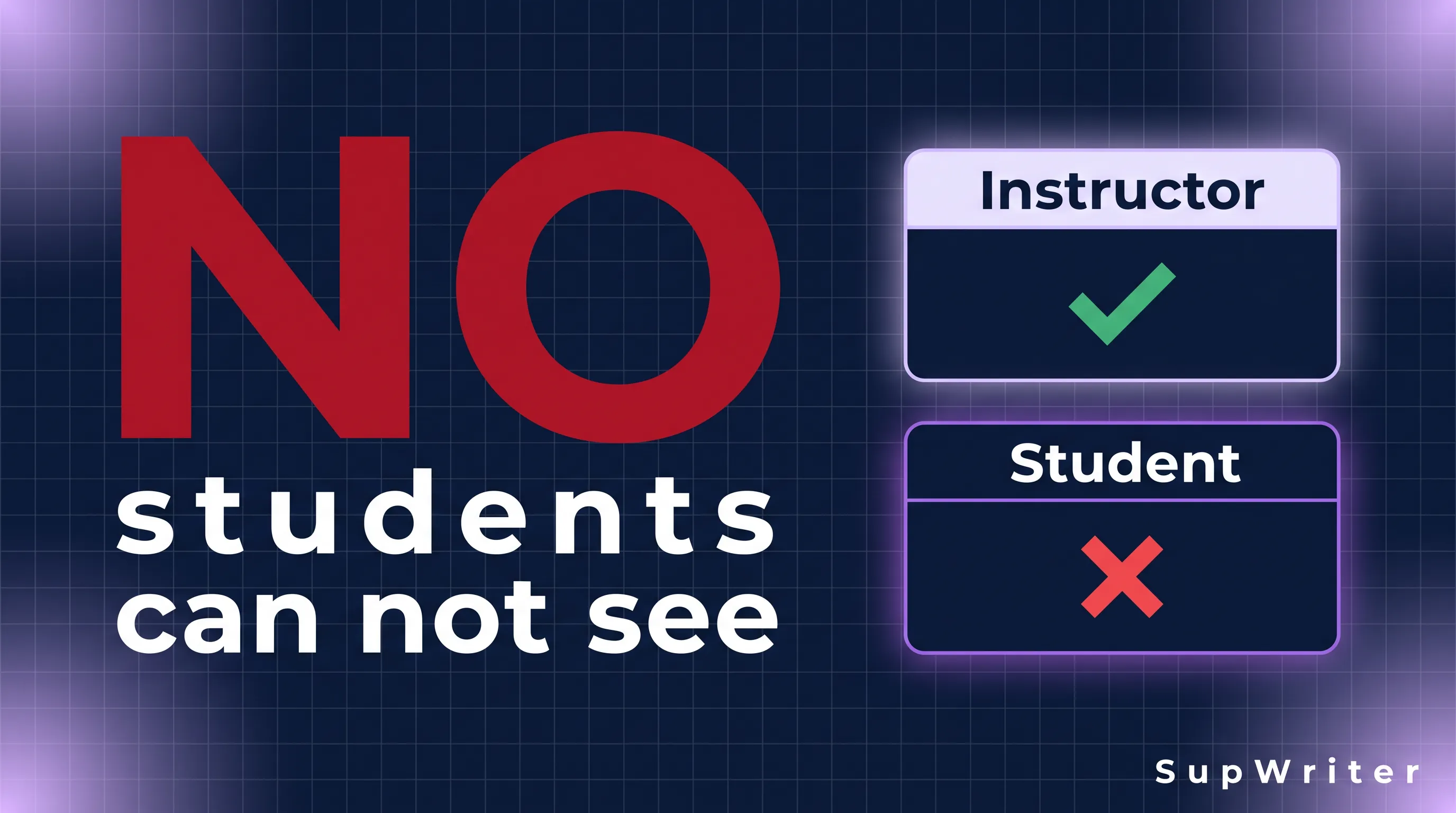
Can Students See Their Turnitin AI Score? (No — Here's How to Check Before You Submit)
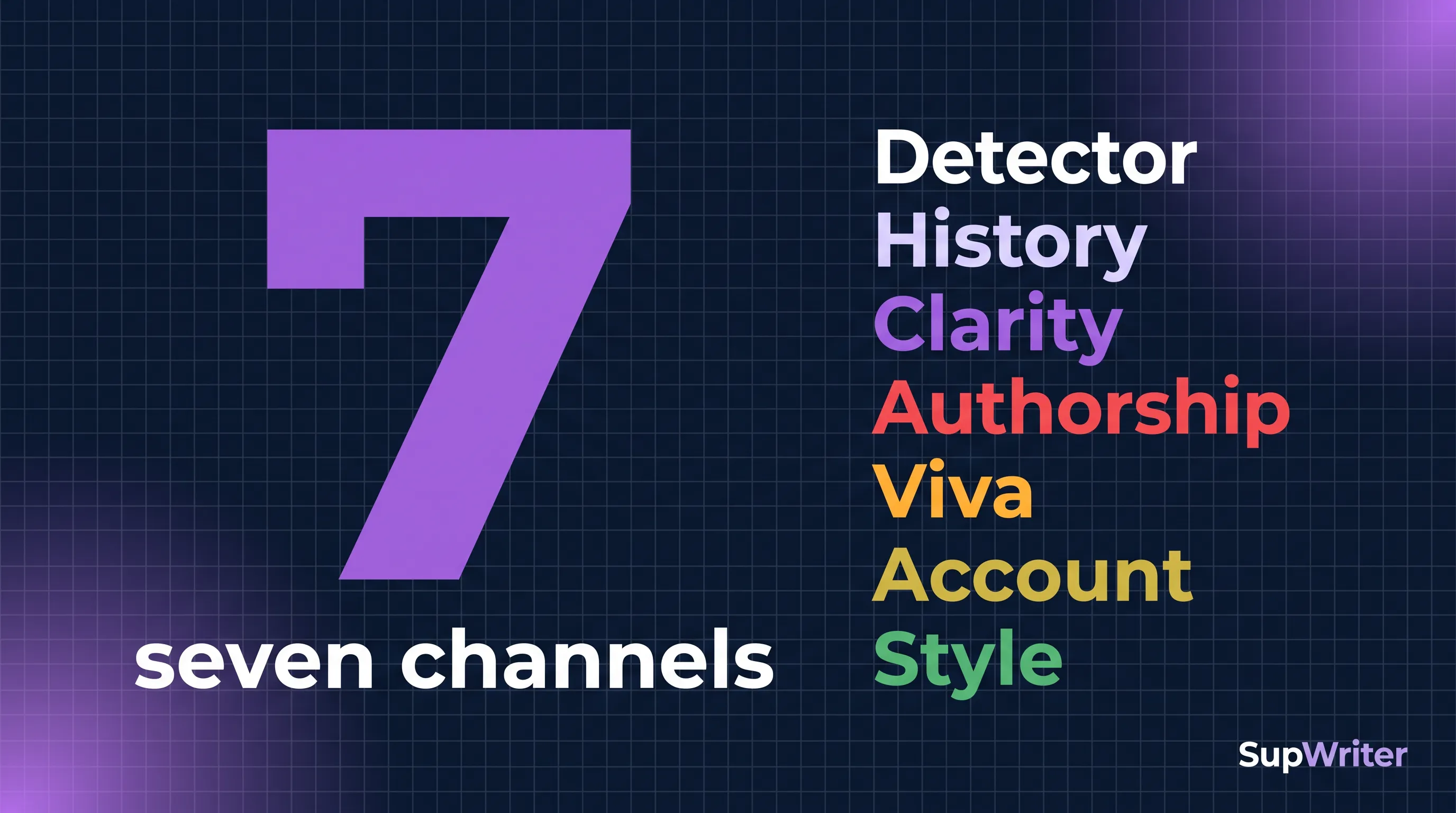
Can Teachers See If You Use ChatGPT? The 7 Ways They Actually Find Out
Best AI Humanizer for Malaysian Students (2026): UM, USM, UKM, UTM, UiTM Turnitin Rules and the MOHE Declaration