
By ShriprasannaPublished March 21, 2026Updated September 26, 2026
AI for MBA Students: What Business Schools Allow
In a survey of business students at American University's Kogod School of Business, reported by Poets&Quants in August 2026, more than 80% said they had used AI tools for academic work in the past six months, and roughly 44% said they had used AI as a shortcut or substitute for their own work at some point (Poets&Quants). That won't shock anyone who's actually in business school right now. Between case analyses, group projects, financial modeling homework, and the constant stream of "leadership reflection" papers, the workload is designed for people who don't sleep. AI fills the gap.
But here's the problem: business schools don't agree on what's allowed. Harvard Business School requires explicit instructor permission before you use generative AI on anything graded. Wharton has no school-wide policy and leaves it to each instructor. Stanford's university-wide guidance treats AI like help from another person unless your instructor says otherwise. And most students have no idea where their own program draws the line, because the policies are buried in handbooks and syllabi that nobody reads past the grading breakdown.
This guide covers what three well-known MBA programs actually publish, where AI helps with less risk, where it'll get you into trouble, and how to handle the gray areas that every MBA student encounters.
The Policy Landscape: What Top Programs Say
Published policies fall into two broad patterns: a school-wide default with room for instructors to change it, or no school-wide rule at all, with each course setting its own. Here's what three of the best-known programs say, in their own documents. If your school isn't here, the same questions apply.
Permission First: Harvard Business School
HBS's MBA handbook says students "must obtain explicit permission from the faculty member of the applicable course before using generative AI or AI-enabled tools to complete any assignment, assessment, or other work that will be submitted for evaluation or used as a basis for grading" (HBS MBA handbook).
Preparation is treated differently. Unless faculty prohibit it, students may use AI to prepare for exams and for class discussions, for example for case analysis, suggesting comments to make in class, and summarizing case points. Disclosure is not optional: students must disclose and cite their use of AI tools, and not doing so "violates the MBA Honor Code, just as would failing to cite any other source." And students "may not represent AI-generated content, analysis, ideas or other substantive outputs as their own independent work." The handbook's plagiarism section makes the same point: presenting words or ideas developed with AI as your own independent work counts as plagiarism (HBS plagiarism policy).
Instructor by Instructor: Wharton
Wharton's MBA academic policies are blunt about the gap: "Neither the University nor the School has adopted a formal generative AI policy, and individual faculty set their own expectations for AI use in their courses" (Wharton MBA academic policies). Students are told to read each syllabus carefully, follow each instructor's AI policy, and ask when they're unsure. Breaking a course's AI rules falls under the MBA Code of Ethics.
That puts the burden on you. The same behavior can be encouraged in one Wharton course and a violation in the next, so the syllabus, not the school, is your rulebook.
A University-Wide Default: Stanford
Stanford's guidance, adopted in February 2023, applies across its courses: "Absent a clear statement from a course instructor, use of or consultation with generative AI shall be treated analogously to assistance from another person." By default, "using generative AI tools to substantially complete an assignment or exam (e.g. by entering exam or assignment questions) is not permitted." Instructors are free to set their own policies, "including allowing or disallowing some or all uses" (Stanford Office of Community Standards).
So a Stanford course can embrace AI, but only because the instructor said so. Without that statement, the default is closer to "don't have someone else do it for you."
Everywhere Else: Read the Syllabus
Other programs, from Kellogg and Booth to INSEAD and London Business School, have their own rules, and they change. We haven't summarized them here because a second-hand summary is exactly what gets students into trouble. Look for three things in your program handbook and in every syllabus: whether AI is allowed by default, what needs instructor permission, and how you're expected to disclose use.
Policy Summary Table
| School | Default for graded work | Can instructors change it? | Disclosure |
|---|---|---|---|
| Harvard Business School | Explicit faculty permission required | Yes; faculty can also restrict preparation use | Required; failing to disclose violates the MBA Honor Code |
| Wharton | No school-wide policy; set course by course | Yes; each instructor sets expectations | Per the course policy |
| Stanford | AI treated like help from another person; substantially completing work with AI not permitted | Yes; instructors can allow or disallow some or all uses | Per the course policy |
| Your school | Check the handbook | Check each syllabus | Check both |
Sources: each school's published policy, linked above, checked Sept 2026.
Where AI Actually Helps in MBA Programs
Not all MBA work carries the same risk. Some tasks are improved by AI with fewer integrity concerns. Others are career-limiting landmines. Either way, your course policy comes first.
Lower-Risk, High-Value Uses
Financial modeling and data analysis. This is often the lowest-risk zone for AI in business school. Using AI to help build Excel models, write Python scripts for data analysis, or troubleshoot formula errors is common, and the output is a functional model, not a written argument, so there's nothing for a text detector to flag. But lower risk isn't automatic permission: at HBS, for example, you need your instructor's explicit permission before using AI on anything submitted for evaluation.
Brainstorming and framework identification. Asking Claude or ChatGPT to suggest relevant frameworks for a case analysis is much like searching "which framework should I use for market entry analysis," only faster. HBS explicitly allows AI for preparing case discussions unless faculty prohibit it. AI is good at mapping a business problem to established frameworks like Porter's Five Forces, SWOT, or the BCG matrix. The strategic thinking still has to come from you.
Research and literature review. Using AI to summarize papers, find relevant industry data, or synthesize background information is often acceptable where your course allows AI. It's research assistance, not ghostwriting. Just verify the sources, because AI still fabricates citations.
Presentation deck structuring. AI can help organize a presentation's narrative arc, suggest slide structures, and generate initial bullet points for group presentations. The analysis and delivery are still yours, and the course policy still applies to the deck you submit.
High-Risk, Proceed-With-Caution Uses
Case analysis write-ups. This is where most MBA students get into trouble. Case write-ups are the bread and butter of MBA assessment, and they're the assignments professors scrutinize most carefully.
AI can produce a competent case analysis. It can identify the key issues, apply relevant frameworks, and recommend a course of action. The problem is that AI case analyses tend to get noticed for two reasons: an AI detector may flag the writing patterns, where your school uses one, and professors can often tell because AI analyses lack the specific, opinionated edge that strong MBA students bring.
A good case analysis doesn't just apply a framework. It makes a judgment call about which framework matters most and why. It takes a stand on the protagonist's best option and defends it against alternatives. AI tends to hedge, presenting "on the one hand / on the other hand" analysis that covers all bases without committing to any of them. Business professors notice this quickly.
Individual reflection papers. These assignments ask you to connect course concepts to your personal professional experience. AI can't do this well because it doesn't know your experience. It can fabricate plausible-sounding professional anecdotes, but they lack the specific detail and emotional texture that make reflections authentic. A professor who reads 60 reflections per section can spot the generic ones.
Take-home exams. The highest-risk category. Take-home exams are designed to test your individual analytical ability under time pressure. Unless your instructor explicitly allows it, treat AI on a take-home exam as off-limits: Stanford's default guidance, for instance, names using generative AI to substantially complete an exam as not permitted. It's also the scenario most likely to lead to serious consequences.
MBA Content Types and Risk Levels
| Content Type | AI Risk Level | How problems usually surface | Consequence if Misused |
|---|---|---|---|
| Financial models / code | Lower | Instructor review | Depends on course policy and disclosure |
| Research summaries | Low | Unverified or invented sources | Depends on disclosure |
| Presentation drafts | Low | Q&A during delivery | Usually minimal if permitted |
| Discussion posts | Medium | Style mismatch, AI detector if used | Grade penalty |
| Case write-ups | High | Cold calls, generic analysis, AI detector if used | Honor code process |
| Individual reflections | High | Professor judgment, style mismatch | Honor code process |
| Take-home exams | Very High | Follow-up questions, proctoring where used | Serious sanctions possible |
The Group Project Problem
MBA programs are built on group work, and AI has created a new dynamic that nobody really talks about openly: in many study groups, someone is using AI to draft their section.
This creates a collective action problem. If your teammate uses AI and you don't, you're spending three hours on what they finished in twenty minutes. If everyone uses AI, the group output is uniformly polished in a way that reads as generic. And if you raise the issue with the group, you're the person who made it awkward.
The practical reality is that many groups have tacitly adopted a "don't ask, don't tell" approach to AI. The students who use it don't announce it. The students who don't use it suspect what's happening but don't press the issue because they're all getting graded on the same deliverable.
Our recommendation: agree as a group, at the start, on what the course allows and how you'll disclose any AI use, because a disclosure failure by one member can become everyone's problem. Then have one person do a real editing pass for a single consistent voice. Sections drafted separately, by people or by AI, tend to read as stitched together.
How MBA Professors Catch AI Beyond Software
AI detectors aren't the only way problems surface. Business school professors have their own informal techniques:
The Socratic follow-up. Many MBA courses use cold-calling and class participation as significant grade components. If you submit a brilliant case analysis but can't articulate the reasoning behind it when called on in class, that disconnect is obvious, and a professor who notices it has an easy way to probe further.
Style comparison across assignments. Your first few assignments establish a writing baseline. If your style dramatically shifts mid-semester, suddenly more polished, more structured, more comprehensive, professors notice. Instructors who read your work every week build a sense of each student's writing level, and a submission that doesn't match it invites questions.
The specificity test. AI produces analysis that is technically correct but generically applicable. A human MBA student draws on specific examples from class discussion, references particular data points from the case, and connects the analysis to their own professional experience. AI analysis reads like a consulting framework template. It's competent but impersonal.
Humanizing MBA Writing the Right Way
If you're using AI to help with MBA assignments, and the survey above suggests most business students do, handle the policy question first and the writing quality second.
Use AI for what it does well, where your course allows it: structuring arguments, suggesting frameworks, generating first drafts, analyzing data. Then make the output yours by adding specific references to class discussion, incorporating your professional experience, and taking a clear analytical position rather than hedging. Disclose the use the way your school requires.
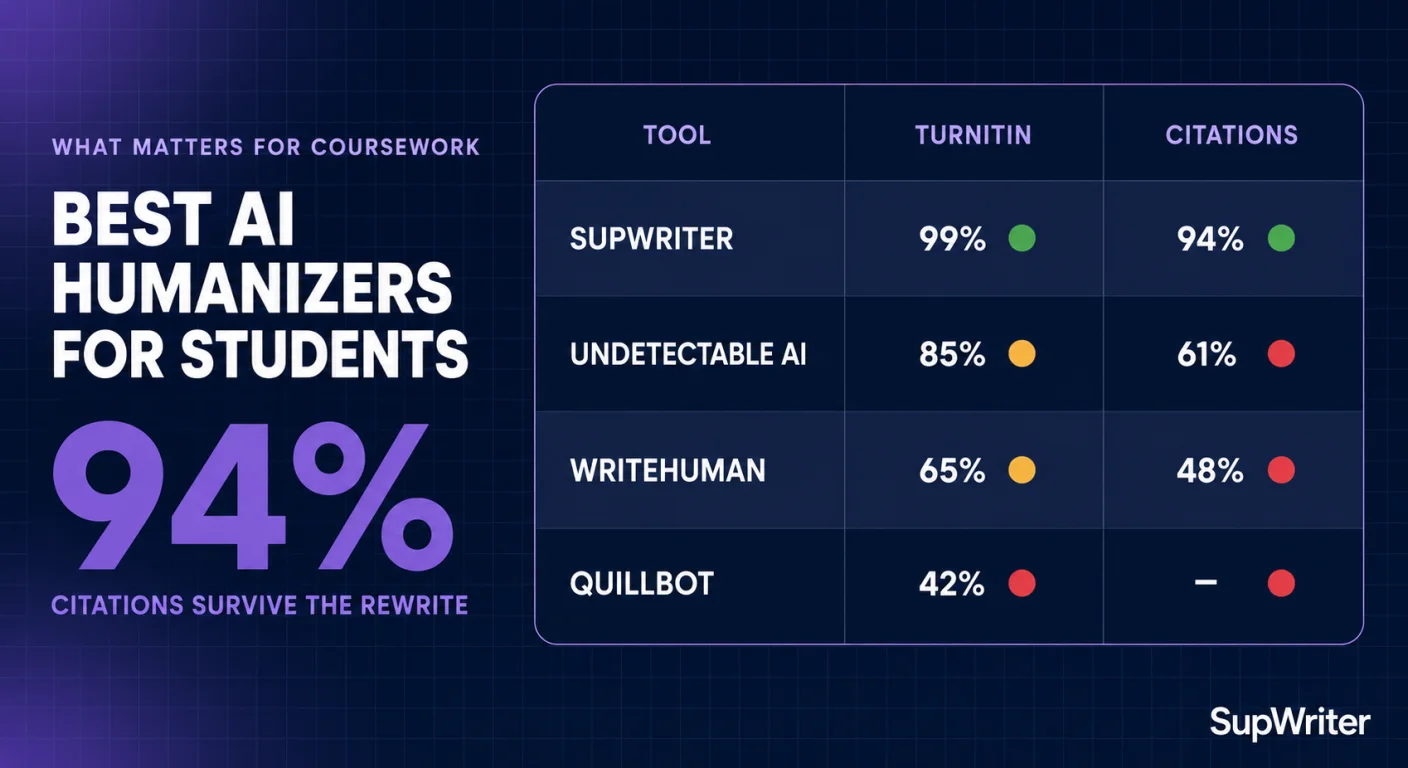
If your course permits AI assistance, a humanizer like SupWriter can help an AI-assisted draft read in a natural voice, and its built-in AI detector gives you a pre-check. That check is based on one scoring model, not your school's detector, and no tool can guarantee a result. It also can't make undisclosed AI use acceptable: at HBS, non-disclosure is itself an Honor Code violation. For more on the text side, see our guide on how to avoid AI detection in your writing.
The real work is the part no tool can do: software may flag statistical patterns, but professors catch generic analysis, and only your actual business experience and critical thinking fix that.
For more on how detection tools work and their limitations, check out our coverage of universities dropping AI detection. And if you're an MBA student looking to use AI responsibly, understanding how to write with AI for academic contexts is worth the fifteen-minute read.
What This Means for Your MBA
Business schools are still settling their AI policies, and the rules can change between semesters. The direction of travel is toward teaching AI fluency, with guardrails, rather than banning it outright. But the guardrails differ, and they're what you'll be held to.
In the meantime, know your program's specific policy. Don't assume that what's acceptable in one Stanford course is acceptable at Harvard, or even in the next course on your own schedule. Use AI for the tasks where it adds genuine value, such as modeling, research and structuring, and bring your own analytical judgment to the tasks that define your MBA experience.
And if you're going to use AI for written assignments, be smart about it. Don't submit raw AI output. Disclose what your school requires you to disclose. And don't underestimate a professor who's been reading MBA cases for twenty years and knows exactly what a student's authentic analysis looks like versus what ChatGPT produces.
Related Articles
Can Students See Their Turnitin AI Score? (No — Here's How to Check Before You Submit)
Can Teachers See If You Use ChatGPT? The 7 Ways They Actually Find Out
Best AI Humanizer for Malaysian Students (2026): UM, USM, UKM, UTM, UiTM Turnitin Rules and the MOHE Declaration