

By ShriprasannaPublished April 2, 2026Updated September 26, 2026
Google's Stance on AI Content in 2026: What You Need to Know
Google has never been particularly clear about its position on AI-generated content, and 2026 hasn't changed that. If anything, the picture has gotten muddier. Official statements say one thing. Ranking behavior, as publishers experience it, suggests another. And the introduction of AI Overviews has added a layer of irony that would be funny if it weren't costing publishers real traffic and revenue.
Let me try to cut through the noise and lay out what Google actually says, what it demonstrably does, where the two seem to diverge, and what it practically means for anyone producing content in 2026.
The Official Position: A Brief History
Google's public stance on AI content has shifted in tone -- though they'd probably insist it hasn't.
2023: The "we don't care about origin" era. In February 2023, Google published guidance saying it would reward high-quality content "however it is produced" (Google Search Central). The same post said that using automation, including AI, to generate content primarily to manipulate rankings violates its spam policies. The first message got all the attention; it was widely read as a green light for AI content. The content marketing world exhaled and cranked up the AI content machines.
2024: The helpful content crackdown. In March 2024, Google announced a core update alongside three new spam policies: scaled content abuse, site reputation abuse and expired domain abuse (Google Search Central). Scaled content abuse targets the practice of producing large volumes of low-value pages to manipulate search rankings. The policy applies however the pages are made, and its examples include "using generative AI tools or other similar tools to generate many pages without adding value." Sites built on mass-produced pages were widely reported among the hardest hit.
2025: Nuanced enforcement. Google's documentation on generative AI content, last updated in December 2025, spells out both halves of the message. It says generative AI "can be particularly useful when researching a topic, and to add structure to original content," and tells creators to "focus on accuracy, quality, and relevance, especially when automatically generating the content." It also warns that "using generative AI tools or other similar tools to generate many pages without adding value for users may violate Google's spam policy on scaled content abuse" (Google Search Central). The message was becoming clearer: quality matters, but the bar for what counts as "quality" keeps rising.
2026: The AI Overviews paradox. Google now generates its own AI content at massive scale through AI Overviews, which appear at the top of the results for a large share of informational queries. It is simultaneously telling publishers that content quality matters more than ever while answering many queries itself with AI-written summaries. Its spam policies page, last updated in August 2026, still lists generating many pages with generative AI "without adding value" as scaled content abuse (Google spam policies).
What Google Actually Penalizes
Here's the part most people get wrong: Google doesn't penalize content because it's AI-generated. By its own account, it acts against content that is low-value or made to manipulate rankings. The problem is that a lot of AI content is low-value in ways that are easy to produce at scale.
Scaled Content Abuse
The clearest penalty target. Google defines it as "when many pages are generated for the primary purpose of manipulating search rankings and not helping users." If you're using AI to pump out hundreds of articles with minimal human oversight, primarily to capture search traffic, you're in Google's crosshairs. This applies whether you're using AI, human content mills, or any other method of mass-producing low-value content. AI just made it cheaper and faster to do what spammers have always wanted to do.
Content That Lacks E-E-A-T Signals
Google's quality rater guidelines describe helpful content in terms of Experience, Expertise, Authoritativeness, and Trustworthiness (E-E-A-T), and its February 2023 guidance points creators to the same idea. Raw AI content typically struggles on all four:
| E-E-A-T Signal | Why Raw AI Content Struggles | What Google Rewards Instead |
|---|---|---|
| Experience | AI can't have lived experiences | First-person accounts, specific anecdotes, original observations |
| Expertise | AI synthesizes existing knowledge without deep understanding | Demonstrated depth, novel analysis, professional credentials |
| Authoritativeness | AI has no reputation or track record | Backlinks, citations, recognized brand presence |
| Trustworthiness | Generic voice, no accountability | Transparent authorship, contact info, editorial standards |
Content that reads like a competent but impersonal summary of existing information -- which describes most raw AI output -- tends to be outranked by content that demonstrates genuine human involvement. This isn't a penalty in the technical sense. It's how ranking works when the system is designed to reward usefulness and originality.
Thin, Redundant Content
If your AI-generated article about "best credit cards for travel" covers exactly the same ground as the 200 other articles on that topic without adding original research, personal experience, or unique analysis, it's not going to rank. Not because Google detected it as AI, but because it doesn't offer any reason to rank above the competition.
What Google Doesn't Penalize
This distinction matters. Google does not appear to penalize:
- AI-assisted content with genuine human editorial oversight. If a human outlines the piece, reviews the AI draft, adds original insights, fact-checks, and edits for voice and quality, the resulting content can perform fine in search.
- AI content in non-YMYL categories with adequate quality. Product descriptions, technical documentation, data summaries, and other functional content types that don't require deep personal expertise can rank effectively even with significant AI involvement.
- Edited AI content that genuinely serves readers. Google's stated position is that it judges the content, not how it was produced. Humanizing a draft can help with voice and variety, but it doesn't add the experience, accuracy or original information that make a page worth ranking. People add those.
Is Google Detecting AI Content in Rankings?
This is the big question, and the honest answer is: we don't know for certain, and Google isn't telling.
What we do know:
Google hasn't said it uses an AI-text classifier in ranking. Its published position is the one above: it rewards quality however content is produced, and it acts against scaled, low-value content. Google clearly has the technical resources to build such a classifier. Whether it runs one on web pages, and what it would do with the result, isn't public.
Detection would be a signal, not a verdict, anyway. Even the companies that sell AI detectors describe their scores as probabilities, and OpenAI withdrew its own AI-text classifier in 2023 because of its low accuracy (OpenAI). A ranking system built on "is this AI?" would misfire constantly. A system built on "is this useful?" doesn't need to ask.
The practical outcome is similar either way. Raw AI output tends to lack the things Google says it rewards: first-hand experience, original information, a clear author, a reason to exist beyond the ten pages already ranking. Whether Google detects AI directly or simply ranks those qualities, unedited AI pages end up in the same place.
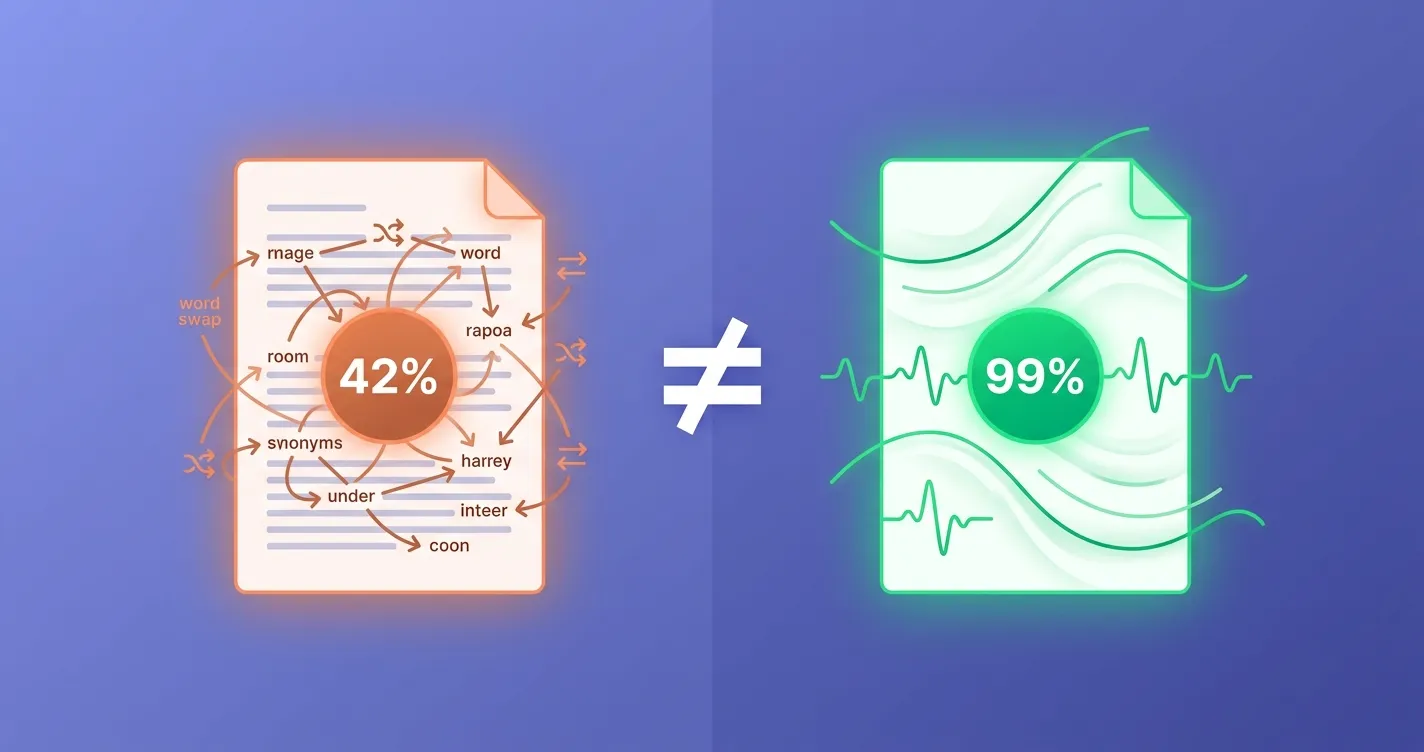
Understanding how AI detection actually works provides useful context here. The predictability patterns that third-party detectors look for are the kind of signal a search engine could measure. Whether Google does, and what it would do with the information, is the part nobody outside Google can confirm.
The AI Overviews Contradiction
Here's where Google's position gets philosophically interesting. Through AI Overviews, Google now generates and displays AI-written content at the top of search results for a vast number of queries. This AI content directly competes with -- and often cannibalizes traffic from -- the human-written and AI-assisted content that publishers create.
Google's implicit argument is that its AI-generated summaries meet a higher bar because they synthesize from multiple sources and link back to them. Whether you buy that argument or not, the practical implication is clear: Google isn't against AI content. It's against AI content that isn't useful. And it gets to define "useful."
For publishers, this means the competitive landscape has fundamentally shifted. You're not just competing against other publishers anymore. You're competing against Google's own AI-generated summaries. The content that survives this is content that offers something the AI Overview can't: original research, personal experience, depth of analysis, and authentic voice that goes beyond synthesizing existing information.
How Humanization Fits Into Google's Framework
This is where the practical strategy comes together. When done well, humanization isn't about tricking Google. It's one editing step in producing content that legitimately aligns with what Google says it wants to reward.
Effective humanization can add:
- Natural language variation that sounds like a real human voice rather than a language model's default phrasing
- Structural variety -- sentence length variation, paragraph breaks that follow thought patterns rather than templates, the small irregularities that characterize genuine writing
- Voice consistency that suggests a specific author with specific perspectives, not a general-purpose text generator
- Readability that keeps people on the page long enough to get what they came for
What it can't add is the substance: the experience, data and judgment that make a page worth ranking. That's still the writer's and editor's job.
SupWriter's humanizer is built for the voice-and-rhythm part of that work: it rewrites AI drafts so they read naturally rather than like default model output. For teams focused on search, our SEO humanization workflow covers how to fit it into an editorial process that also adds the expertise and original information no tool can supply.
Practical Recommendations for 2026
Based on what Google says and what its policies describe, here's what content producers should do:
1. Use AI, But Don't Publish Raw Output
The "generate and publish" approach is dead. Every piece of AI content needs human involvement -- at minimum, editing for voice, fact-checking, and adding original perspective. Humanization tools can handle the voice and style transformation; the human editor adds the experience and expertise signals that no tool can fabricate.
2. Focus on Content That AI Overviews Can't Replace
Prioritize original research, case studies, opinion pieces backed by expertise, and content that requires lived experience. If Google's AI can fully answer the query in a paragraph, competing for that query with a 2,000-word article is a losing proposition.
3. Build Author Authority
Author identity matters more than ever to readers, and it's one of the clearest ways to show experience and expertise. Real bylines with verifiable expertise, consistent publishing history, and topical authority help. Google's own generative AI guidance adds that "sharing information about how a piece of content was created can help give your readers more context." Anonymous AI-generated content is at a structural disadvantage.
4. Check How Your Content Reads
Tools like SupWriter's built-in AI detector can show which passages read most like default machine prose. Treat the score as a proxy, not a Google preview: it's one model's opinion, and nobody outside Google knows whether it uses anything similar. If a passage reads as generic to a detector, it probably reads that way to people too, and that's reason enough to rewrite it.
5. Prioritize Reader Engagement
Google doesn't publish which engagement signals, if any, feed its rankings, so don't chase bounce rate for its own sake. But content that people actually read to the end is the content that earns links, shares and return visits. Content that reads naturally and engages genuinely -- regardless of how it was produced -- is the stronger argument for careful editing, not a detection-avoidance tactic.
Where Google Goes From Here
My read on 2027 and beyond: Google will continue to avoid a clear binary stance on AI content. It won't announce a "no AI content" policy because it can't -- its own products rely on AI generation. It won't announce full acceptance because it needs the threat of penalties to maintain content quality standards.
What it will do is continue refining its systems to reward content that demonstrates genuine value, regardless of how it was produced. The tools for determining that value will get more sophisticated. The bar for what counts as "quality" will keep rising. And the publishers and content teams that invest in producing genuinely useful, authentically voiced content -- whether human-written, AI-assisted, or humanized -- will continue to rank.
The ones publishing raw AI output and hoping for the best? They're already losing. They just might not have checked their analytics recently enough to notice.
Related Articles

Is Using an AI Humanizer Cheating? When to Disclose AI Assistance
What SupWriter's AI Detector Actually Checks (vs Turnitin and Originality.ai)
What Is an AI Humanizer (and What It Is Not)