By ShriprasannaPublished March 25, 2026Updated September 26, 2026
75+ Essay Hook Examples That Actually Sound Human
Let's be honest — most essay hooks are terrible. And now that everyone's using ChatGPT to write them, they all sound exactly the same. "In today's ever-changing world..." or "Throughout history, humans have always..." You've read those openings a thousand times. Your professor has read them ten thousand times.
A good hook doesn't just start your essay. It makes someone want to read the rest. That's it. That's the whole job. And it's harder than it sounds, because a hook has to be specific enough to be interesting but broad enough to lead into your thesis.
This guide has 75+ real hook examples you can actually use. They're organized by type and by essay format. Steal them, adapt them, or just use them as inspiration to write something better than "Since the dawn of civilization..."
What Makes a Good Essay Hook?
Before we dive into examples, let's talk about what separates a hook that works from one that falls flat.
A good hook does three things:
- It surprises. The reader encounters something they didn't expect — a weird fact, a counterintuitive claim, a vivid image. Their brain goes "wait, what?" and they keep reading.
- It's specific. Generic hooks are invisible. "Many people struggle with anxiety" is wallpaper. "I threw up in a Wendy's parking lot before every exam for three semesters" is a hook.
- It connects. The cleverest opening in the world is useless if it doesn't lead naturally into your actual topic. Your hook is the on-ramp, not the destination.
A bad hook:
- Relies on dictionary definitions
- Opens with a vague statement about "society" or "the world"
- Sounds like it could open literally any essay on any topic
- Is so dramatic it can't be followed up with real substance
Now let's look at what actually works.
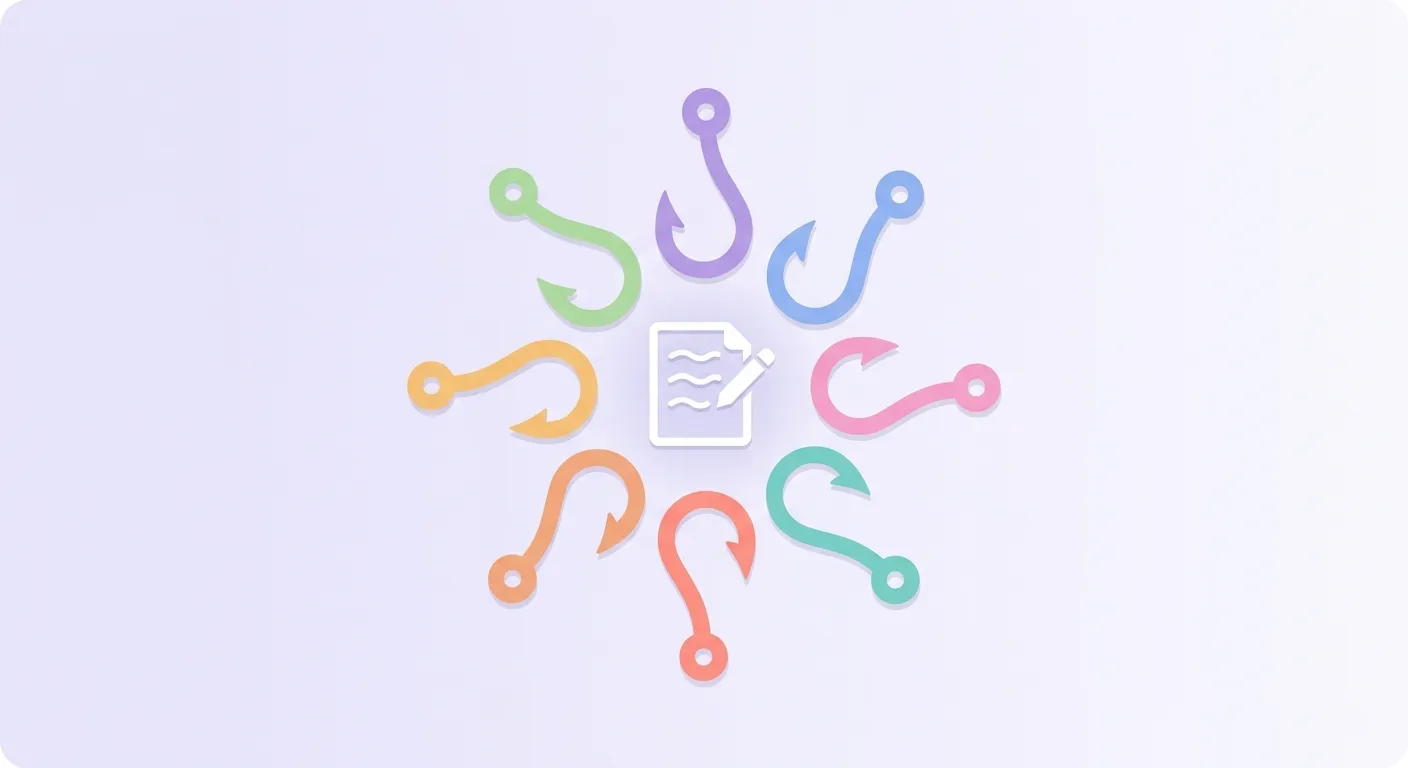
7 Types of Essay Hooks (With Examples)
1. Question Hooks
A question hook works because it activates the reader's brain. They can't just passively absorb the sentence — they have to think about an answer, even for a second. That second of engagement is all you need.
The keys: Ask something genuinely interesting. Avoid yes/no questions unless the expected answer is wrong. Never ask something so broad it could apply to anything.
Examples:
- "What would you do if you woke up tomorrow and every social media platform had been permanently deleted?"
- "Why do we trust strangers on the internet with our deepest secrets but lie to our doctors about how much we drink?"
- "If you could erase one memory completely, would you? And would you want to know what you'd erased?"
- "How many decisions did you make before breakfast this morning — and how many of them were actually yours?"
- "What happens to a neighborhood when the last grocery store closes?"
- "If prison doesn't reduce crime, why do we keep building more of them?"
- "Can you be addicted to something that everyone agrees is good for you?"
- "Why do so many people work harder than their parents did and still feel like they're falling behind?"
- "What if the most effective treatment for depression isn't a pill, a therapist, or a meditation app — but a dog?"
- "When was the last time you changed your mind about something important? Not adjusted. Actually changed."
- "How do you mourn a language that dies? Who attends its funeral?"
When they work best: Argumentative essays, philosophical topics, persuasive writing. Great for essays where you're about to challenge a common assumption.
When they fall flat: Research papers that need to establish credibility fast. Overly broad questions ("Have you ever wondered about love?") that sound like a bad dating app prompt.
2. Statistic Hooks
Numbers cut through noise. When you open with a statistic, you're telling the reader: I did the research. This is real. Pay attention. The best statistic hooks pair a surprising number with a framing that makes it feel personal or urgent.
The keys: Choose stats that genuinely surprise. Provide context so the number means something. Cite your source, and check it's the original. The examples below link to theirs, so you can see the kind of source that backs a number up.
Examples:
- "More than 80% of business students in one university's survey said they'd used AI tools for academic work in the past six months. Roughly 44% admitted using it as a shortcut or a substitute for their own work." (Poets&Quants)
- "Seven AI detectors were shown 91 essays that non-native English speakers wrote for the TOEFL. On average, they labeled 61% of them as AI-generated. People wrote every one." (Liang et al., 2023)
- "By 2015, humans had produced about 6.3 billion metric tons of plastic waste. Only around 9% of it was ever recycled; 79% is sitting in landfills or the natural environment." (Geyer et al., 2017)
- "Turnitin said its AI detector had a false positive rate of about 1%. Vanderbilt did the math: of the roughly 75,000 papers it put through Turnitin in a year, about 750 could have been wrongly flagged. It switched the detector off." (Vanderbilt)
- "Turnitin won't show an AI score between 1% and 19%. Anything in that range appears as an asterisk." (Turnitin)
- "Women weren't officially allowed to run the Boston Marathon until 1972. Picture explaining that rule to the women who win it now."
- "The human brain can identify an image it has seen for as little as 13 milliseconds. That's faster than you can blink."
When they work best: Research papers, informative essays, any piece where you need to establish stakes quickly. Especially effective for policy arguments and social issues.
When they fall flat: Personal narratives (feels clinical), creative essays (feels impersonal), situations where the stat needs too much context to make sense on its own.
3. Anecdote Hooks
Nothing hooks a reader like a story. We're wired for narrative — it's how humans have transmitted information for thousands of years. An anecdote hook drops the reader into a moment. They see, hear, and feel something specific before they even know what the essay is about.
The keys: Keep it short (2-4 sentences max). Use concrete details. Make sure the story connects to your thesis without requiring an awkward bridge paragraph.
Examples:
- "My grandmother kept every letter she ever received in a shoebox under her bed. After she died, we found 340 of them, spanning 61 years. Not one was from someone who'd typed it."
- "The first time I failed a test, my mother didn't yell. She sat at the kitchen table, looked at the paper, and said, 'Good. Now you know what that feels like.' I didn't understand what she meant until college."
- "In the Japanese village of Nagoro, life-sized dolls outnumber the people who still live there. The dolls sit in classrooms, wait at bus stops, and fish by the river. They replace the people who left and never came back."
- "When my family moved to the United States, my father's medical degree was worth nothing. He spent three years driving a taxi while studying to re-certify. His passengers never knew the driver had performed over 200 surgeries."
- "A friend of mine applied to 167 jobs after graduation. She got three interviews and one offer — at a coffee shop. She has a degree in biomedical engineering."
- "Last Tuesday, I watched a five-year-old at the airport hold a full conversation with Siri about whether dinosaurs had feelings. His mother was on the phone. Siri was more patient."
- "The town I grew up in had one traffic light, one bar, and zero bookstores. The nearest library was a 40-minute drive. I read my first real novel because a truck driver left a copy of Holes in a gas station bathroom."
- "In 1960, a six-year-old girl named Ruby Bridges walked into a New Orleans school flanked by federal marshals. Sixty-six years later, the argument about who learns alongside whom still isn't over."
- "My roommate freshman year slept with a white noise machine, an eye mask, a weighted blanket, and melatonin gummies. She still couldn't sleep. None of us could."
- "The night nurse on my grandfather's ward kept a laminated checklist clipped to her badge. She told me it had caught more mistakes than any doctor she'd worked with. I didn't believe her until I watched it happen."
When they work best: Narrative essays, personal statements, argumentative essays where you want to humanize an abstract issue. Fantastic for college application essays.
When they fall flat: Highly technical papers, formal research writing where personal stories feel out of place, short-answer responses where you don't have room to set a scene.
4. Quote Hooks
Quotes lend authority. Someone smart already said the thing you're about to argue, and borrowing their words signals that your essay is part of a larger conversation. The trick is avoiding overused quotes that make your professor's eyes glaze over.
The keys: Don't just drop a quote and move on — contextualize it. Avoid the most cliched options (no "Be the change you wish to see" unless you're actively subverting it). Mix famous figures with surprising sources.
Examples:
- "'The most common way people give up their power is by thinking they don't have any,' Alice Walker wrote. She was talking about politics. But she could just as easily have been talking about student loan negotiations."
- "'I have no special talents. I am only passionately curious.' Einstein's self-assessment sounds modest until you realize that curiosity, not talent, predicted nearly every breakthrough in his career."
- "'In the middle of difficulty lies opportunity.' That's Einstein again — and it's the motto of every startup founder who's about to run out of money."
- "'Not everything that is faced can be changed, but nothing can be changed until it is faced.' James Baldwin wrote that in 1962. Sixty-four years later, the advice feels more urgent, not less."
- "'You can't use up creativity. The more you use, the more you have.' Maya Angelou's line sounds like a poster slogan until you've kept a daily writing habit for a month."
- "'First they ignore you, then they laugh at you, then they fight you, then you win.' This quote is usually attributed to Gandhi, who never actually said it. Which tells you something about how much we care about accuracy when a quote sounds good."
- "'I learned that courage was not the absence of fear, but the triumph over it.' Mandela was talking about apartheid. I was just trying to give a presentation in my 8 a.m. seminar. But fear is fear."
- "'The only way to do great work is to love what you do.' Steve Jobs said that at Stanford in 2005. A year later, reporters were investigating conditions at the factory that assembled his iPods."
- "'We don't see things as they are; we see them as we are.' Anais Nin captured in one sentence what psychologists spent decades proving — that perception is never neutral."
- "'If you want to go fast, go alone. If you want to go far, go together.' This African proverb sounds like teamwork propaganda until you watch a group project implode at 2 a.m. in the library."
When they work best: Literary analysis, argumentative essays, speeches, essays on philosophy or social issues. Especially effective when you add a twist or challenge the quote.
When they fall flat: STEM papers, technical writing, situations where the quote feels forced or when you can't bridge it naturally to your argument.
5. Bold Statement Hooks
A bold statement hook is an assertion. It's confident, slightly aggressive, and dares the reader to disagree. The best ones flip a common belief on its head or state something that sounds wrong until you read the rest of the essay.
The keys: You have to back it up. A bold statement without evidence is just arrogance. Make it specific, not vaguely provocative. "Everything is broken" is lazy. "Group projects teach students to hide in a crowd" is a hook.
Examples:
- "The five-paragraph essay is the worst thing that ever happened to student writing."
- "Homework doesn't make kids smarter. It makes them tired."
- "Social media hasn't made us more connected — it's made us better performers."
- "College is the most expensive thing most Americans will buy that they're not allowed to question."
- "Recycling, as practiced by most American households, is theater."
- "Your personality is not fixed. It wasn't fixed at five, it wasn't fixed at twenty-five, and the entire self-help industry depends on you not knowing that."
- "Democracy doesn't work the way your civics teacher told you it does."
- "The war on drugs was never about drugs."
- "Most career advice is survivorship bias disguised as wisdom."
- "Standardized tests don't measure intelligence, potential, or even knowledge. They measure how well you take standardized tests."
- "Kindness will do more for your career than intelligence."
When they work best: Opinion pieces, argumentative essays, persuasive writing, any essay where you're about to challenge the status quo. Great for topics where readers have strong preexisting beliefs.
When they fall flat: Neutral informative writing, research papers that need to appear objective, topics where being provocative feels tone-deaf (grief, tragedy, sensitive social issues).
6. Metaphor/Simile Hooks
A metaphor hook asks the reader to see one thing in terms of another. When it works, it creates an instant mental image that frames your entire essay. When it doesn't, it sounds like a bad greeting card.
The keys: Be original. If you've seen the comparison before, your reader has too. Make the comparison do real intellectual work — it should reveal something about your topic, not just decorate it.
Examples:
- "The economy is a house of cards, and the table is shaking."
- "Learning a second language as an adult is like rebuilding a house while you're living in it — nothing is where you expect it to be, and you'll be sleeping in the kitchen for a while."
- "Social media is a funhouse mirror. It shows you a version of yourself — distorted, exaggerated, and weirdly addictive to stare at."
- "Writing a thesis is like packing for a trip you've never taken. You think you know what you need until you get there and realize you brought three sweaters and no socks."
- "The American healthcare system isn't broken. A broken thing was once whole. This system was built this way."
- "Grief isn't a river you cross to reach the other side. It's the weather. Some days it rains. Some days it doesn't. You never leave the climate."
- "Democracy is a garden. It needs constant tending, it grows slowly, and the weeds never stop."
- "High school is a pressure cooker with a guidance counselor."
- "Trying to regulate the internet is like trying to nail Jello to a wall — the Jello doesn't care, and now your wall has holes."
- "Memory is an unreliable narrator. It edits, embellishes, and occasionally fabricates entire scenes — and you'll defend its version of events with your life."
When they work best: Creative essays, narrative writing, literary analysis, opinion pieces. Especially effective when you return to the metaphor in your conclusion.
When they fall flat: Formal academic writing, research papers, any context where the comparison might confuse rather than clarify. Mixed metaphors are always bad.
7. Scene-Setting Hooks
A scene-setting hook paints a picture. You're not telling the reader about your topic — you're dropping them into a moment. They see the place, feel the atmosphere, and then you pull back to reveal why it matters.
The keys: Use sensory details (sight, sound, smell, texture). Be specific — "a room" is nothing, "a room with fluorescent lighting that buzzed like a dying insect" is a scene. Keep it to 2-3 sentences.
Examples:
- "The waiting room smelled like hand sanitizer and anxiety. Fifteen plastic chairs, twelve of them occupied, not a single person making eye contact. A television in the corner played the news on mute."
- "At 6 a.m. on a Tuesday in November, the parking lot of a Walmart in rural Ohio is already half full. Engines idle. Breath fogs the windows. The doors won't open for another hour."
- "The classroom was silent except for the scratch of pencils on paper and the occasional creak of a desk chair. Twenty-seven students, heads down, writing the same standardized test they'd been practicing for since September."
- "The border crossing at Tijuana is louder than you'd expect. Car horns, vendors selling churros and phone chargers, children playing tag between the concrete barriers. It doesn't look like a crisis. It looks like a Tuesday."
- "The lab is cold — kept at 65 degrees to protect the equipment, not the researchers. Dr. Patel works in fingerless gloves, peering at a screen showing a protein folding simulation that's been running for eleven days straight."
- "Three stories below the streets of New York, the subway platform at 168th Street feels like an oven in August. A busker plays saxophone. Rats move along the track with the confidence of commuters."
- "The library at 11 p.m. during finals week looks like a disaster shelter. Students draped over chairs, energy drink cans lined up like soldiers, someone asleep with a textbook open on their face."
- "On the last day of school, the hallways are always louder. Lockers slam. Sneakers squeak on freshly waxed floors. Someone throws a paper airplane from the second-floor balcony, and it sails for what feels like forever."
- "The coffee shop on the corner of 5th and Main used to be a bookstore. Before that, a hardware store. Before that, a pharmacy that served egg creams. Now it serves oat milk lattes to people who've never heard of any of those things."
- "The field behind the factory hasn't been mowed in years. Wildflowers grow through cracks in what used to be a parking lot. A rusted sign still reads 'Employee of the Month — March 1997.'"
When they work best: Narrative essays, descriptive writing, journalism-style essays, place-based arguments. Killer for essays about social issues, memory, and change.
When they fall flat: Analytical essays that need to get to the point quickly, short-answer responses, any context where the reader needs information more than atmosphere.
Essay Hooks by Essay Type
Different essay types have different expectations. Here are hooks tailored for four common formats.
Argumentative Essay Hooks
- "The drinking age in America has been 21 since 1984. Walk through any college town on a Friday night and ask what that law has actually changed."
- "An unpaid internship is a job only some students can afford to take. We call that opportunity."
- "Schools ban phones in class and then hand students laptops with the same apps on them. Which one is the distraction?"
- "Look up what your state spends to keep one person in prison for a year, then compare it with a year of college tuition. The gap is an argument all by itself."
- "The average American throws away far more trash each day than the average Swede. The difference isn't genetics — it's policy."
Narrative Essay Hooks
- "I found out my father wasn't my biological father the same way I found out about everything important in my family — by accident, at a barbecue, from an uncle who'd had too many beers."
- "The summer I turned sixteen, I got a job at a funeral home. I thought it would be morbid. It turned out to be the most life-affirming thing I've ever done."
- "My first word wasn't 'mama' or 'dada.' According to my mother, it was 'no.' She says this explains a lot."
- "I didn't learn to swim until I was nineteen. Not because I was afraid of the water — because no one in my family knew how, and it never occurred to us that was unusual."
- "The day I left home for college, my mother handed me an envelope and told me not to open it until I felt alone. I opened it in the car before we'd left the driveway."
Persuasive Essay Hooks
- "You will spend approximately 90,000 hours of your life at work. If that number doesn't make you care about labor policy, nothing will."
- "You agreed to a privacy policy today. You didn't read it, and the company that wrote it was counting on that."
- "Every summer, we call the heat 'record-breaking.' At some point, a record you break every year stops being a record and starts being the climate."
- "If your tap water were a different color — say, bright orange — you'd never drink it. But it can contain lead, PFAS, and pharmaceutical residue while looking perfectly clear."
- "We teach kids to share in kindergarten and then spend the rest of their education ranking them against each other. Something doesn't add up."
Research Paper Hooks
- "In 2023, Stanford researchers showed that AI detectors routinely mistake non-native English writing for machine output. By September 2025, the University of Waterloo had switched off Turnitin's AI detection entirely." (Liang et al.; Waterloo)
- "In 1928, Alexander Fleming left a petri dish uncovered by accident and discovered penicillin. Today, antibiotic resistance kills more people annually than HIV/AIDS — and the pipeline of new antibiotics is thin."
- "In a 2019 study, people asked to spot machine-generated text managed it 54% of the time, barely better than a coin flip. Given a simple color-coded view of word probabilities, they reached 72%." (Gehrmann et al.)
- "Before Turnitin updates its AI detector, it tests the model on more than 700,000 academic papers written before ChatGPT existed. Every one of them is, by definition, human." (Turnitin)
- "OpenAI built a tool to recognize text written by AI. It correctly identified 26% of it, and OpenAI withdrew it in July 2023, citing its 'low rate of accuracy.'" (OpenAI)
Common Hook Mistakes to Avoid
The Dictionary Definition
"According to Merriam-Webster, resilience is defined as..."
No. This was already tired in 2005. Your professor has read this opening hundreds of times. It signals that you couldn't think of anything original and Googled your way to an opener. If you need to define a term, weave the definition into your argument naturally.
Overly Broad Questions
"Have you ever thought about how technology affects our lives?"
Yes. Everyone has. This question is so general that it could open an essay about smartphones, farm equipment, medical devices, or toasters. It gives the reader no reason to keep going because it reveals nothing specific about what your essay will actually argue.
Cliches and Overused Quotes
"In the words of Albert Einstein, 'Insanity is doing the same thing over and over and expecting different results.'"
Einstein never actually said this (it's often misattributed), and even if he had, it's been used so many times that it's lost all impact. The same goes for "Be the change you wish to see in the world" (a Gandhi paraphrase, not a direct quote) and "The only thing we have to fear is fear itself."
The Announcement
"In this essay, I will discuss..."
This isn't a hook. It's a table of contents. Show, don't tell. Let the reader discover your topic through an engaging opening, not through a roadmap that reads like an instruction manual.
The False Start
Opening with something dramatic that has zero connection to your actual essay. If your hook about a skydiving accident is followed by an essay about tax policy, you've lost the reader's trust before your thesis statement.
How to Make Your Hooks Sound Human (Not AI-Generated)
Here's the thing no one talks about: AI-generated hooks are now everywhere, and they all sound the same. They're grammatically flawless, thematically appropriate, and completely forgettable. They hit every mark and miss the point entirely.
AI hooks tend to:
- Open with "In today's rapidly evolving world..." or similar throat-clearing
- Use perfectly balanced sentence structures
- Avoid anything too specific, too risky, or too personal
- Sound like they were written by a very polite committee
Human hooks tend to:
- Include an unexpected detail or an imperfect observation
- Vary wildly in sentence length (short punch. Then a longer unfolding thought that takes its time getting where it's going.)
- Take a stance or reveal a personality
- Sound like one specific person wrote them, not "a writer"
If you're using AI to help draft your essays — and let's be real, most students are — the hook is the place where you most need to inject your own voice. An AI can give you a decent structure, but it can't give you the specific memory of throwing up in that Wendy's parking lot. It can't give you the detail about the 340 letters in the shoebox. Those details are yours, and they're what make a hook actually work.
If you've drafted your essay with AI and need the whole thing to sound more natural — not just the hook — SupWriter can help. It rewrites AI-assisted text so it reads naturally, rather than just swapping words around the way a basic paraphraser does. It can't promise how any detector will score the result, so check your school's AI policy first and make sure the finished essay still sounds like you.
More writing resources:
- Types of Essay Hooks — our companion guide focused on technique
- How to Write a Thesis Statement — where your hook leads next
- How to Make AI-Generated Essays Sound Human — practical tips beyond just the opening line
Related Resources
- Grammarly for Students — Best Grammarly alternative for essays
- Grammarly vs QuillBot — Which writing tool should you use?
- Does Grammarly Detect AI? — What Grammarly's AI checker does and doesn't do
- Best AI Humanizer Tools — The main tools compared
- Free QuillBot Alternative — For budget-conscious students
Related Articles
7 Types of Essay Hooks: Examples and Templates
Hooks for Argumentative Essays: 30+ Examples
Can a Hook Be a Question? Guide