By ShriprasannaPublished March 23, 2026Updated September 26, 2026
Can Professors Detect QuillBot? Yes — Here's Exactly How
Let's address this directly because we know why you're here. You used QuillBot on something you're about to submit, and now you're second-guessing whether your professor will notice. Or maybe you're thinking about using it and want to know the risk before you commit.
The short answer: yes, professors can detect QuillBot. Not always, and not every professor, but the tools and methods available in 2026 make it easier than many students assume. Here's how they do it, what they look for, and what you should know.
How Turnitin Catches QuillBot
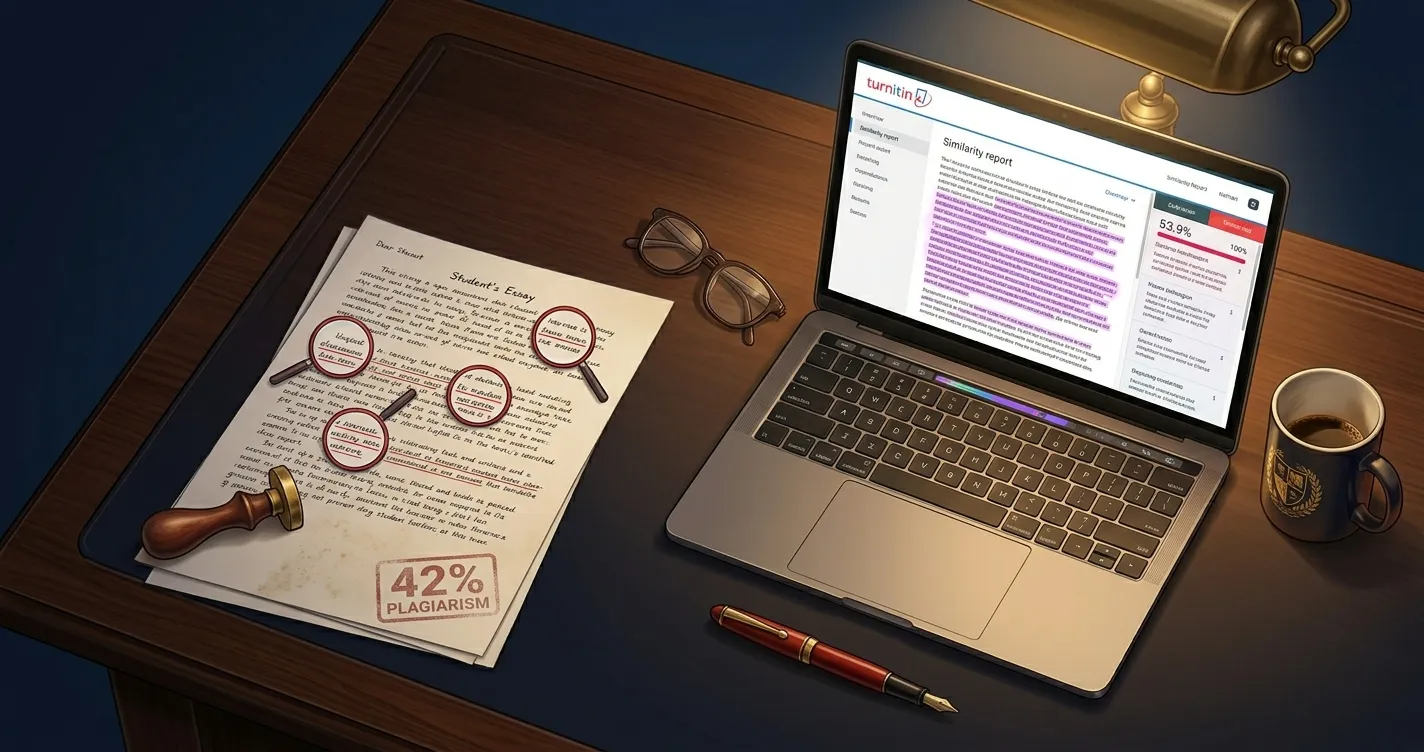
This is the big one. Turnitin's AI writing detection doesn't only look for raw ChatGPT text. Turnitin says it also detects "likely AI-generated content that may have been modified by an AI paraphraser or bypasser" tool, which covers exactly what QuillBot does to an AI draft. That check applies to English submissions (Turnitin AI detection FAQ).
Here's how it shows up for your professor. Turnitin gives each submission an AI writing percentage for its qualifying prose, and highlights the text it attributes to AI. Until recently the report split that into two colors: blue for "AI-generated only" and purple for "AI-generated text that was AI-paraphrased." On 4 August 2026 Turnitin merged them into a single blue "AI-generated" category (Turnitin release notes). Paraphrased AI text still counts toward the score. The report just no longer labels it separately.
A few other details matter:
- Turnitin needs at least 300 words of prose before it gives an AI score, and it ignores lists and bullet points.
- Scores from 1% to 19% show as an asterisk rather than a number.
- Turnitin says the percentage "should not be used as the sole basis for action or a definitive grading measure by instructors."
- You can't see the AI report yourself; it's shown to instructors, who can download and share it.
Turnitin doesn't publish how often it catches paraphrased text, and we haven't tested it ourselves (how we test). So treat any precise "QuillBot detection rate" you see online with suspicion. What's documented is that the check exists and that it targets this workflow.
What Professors Actually Look For (Beyond Software)
Software aside, experienced professors have their own detection methods. These are less precise than Turnitin but often more decisive because they're based on personal knowledge of you as a student.
1. Writing Style Changes
Your professor has read your work before. If you've been turning in papers with a consistent voice, vocabulary level, and sentence structure all semester, and then suddenly submit something that reads completely differently, they'll notice.
Paraphraser output has a quality that's hard to describe but easy to recognize once you know what to look for. It tends to be:
- Overly formal. Paraphrasers often reach for academic-sounding language even when the original was casual. "I think" becomes "It is believed that." "A lot of" becomes "A substantial quantity of."
- Synonym-heavy. You'll see unusual word choices that technically work but feel forced, the kind of phrasing where someone clearly reached for a thesaurus. "Use" becomes "utilize." "Help" becomes "facilitate." "Important" becomes "paramount."
- Structurally uniform. Paraphrased sentences tend to keep the same length and shape as the AI original. Real student writing has more variation: short sentences mixed with long ones, fragments, the occasional run-on.
If you normally write casually and concisely, and you submit something that reads like it was written by someone who swallowed a thesaurus, that disconnect is visible to anyone paying attention.
2. Knowledge Gaps During Discussion
Many professors, especially in smaller classes and seminars, will ask you about your paper. Not as a gotcha, but as a natural extension of the course. "Tell me more about your argument in section three." "What sources informed your conclusion?" "How did you arrive at this thesis?"
If you can't discuss your own paper fluently and in depth, that's a signal. A student who wrote their paper can talk about it at length: the research process, the decisions they made, the parts they struggled with. A student who paraphrased something they didn't write will be vague, surface-level, and uncomfortable with follow-up questions.
Some professors have formalized this into oral defenses for major assignments. You submit the paper, and then you have a 10-minute conversation about it. More instructors are adding this kind of check because of AI and paraphrasing tools.
3. Process Evidence
More professors are asking for process documentation: outlines, drafts, revision histories, annotated bibliographies. If you used QuillBot to paraphrase an AI-generated essay, you probably don't have an organic writing trail. No early drafts with crossed-out sections. No notes in the margins. No evolution from a rough idea to a polished argument.
Google Docs version history is particularly revealing. A professor who can open your document's history can see when text appeared and how it changed over time. If it shows a large block of text pasted in and barely touched, or several blocks pasted in one after another (the telltale sign of running chunks through a paraphraser), that pattern is visible.
4. Inconsistency With In-Class Performance
If you struggle to write a coherent paragraph during an in-class essay but turn in polished, sophisticated papers at home, the gap speaks for itself. Professors aren't naive about this. They notice when a student who can barely form an argument during discussion produces a paper that reads like a published journal article.
This is especially true for writing-intensive courses where the professor sees your work regularly. The baseline they build from your in-class performance, discussion board posts, and low-stakes assignments creates a profile of your writing ability. A submission that dramatically exceeds that profile raises immediate questions.
What QuillBot's Paraphrasing Actually Changes (And What It Doesn't)
Understanding why QuillBot is detectable requires understanding what it actually does to your text. At its core, a paraphraser performs three operations:
- Synonym substitution: replacing words with alternatives that have similar meanings
- Sentence restructuring: rearranging clauses within sentences
- Voice shifting: changing between active and passive constructions
What it largely leaves alone:
- Predictability patterns. The statistical predictability of the text stays similar. Swapping "use" for "utilize" doesn't change the underlying probability distribution much.
- Rhythm. The variation in sentence length and complexity stays close to the original. A paraphrase doesn't introduce the natural rhythm of human writing, with short punchy sentences followed by long meandering ones.
- Argument structure. The logical flow stays identical to the AI-generated original. The same points appear in the same order with the same supporting evidence.
- Idea density. The ratio of ideas to words stays constant. Human writing naturally varies: some paragraphs are idea-dense, others more expansive and exploratory.
This is why detectors can often still identify paraphrased AI text. The surface has changed, but the skeleton underneath hasn't. It's like putting a new coat of paint on a car: it looks different, but the engine, frame, and dimensions are identical.
What Happens If You Get Caught
The consequences vary by institution and by case. Common sanctions include:
- For a first offense: a formal warning, a grade of zero on the assignment, or a required academic integrity course
- For a repeat or more serious offense: course failure, academic probation, or a notation on your transcript
- For severe or repeated violations: suspension, expulsion, and in rare cases degree revocation
And here's the part people don't think about: the process of being accused is itself a punishment. You'll meet with your professor, then potentially with a department chair, then potentially with an academic integrity board. You may need to prepare a defense. The stress, the time, and the reputational damage within your department are significant even if you're ultimately cleared.
Hiding AI use can also make things worse. Some schools explicitly separate open, permitted AI use from undisclosed use. Harvard Business School's MBA policy, for example, requires students to disclose and cite their use of generative AI, and says that not doing so violates the MBA Honor Code (HBS MBA handbook). A paraphrasing layer can turn "using AI" into "using AI and trying to conceal it."
What Students Should Actually Do
We're not going to lecture you about academic integrity: you know the landscape, and you're going to make your own decisions. But we will tell you what holds up and what doesn't.
What doesn't hold up:
- Running AI text through QuillBot and hoping Turnitin misses it. Turnitin says it looks for exactly that.
- Switching to a heavier paraphrasing mode. It changes more words, but it also drifts further from your meaning.
- Running text through multiple paraphrasers in a row. It rarely helps and makes the text worse.
- Light manual edits to paraphrased output. Unless you genuinely rewrite it, the structure of the original stays.
What holds up better:
If AI is part of your writing process, the output needs to be genuinely rewritten, not just paraphrased: different sentence structure and rhythm, your own examples, your own argument.
SupWriter is built for that kind of rewrite. It's an AI humanizer, not a paraphraser: it reworks sentence structure and rhythm rather than swapping synonyms. Before you submit, you can check the result with its built-in AI detector. That's a pre-check based on one scoring model, not the detector your school uses, and results vary by detector, text length and topic. No tool can guarantee a result, and Turnitin says its model targets humanizer output too.
On price, be clear-eyed. SupWriter's Basic plan is $9.99 a month for 5,000 words, or $4.99 a month billed annually. QuillBot Premium is $8.33 a month billed annually for full paraphrasing access (QuillBot Premium). So SupWriter isn't the cheaper option if you process a lot of text. What you pay for is a different kind of rewrite, plus the pre-check.
Additional tips regardless of what tools you use:
- Always be able to discuss your paper in depth. If you can't explain your argument, tools won't save you.
- Keep drafts and notes. Process evidence protects you even against false positives.
- Know your university's AI policy. Some schools now permit AI use with disclosure. If yours does, being transparent might be the simplest path.
- Don't submit anything you couldn't defend in a conversation. That's the real test, and no tool can help you pass it.
The Bottom Line
Can professors detect QuillBot? Yes. Through Turnitin's paraphrase-aware AI detection, through personal knowledge of your writing, through process evidence, and through the patterns that paraphrased text leaves behind. No one publishes a reliable detection rate, but Turnitin built its check for exactly this workflow.
If you use AI at all, the thing that protects you isn't a tool. It's text that is genuinely yours: rewritten in your own voice, backed by drafts you can show, and an argument you can defend out loud.
Related Resources
- Can Turnitin Detect QuillBot Paraphrasing? — What Turnitin documents about paraphrased AI text
- QuillBot Review 2026 — Features, pricing and limits
- Free QuillBot Alternative — Options compared on price
- Grammarly for Students — Writing tools for academic work
- QuillBot Alternative — Alternatives compared on features and price
Related Articles

What SupWriter's AI Detector Actually Checks (vs Turnitin and Originality.ai)
How SupWriter's AI Detector Score Is Produced
How We Test AI Detectors: Method and Results So Far